Politics & Government
'What's Going On In Chicago?': Trump Talks With Heads Of Police Union
Analysis: The president wants answers about Chicago's rampant gun violence. But what about his promises of federal aid to the city?


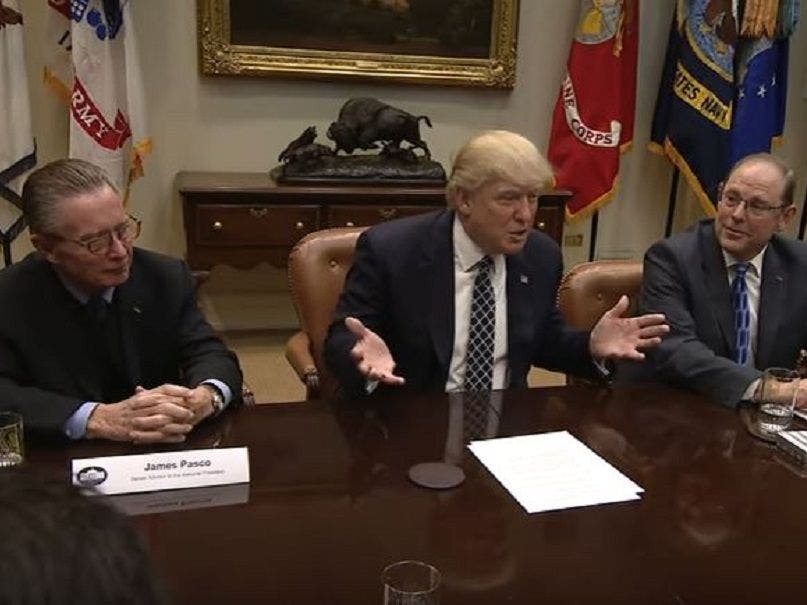
WASHINGTON, D.C. — President Donald Trump praised the work of police officers around the country and thanked Fraternal Order of Police leaders for their support Tuesday morning during a White House listening session with nearly a dozen officials from the law enforcement union.
But Trump leveled a pointed question at the group, which included Dean Angelo, president of Chicago's FOP chapter: "What's going on in Chicago?"
"Last year, in Chicago, 4,368 people were shot. Nearly 700 more have already been shot since January of this year alone," he said. "I ask, what’s going on in Chicago, right? What is going on there? There’s no excuse for it. There’s no excuse for it. I’m sure you’re asking the same question: What’s going on in Chicago?"
Find out what's happening in Chicagofor free with the latest updates from Patch.
Atlhough no explanation was offered, the rhetorical question was another example of the president's focus on Chicago's escalating crime and gun violence problem. Throughout his presidential campaign and since taking office in January, Trump has lamented the growing number of shootings in the city while at the same time criticizing city leaders for their inability to curb the rash of violence.
RELATED: Trump's 'Send In The Feds' Threat: Chicago Officials Would Welcome Help But Not The National Guard
Find out what's happening in Chicagofor free with the latest updates from Patch.
"It comes as no surprise that the violence which continues to tear through our neighborhoods has the attention of every media outlet from New York to Los Angeles," Angelo, who represents more than 8,000 Chicago officers, wrote in a statement before Tuesday's meeting. "On more than one occasion, President Trump referenced the bloodshed and shootings that seem to have Chicago in a death grip. We could only assume that the topic of Chicago crime might find its way on the agenda.
"To that point, President Angelo will carry the message of the ‘Working Police’ to the White House in an attempt to ensure that your voices are not only heard, but that our input towards any future federally-supported solutions are seriously considered."
WATCH: President Donald Trump meets Tuesday with leaders from the Fraternal Order of Police during a White House listening session:
Trump raised the issue of federal aid for Chicago in a now-infamous Twitter update in which the president threatened to "send in the Feds" if city leaders couldn't find solutions to the violence.
What Trump meant by that ultimatum has never been clear or explained, but Mayor Rahm Emanuel and Chicago police Superintendent Eddie Johnson have said they would welcome D.C. as a partner that had a larger role in local law enforcement. They also would like to see federal money put toward non-law enforcement measures, such as mentoring and after-school programs for teens that target the social causes of Chicago's crime and violence instead of simply reacting to it.
Talking to reporters after the meeting, Angelo felt confident that the White House would help the city and its challenging law enforcement issues, according to the Chicago Sun-Times.
"Those programs that are necessary to reduce crime in Chicago, we feel certain the administration is going to work with us — especially gun violence in the city of Chicago," he said.
One degree of federal assistance that Emanuel and Johnson — not to metion many city aldermen and even Illinois Republican Gov. Bruce Rauner — would object to is sending in the National Guard. That option has never been specifically suggested, but its implication has been strong enough that local officials have felt the need to address it since Trump's tweet.
RELATED: Emanuel Questions If Trump 'Cares Enough' About Ending Chicago's Violence After Speech
Overall, Trump's concerns about Chicago's tragic trends are emblematic of his administration's national law enforcement agenda to encourage better cooperation between law enforcement and the American people to end "the cycle of violence." Tuesday's meeting with FOP leaders — the national group, with a membership of more than 330,000, endorsed Trump in the 2016 election — was another chance to reinforce his pledge of support for U.S. police departments and his promise not to hamstring them when it comes to keeping people safe.
RELATED: Ohio Pastor Tells Trump Chicago Gangs Want To Meet, But That's More Hype pe Than Hope
"Sadly, our police are often prevented from doing their jobs," Trump said Tuesday. "When policing is reduced, the main victims are the most vulnerable citizens of our society — and you see that all over. In too many of our communities, violent crime is on the rise, and in too many places, our citizens have not been safe for a very, very long time.
"These are the painful realities many in Washington do not want to talk about," he added. "They just don’t want to hear about it."
While Trump has drawn a great deal of national attention to these "painful realities" about crime, especially in Chicago's case, another "painful reality" is that the notoriety has generated very little action from his administration, especially in Chicago's case, a case that has been the target of many of the president's threats, pledges and promises.
Even when steps forward are taken — a Cleveland pastor and presidential adviser helped organize a "summit" with Chicago gang members interested in working with president to stop the city's gun violence — the Trump administration has hit a stumbling block — that meeting was canceled at the last minute over scheduling issues and has yet to be rescheduled — taking two steps back.
RELATED: Trump Continues Chicago Bashing; Check Out His City Swipes Since Being Elected
Frustration over the lack of follow-through in the face of Trump's urgency has led to Emanuel publicly challenging the president and questioning his actual concern about the city's crime problems.
"We have repeatedly made specific requests of the administration for greater law enforcement integration and resources; a higher priority placed on federal gun prosecutions; and funds restored toward mentoring and after-school and summer jobs programs that have proven to be positive alternatives for our young people," he said after Trump's first-ever address to a joint session of U.S. Congress on Feb. 28.
"Because this is so important, I’ll always be ready with this list whenever the President asks. The better question, I’d suggest, is whether the President cares enough about violence in our city to do more than talk or tweet about it."
So it comes back to questions. But perhaps Trump should be answering them instead of asking them. Questions like …
- What's going on with the "top police officer in Chicago who is not the police chief" — a "rough, tough guy" that Trump mentioned during an August interview with Fox News' Bill O'Reilly — who could "use tough police tactics" to solve the city's gun violence?
- What's really going on with Trump's "sending in the Feds" promise/theat? What's it mean? Is it money for social programs, more federal agents or better agency? cooperation? When's the deadline?
- And quite simply, what's going on with Trump's pledge to help — or to hold him to his high claim, to solve — the city's crime epidemic?
Chicago has become something of a personal crusade for Trump, but it's a pursuit that only concerns a small section of the president's constituency. Dropping the ball when it comes to curbing the city's rampant shootings isn't the same as, say, dropping the ball on repealing and replacing the Affordable Care Act.
But Trump should learn from the Republican Party's mistakes surrounding the American Health Care Act fiasco: If you're going to denounce the handling of a crisis and boast you have the keys to solving it, better make sure you have that alternative plan ready to go when it's time.
After bashing Chicago's leaders and elected officials with the blunt, public image cudgel that is their inability to stem the tide of rampant gun violence in the city, Trump's solution can't just be different. It has to work better than anything before it.
And because it will be sporting a giant bullseye for its detractors to take aim at, the president's solution needs to be bulletproof.
So one more time, President Trump: What's going on with your plans for Chicago? What's going on there? I'm sure you're asking the same question.
President Donald Trump meets Tuesday, March 28, with nearly a dozen leaders from the Fraternal Order of Police during a White House listening session, including national FOP President Chuck Canterbury (left), as well as senior presidential adviser Jim Pasco. (screen shot via video by The White House | YouTube)
Like What You're Reading? Stay Patched In!
Get more local news delivered straight to your inbox. Sign up for free Patch newsletters and alerts.