Community Corner
Angelo 'Sam' Ciambrone: Former Mayor Married to the History of the Heights
From building statues to supporting art galleries, Ciambrone is known for his dedication to beautifying Chicago Heights. The city's downturn saddens him, but he hasn't lost hope.
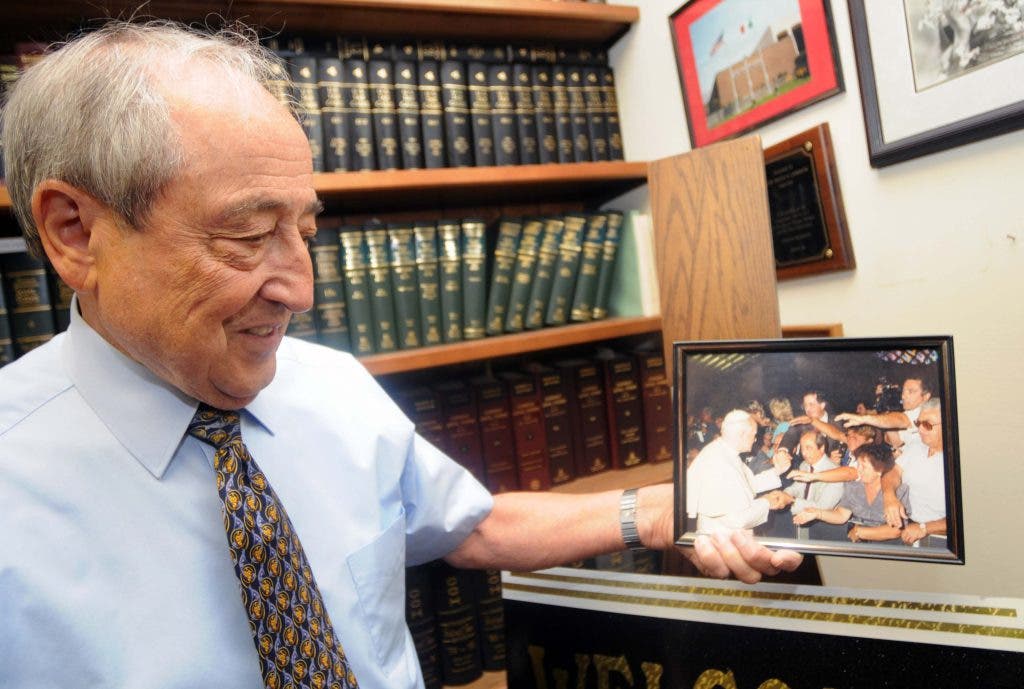


In its heyday, Chicago Heights was the envy of other towns in the South Suburbs. Shoppers came from miles around to buy items from Montgomery Ward, Marshall Field, Kline’s and others. Thousands of men worked at steel plants located on the east side of Chicago Heights.
Things have changed.
Churches that once stood proud have been reduced to a pile of rubble, replaced with grass. Acres of stores along Halsted are now vacant. Children of immigrants have left for greener pastures.
Find out what's happening in Chicago Heightsfor free with the latest updates from Patch.
One lifelong Chicago Heights resident has seen it all, but still has a glimmer of hope. He is former Chicago Heights mayor Angelo “Sam" Ciambrone.
“I love this city," Ciambone says. "I enjoyed it. I’m still here. The 'last of the Mohicans.' On Halsted, we’re the only ones here, and the other place across the street, which I’m not going to name."
Find out what's happening in Chicago Heightsfor free with the latest updates from Patch.
Ciambrone is referring to a liquor store across from his law office Wilczynski Wilczynski and Ciambrone. There is also Respond Now, which helps low- to no-income people in the area, a block north of Ciambrone’s office.
From vitality to virtual poverty is the transformation in this community that has enjoyed visits from two United States presidents.
Despite the notable struggles of an industry-based city facing a less industrial age, Ciambrone focuses on the positives.
“There is Union Street Gallery and Chicago Heights Construction on Otto Boulevard," the former mayor says. "And the anchor of St. James Hospital."
Still, Ciambrone has seen the deterioration of the business districts of the Heights.
"The change of the city is the most dramatic," Ciambrone explains. "When you remember what the city was like, what Halsted Street was like, Illinois Street … There was everything here that you needed. Today, if you wanted to buy a pair of trousers, I don’t know where you would go. Shoes you can buy at 14th and Ashland. Now there is nothing."
A Career in Politics
Ciambrone served two terms as mayor of Chicago Heights. His love of the arts brought the Union Street Gallery to town as well as a popular local landmark—the life-sized Lincoln statue that stands near Lincoln Highway and Dixie Highway, erected in 2003. The two little girls looking at Lincoln were modeled after the likenesses of Ciambrone’s granddaughters.
A popular mayor with a love for the Heights, Ciambrone's political career began in 1959 with a difficult loss.
“I ran for commissioner," Ciambrone says, noting the commission form of government at the time. "I decided to run. I was Democrat and I still am, but at the time I couldn’t get the Democrats to support me. Naturally, the Republicans were not going to support me, so I ran as an independent. A couple of my lawyer friends from Blue Island came out to help me in the primary. You had to elect four commissioners. You needed eight for the ballot. I finished ninth.”
Of course, that wasn't the last we would hear of Ciambrone. Nearly four decades later, in 1995, he became the mayor of Chicago Heights. As he sits back on his office chair, Ciambrone sighs, remembering the ups and downs that began 16 years ago.
“I could have done more," he says. "We had great ambition. I had some opponents on the council. The first year was hectic. We had boycotts. Then we had committees—the beautification and historical committees, which are still in place today."
Preserving History
The former mayor still reflects on one of his biggest regrets.
"One of the major disappointments, still, is we tried to make the Flat Iron building a Historical Society," he says. "We put a lot of money, sweat and tears in there. Volunteers cleaned the mess, they were on the top floor, where the bordello was …"
Ciambrone stops for a moment, looking as if he lost a love of his life.
“They tore it down," he continues. "That’s where the historical artifacts should be. They are at the library. The whole history of our city just lying there. There is no home for it. Barbara Paul, may she rest in peace, did a tremendous amount of work.”
Paul was the head administrator at the Chicago Heights Public Library, and she compiled many old photographs and artifacts capturing the history of Chicago Heights. She and Dominic Candeloro, former assistant to Ciambrone, wrote Chicago Heights: At the Crossroads of the Nation, a book detailing the history of the city. Many of the city's artifacts remain at the library.
Ciambrone blames past political fighting for stopping growth in Chicago Heights. He remembers one of his more amibitious projects.
“We had visions going back to the 1970s," he says. "We worked very hard with the Chamber of Commerce of Chicago Heights. We had a vision to build an art gallery on Illinois Street. They built the parking lot, the new First National Bank was the anchor. We had an architect from San Francisco draw up the plans."
Ciambrone goes on to explain what stopped his plans from coming to fruition.
"It became a political issue in the election of 1975," he says. "The plans died. That was the end of it. A lot of money and effort went for it. All the banks were in favor, as well as the industry. It’s sad.”
Fighting for the Churches
Ciambrone always fights for what he believes in. The two-term mayor has not only been a fighter in the courtroom, he says he's been a fighter for a stronger, morally sound Chicago Heights.
In the early 1990s, Ciambrone, along with his friend August Anzelmo, went to the Vatican several times in an effort to save two Catholic churches in Chicago Heights that had been put on the demolition block—San Rocco and St. Joseph.
"We were successful to have the oratory that we have now," Ciambrone explains. "We were not successful to keep the old church, which was built in the early 1900s. I can even tell you the day the building was destroyed. The day of the primary election in 1995. August and I took a ride along 22nd Street, and that’s when we saw the demolition of San Rocco. St. Joseph was destroyed as well.
“It was an experience dealing with the church in Rome. Everyone treated us beautifully,” he continues. “They said we were right. At that time Rome told us in June of 1991, 'Don’t worry about it.' But it wasn’t true. They acted, then closed the church in July of 1991. St Joseph closed first. We won the battle but lost the war. We as a church were solid. I’ve had personal feelings. I think the destruction of the churches had an effect on the migration of the people.
"There is a rumor I’m moving to Frankfort. I say Frankfort ... when I look at Mokena, New Lenox, Orland, Merrillville, Dyer, St. John … come on—that’s where all our people moved. It’s unfortunate."
Recalling Better Days
Reflecting upon some of the work he did for Chicago Heights, Ciambrone gets sentimental.
Eighteen years ago, Fourth of July events in Chicago Heights included a free concert by the Chicago Heights Symphony Orchestra (the orchestra no longer exists). Thousands of residents would picnic at Bloom Field and listen to the music, enjoying the day with other residents and friends, then watch the traditional fireworks.
“At one time we had the Chicago Heights Symphony Orchestra,” Ciambrone recalls. “I organized the Fourth of July concerts. Our first speaker was Sen. Paul Douglas. At that time fireworks were only about four thousand dollars. The last fireworks show was 25 thousand."
Organizations also raised funds to build playgrounds, award scholarships and donate items to schools.
“The Junior Women’s Club was active. The Lions, Rotary and Kiwanis Club were all fantastic groups, each with a hundred members or more,” he says. “It’s all different now. The younger people are not interested. The banks here are now all branches; they could care less about Chicago Heights. Another bank is closing at the end of this month, something about a basement that they say is too expensive to repair. Another landmark gone, they could care less.
“When we had local bank presidents, a member of their staff would be on every service club in Chicago Heights. Not now.”
What Can Be Done?
Ciambrone still has ideas about how to give Chicago Heights a boost.
“The key is to keep ourselves stable,” he says. “Keep our people here because without people we can’t accomplish much. We have to keep our residents here. We’ve got so many good things going for us, such as Prairie State College, Marian and Bloom high schools, Union Street Gallery and the Illinois Philharmonic Orchestra. But the south end of Cook County, we’re not the lost child, we’re the forgotten child. We need the Metra, we need the airport and we need a casino in Chicago Heights.”
The former mayor believes the former First National Bank building along with the empty parking lot would be a perfect spot for a casino. He is making phone calls to assist his services wherever needed.
“We have to give it the best we have,” he says. “If you can’t give it the best, we’re not going to go anywhere. There was a wise man that once said, “With memory, you can smell the roses in December. So in December, I always try to smell the roses.”
As “Sam” Ciambrone quotes from a historical novel by James Fenimore Cooper, one particular quote is a reminder of the fight the former mayor lives to this day.
“I have lived to see the last warrior of the wise race of the Mohicans,” said Tamenund, the revered Indian sage.
The hope is that other “warriors” like Ciambrone still exist, and they come together and save Chicago Heights.