Schools
Midwestern University Celebrates Discovery at Kenneth A. Suarez Research Day
Students present research posters guided by faculty mentorship

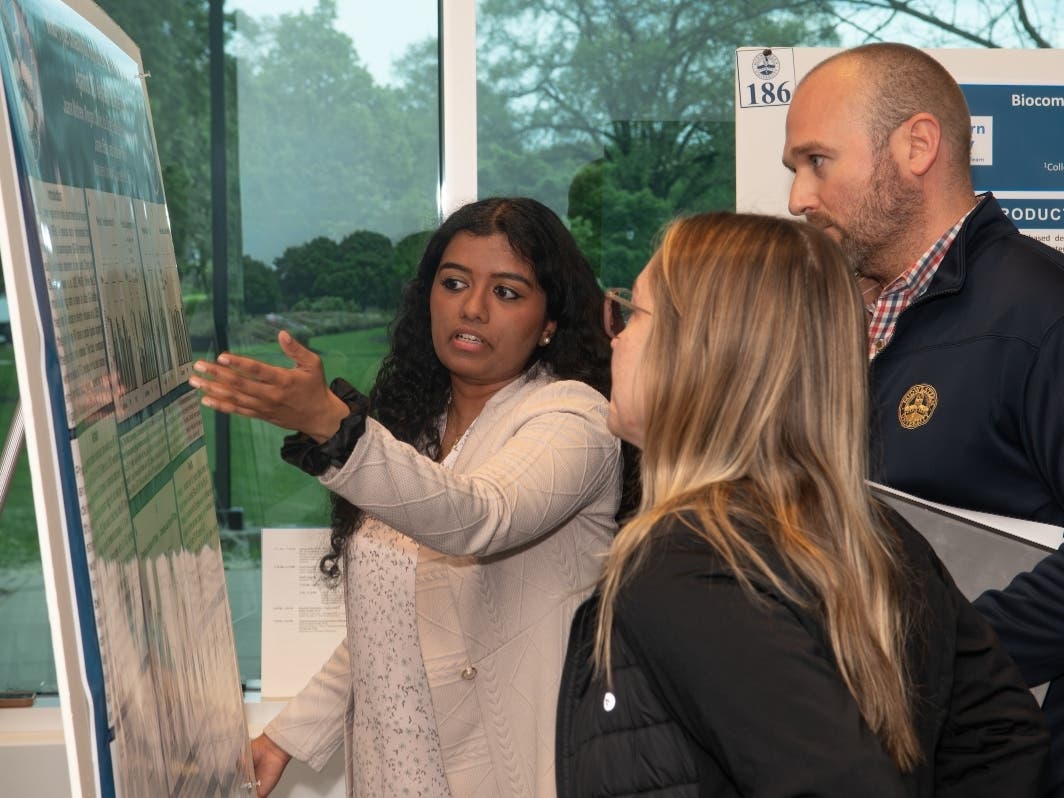


Midwestern University’s annual Kenneth A. Suarez (KAS) Research Day transformed Cardinal Hall into a vibrant hub of discovery, where students across disciplines on the Downers Grove Campus presented research developed in collaboration with their faculty mentors.
This year’s event featured 210 student research posters, representing all colleges on campus and highlighting the depth and wide range of scholarly work underway across the University.
Named in honor of the late Kenneth A. Suarez, Ph.D., who served Midwestern University for more than 25 years as Professor of Pharmacology and Associate Vice President for the Office of Research and Sponsored Programs, the event continues his vision of fostering curiosity, collaboration, and a lifelong commitment to inquiry. The Glendale Campus held its KAS Research Day in early April.
Find out what's happening in Downers Grovefor free with the latest updates from Patch.
Day Dedicated to Scientific Growth
Opening the day, Joshua Baker, O.D., M.S., President and CEO of Midwestern University, welcomed attendees and highlighted the central role of research in student learning.
Find out what's happening in Downers Grovefor free with the latest updates from Patch.
“When our students step behind a poster today, they aren’t just presenting data—they’re demonstrating the critical thinking and evidence-based mindset that will one day save lives,” he said.
Dr. Baker also underscored the broader mission behind the event for students. “Research at Midwestern University is not an extracurricular activity… it is the vital bridge that connects your academic foundation to your future as a practitioner,” he added.
Months of Hard Work Pay Off
For many students, KAS Research Day is the moment when months of work under the guidance of faculty mentors come into focus. Along the way, they gain confidence, ask better questions, and develop reasoning skills that they will carry into practice.
Chicago College of Osteopathic Medicine (CCOM) student Benjamin Schnieders (CCOM ’28) explored the relationship between high-intensity exercise, cognitive function, and cardiovascular hemodynamics. “This project really helped connect physiology to what we’ll actually see in patients, especially with cognitive function and aging populations,” Ben said. “Research is great to be involved with because it gives you practice for future patient encounters and learning how to talk through complex ideas,” he said.
For Clare Mielczarek (CCOM ’28), whose work focused on targeted lipid nanoparticle mRNA delivery for type 1 diabetes, the experience reinforced the importance of translational science. “It was important to me to gain these skills so that as a future physician, I can evaluate research properly and apply it to my patients,” she said.
Chicago College of Optometry (CCO) student John Ruskus (CCO ’28) studied how sequential transcranial stimulation of visual pathways may influence cortical excitability and rehabilitation potential after stroke. “Working on this research project solidified my understanding of neurological concepts, and I feel more confident explaining these systems now,” he said.
“Research is one of the best things I’ve done in my first years here. It changes how you think clinically,” John added.
College of Dental Medicine-Illinois (CDMI) student, Neda Maroof (CDMI ’28) focused her research on developing new materials that could help regenerate bone, an area with important implications for oral surgery and reconstructive procedures.
Her project explored a biocompatible, gel-like scaffold designed to support bone growth at the cellular level, with the goal of creating alternatives to traditional bone grafts used in large surgical defects. “It was a lot of work, but I learned so much in less than a year,” she said. “Being part of something that could eventually become a real clinical product is incredibly motivating.”
For some students, the experience also sparked a deeper interest in research itself. Speech-Language Pathology student Faith Herman (CHS-SLP ’26), who studied how motivation affects communication in individuals with aphasia, said the project reshaped how she thinks about both research and patient care. “If your client isn’t motivated to do something, what you’re working on in therapy is not going to make a difference,” she said. Faith added that the experience helped her discover a new interest in the field: “Through this project, I realized how much I enjoy the research side of the field. It even made me start thinking about continuing to do research in my future.”
A Full Day of Discovery
The event also featured 16 oral student presentations, including traditional and rapid-fire talks, as well as a keynote address by Krista Varady, Ph.D., Professor of Nutrition at the University of Illinois Chicago, whose work on intermittent fasting and metabolic health has helped shape modern nutrition science.
Throughout the day, attendees moved between poster sessions spanning biomedical science, neuroscience, dental innovation, optometry, and the health sciences, creating opportunities for interdisciplinary dialogue and shared learning.
As one student researcher noted, “You don’t usually see this variety of information day-to-day in class or lab. It’s inspiring to see what everyone is working on.”
Honoring a Legacy of Research Excellence
Reflecting on the significance of the day, Jim Woods, Ph.D., Assistant Vice President of Research, Midwestern University, emphasized both student achievement and the role research plays in their development.
“Research Day is integral to the mission and vision of Midwestern University,” he said. “We are an institution focused on healthcare education, and our faculty are deeply engaged in research. That’s something we want to instill in our students as they graduate and go out to practice.”
He highlighted the scale of this year’s event and noted the growing student engagement across disciplines. “Our students do a wonderful job, and my hope is that every student engaged in research has a meaningful experience and takes that forward into their future practice.”
He also recognized the support of the University Research Committee, faculty mentors, staff, and University leadership in making the event possible.