Health & Fitness
Elmhurst Hospital first in Illinois with innovative treatment for AFib
Elmhurst Hospital first in Illinois to use Topera 3D Mapping System for more accurate ablation to treat persistent AFib.
Holly Linneweh knew something wasn’t quite right. The 64-year-old Carol Stream resident had a “weird chest feeling” and went to the ER to get it checked out. It was October 2009 and she was experiencing her first episode of atrial fibrillation (AFib), an irregular heart rhythm.
AFib affects nearly three million people in the U.S. It’s a condition that makes a person feel breathless, tired, weak or dizzy; five times more likely to have a stroke and can lead to congestive heart failure.
In 2009, doctors got Linneweh “back in rhythm” by treating her with various drugs. It was three more years before her next AFib episode, but then they started coming more frequently. November 2012 – her heart went back into rhythm on its own. February 2013 – doctors performed a cardioversion (an electric shock) to restore her heart’s normal rhythm.
Find out what's happening in Elmhurstfor free with the latest updates from Patch.
“They zapped me, which took care of it for a while,” recalls Linneweh.
After another AFib episode in April 2014, which was also treated with a cardioversion, Linneweh’s cardiologist suggested she see Apoor Gami, MD, a specialist in cardiac electrophysiology at Elmhurst Hospital and with Midwest Heart-Advocate Medical Group.
Find out what's happening in Elmhurstfor free with the latest updates from Patch.
“Left untreated, AFib does not go away,” says Dr. Gami. “It is associated with scarring of the heart and other complications.”
And, Dr. Gami says many patients with AFib just feel “miserable.”
Dr. Gami recommended a procedure to ablate, or burn, the areas in Linneweh’s heart that were causing her AFib. That wasn’t unusual. Ablation has been used for a number of years in an attempt to treat AFib patients. However, up until now, the technology didn’t exist to identify all the specific tissues that were the sources of the AFib, so ablation has been somewhat of a guessing game with doctors not quite sure if they were treating all of the sources of the AFib.
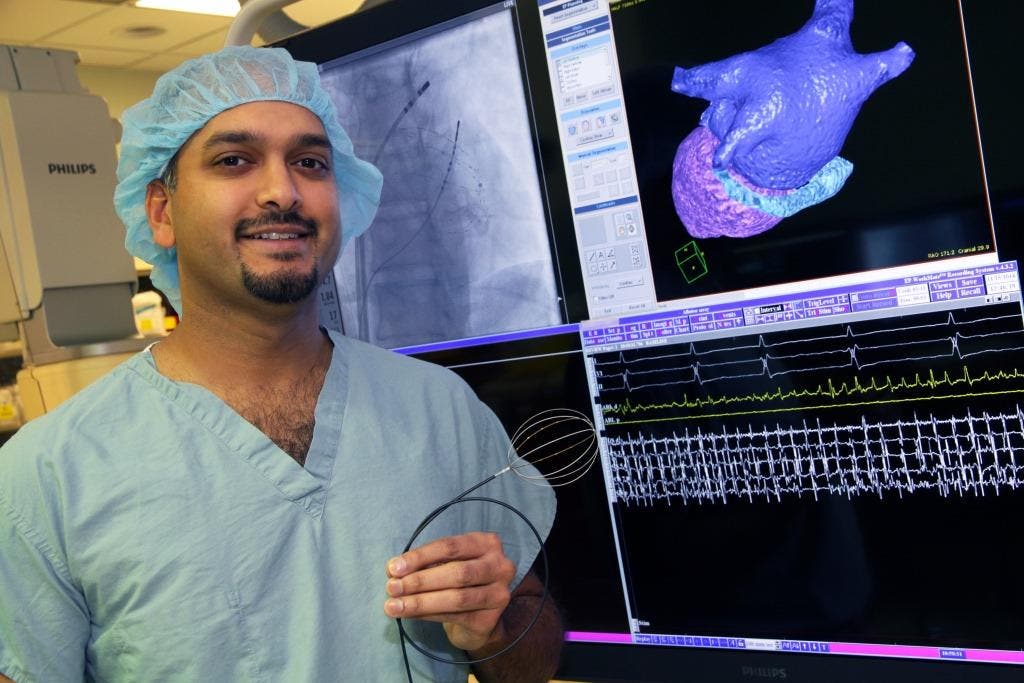
The difference this time was that Dr. Gami used the Topera 3D Mapping System to pinpoint the locations of the chaotic electrical activity that disrupted the normal rhythm of Linneweh’s heart and caused her AFib to continue.
How it works: A catheter is inserted into the upper chambers (atria) of the patient’s heart where an expandable “basket” conforms to the shape of each heart chamber. The basket has eight “splines” with 64 evenly spaced electrodes that create a three-dimensional map of each chamber, which shows doctors the specific areas that are the sources of the irregular heartbeat.
“This new technology enables me to find the exact locations that are important for the arrhythmia, and quickly and precisely ablate the spots in the heart with excellent results,” says Dr. Gami.
According to Dr. Gami, studies show an 80-85 percent success rate one year after an ablation procedure using the 3D Mapping System – a “success rate that was previously unheard of for treatment of patients with persistent AFib,” he says. Three years after the procedure, studies show a 78 percent success rate. Without the new mapping technology, success rates had only been about 40-60 percent when using ablation to treat persistent AFib.
In September 2014 at Elmhurst Hospital, Linneweh became the first patient in Illinois to be treated with the Topera 3D Mapping System, which was approved for use by the Food and Drug Administration in 2013.
“We have a history of bringing new technology early to Elmhurst,” says Dr. Gami. “We stay aware of what’s evolving so that we’re on the cutting edge of electrophysiology. It’s what’s best for our patients.”
That approach has benefited Linneweh. She no longer has to stop to catch her breath after routine activities like walking up a flight of steps.
“This is great that they were able to figure out how to do this,” says Linneweh. “I was excited that this was going to be the end of AFib. He got it, I’m good and I’m alive.”
For more information about heart care at Elmhurst Hospital, visit www.emhc.org/services/cardiology. To find out if you’re at risk for heart disease, take Elmhurst Hospital’s free five-minute test that could save your life at www.emhc.org/HealthAware.