Politics & Government
After Spending Over $8 Million, Evanston Drops James Park Lawsuit
City attorneys last month agreed to drop their environmental lawsuit against utilities instead of arguing the case on its merits at trial.


EVANSTON, IL — Lawyers for Evanston last month abandoned the city's federal environmental lawsuit against Nicor and ComEd after spending more than $8 million. Attorneys for both sides agreed to cover their own costs in a settlement agreed June 21. U.S. District Judge John Lee accepted the dismissal of the case with prejudice, meaning the city cannot revive its claims against the utilities, according to court records.
The move ends more than four years of litigation triggered by the 2012 discovery of methane and oily waste materials near in James Park, according to the judge. City officials first suspected the landfill underneath the park might have been the source but later determined it was more likely to have come from the defunct Skokie Manufactured Gas Plant, which was built in 1910 and shut down in 1950.
Gas utility Northern Illinois Gas Company, or Nicor, and electric utility Commonwealth Edison Company carried out an environmental cleanup on the 18-acre site southwest of McCormick Boulevard and Oakton Street between December 2012 and October 2014. In May 2014, while the cleanup was still taking place, the city asked Nicor to provide records of the location of its pipelines in the area, but the company refused, the city alleged in court.
Find out what's happening in Evanstonfor free with the latest updates from Patch.
The same month the cleanup was complete, Evanston sent the utilities its first notice to sue under the federal Resource Conservation and Recovery Act, or RCRA, and various state and municipal laws. RCRA allows lawsuits against companies if they present "an imminent and substantial endangerment to health or the environment" by their handling of hazardous waste.
When Evanston sued, Nicor responded with a counter claim identifying the landfill under the park as a more likely source of the methane gas detected in the area. Lee dismissed the first suit in February 2016 because the city had failed to follow the law's requirement to provide a 90-day notice about its claim. Evanston filed a fresh complaint in May 2016.
Find out what's happening in Evanstonfor free with the latest updates from Patch.
Lawyers for the city asserted that the companies should have known by 2015 that the oils had gotten into a water line along Dodge Avenue and alleged that the corporations had acted in a "negligent, willful and wanton" manner.
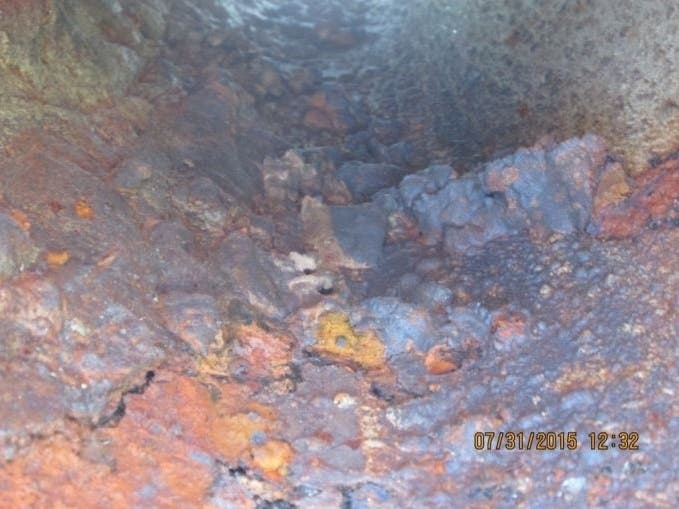
In a June 2016 statement, city officials said the black crust found inside the water line in the summer of 2016 matches the "chemical fingerprint" of coal tar found at the Skokie manufactured gas site. (However, David Hendron, an environmental consultant hired by the city, admitted he never analyzed the samples to compare them to the Skokie facility as part of what the judge would later describe as a "rather simplistic analysis.")
According to its 2016 statement, Evanston was left with no choice other than to file the "prudent" federal lawsuit, the second of which would set the city back more than $6.5 million in litigation costs alone.
"While the materials found pose no hazard today to drinking water or in any other way to the community, the City believes these materials were brought to the area by now abandoned gas lines used in the early to mid-20th Century," it said.
"The presence of any coal tar inside the City's water line is unacceptable. Therefore, the lawsuit is prudent to address Nicor and ComEd's inaction and to force the corporations to address the present subsurface conditions in and around the James Park neighborhood. The City believes but for the actions of Nicor and ComEd, none of this material would be below ground. Since Nicor and ComEd refuse to provide information, refuse to cooperate, and take no responsibility whatsoever for this matter, the City has no choice but to prudently exercise its rights under applicable environmental statutes to determine the extent of this situation and identify appropriate means to remediate it to ensure the long-term health and safety of the community."

The utilities moved to dismiss all six counts of the lawsuit, but the judge allowed all of them to proceed in January 2017, except for a violation of the Evanston Hazardous Substances Ordinance, since the city failed to state a claim of a "sudden release" or "threatened release" of the waste oils. A plaintiff's claims must only be properly alleged, rather than proven, to survive a motion to dismiss.
In response to Lee's order, the city issued a statement saying it would seek punitive damages against the utilities and seek to have all their attorneys' and expert consultant fees reimbursed.
"Nicor and ComEd spent tremendous energy and money to defeat the City's Amended Complaint. They failed," it said. "Nicor and ComEd must now answer the City's complaint."
In December 2017, the city filed a motion for a preliminary injunction, asking the utilities to take steps to clean up the contamination. Eight days of evidentiary hearings concluded in September 2018 before oral arguments were held on Jan. 23, the Evanston RoundTable reported.
While the city argued that byproducts from the plant leaked from broken joins in pipelines, traveled through the soil to municipal water lines and covered them in a "black crust," the utilities pointed to a chemical analysis showing the materials discovered on the city's pipeline could not have come from the Skokie facility or its pipelines. The utilities further argued that Evanston's 1920s-era cast-iron pipelines were originally coated with coal tar to protect against rust.
In its motion, Evanston requested that the judge order the utilities to pay for an investigation by a court-appointed panel to determine the full extent of environmental contamination in the area and come up with a plan to fix it.
But in order to have such a motion granted, Evanston was required to demonstrate that its claims have a "better than negligible" chance of success on the merits and that it will "suffer irreparable harm if a preliminary injunction is denied," according to the judge. In order to establish the likely harm, the city was required to show "a reasonable prospect of a near-term threat of serious potential harm." Lee found the Evanston failed to meet any of the standards for a preliminary injunction.
"Although the City's theory sounds plausible, it is not supported by the weight of the evidence," Lee said in an April 9 order denying the city's motion and allowing expert witnesses from both sides.
"In the end, while the Court finds that, on balance, the Utilities advance the better arguments, it must be remembered that it is not the Utilities that bear the burden of proving that a source other than the Skokie MGP caused the [contaminants;] rather, the burden rests with [Evanston] to prove that [the contaminants] came from wastes associated with the Skokie MGP plant and related infrastructure."
"Contamination that does not currently present a possible threat is insufficient" to establish the kind of "endangerment" required for a claim under RCRA, he said.
"In fact, it argues, this situation may already be occurring and causing a current dangerous situation to public health," Lee said. However, tests conducted by Evanston and a preliminary review by the U.S. Environmental Protection Agency found the city's drinking water was safe.
"[Evanston's] own actions with respect to the contamination have been inconsistent with the notion of irreparable harm requiring preliminary relief. The City continues to tout the safety of its drinking water to its residents, and even sells its water to other municipalities," the judge said.
"The City's actions are more telling than its words—if it believed that an imminent and substantial risk may exist, one would think it would begin doing everything in its power to protect its residents, even if that meant funding further investigations itself," Lee reasoned.
Evanston city officials released a statement on April 12 saying it would "weigh its next steps" in response to the denial of its motion. It said they filed the suit after utilities refused to provide information relating to the gas distribution system, although the requests in the motion for preliminary injunction go far beyond such an objective.
"We believe much of the costs associated with this litigation could have been avoided if the utilities had worked with the City during the investigation," the statement said, without explanation. In correspondence between the parties included in the court record, attorneys for Evanston accuse Nicor of "stonewalling," while the utility's attorneys said Evanston continued to "misstate the facts of Nicor's extensive cooperation" to address the city's concerns before the lawsuit was filed.
"Although [the city] disagrees with [Judge John Lee's] decision to not hold the utilities liable for remediating environmental issues in the James Park area, [Evanston] remains steadfastly committed to public health and the safety of our drinking water," city officials said.
However, the judge did not, in fact, decide to "not hold utilities liable." No trial was held, and the judge did not make a determination of liability for the contamination.
Instead, the court decided that the city's case did not meet the standards required for a preliminary injunction. Then, in response, the city voluntarily decided not to take the case to trial or potentially appeal. Instead, it agreed to drop the case, pay for its own legal fees and never raise its rejected claims again.
"Dismissal of the city's case was appropriate in light of the court's prior ruling that the city is not likely to prevail on the merits and to avoid unnecessary costs of further litigation," a Nicor spokesperson told Patch. "We continue to work together with federal, state and local leaders to meet our shared clean energy goals."
The utilities were represented by the large Chicago-based law firms of Mayer Brown and Jenner & Block. Evanston was represented by its legal department and the firms of Jeep & Blazer and Sperling & Sperling.
Evanston's top city attorney at the time of the lawsuit, Grant Farrar, resigned in April 2018 to take a job with the Northbrook-based consulting company GovHR, where he became a senior vice president. Farrar's "risk management and litigation strategies" purportedly saved Evanston $12 million over his eight years in charge of the law department, according to a biography with the firm. He has not responded to a request for an interview about the abortive $8.2 million lawsuit he filed.
Read U.S. District Judge John Z. Lee's April 9 order in Evanston v. Nicor
Get more local news delivered straight to your inbox. Sign up for free Patch newsletters and alerts.


