Health & Fitness
Good news for family caregivers!
Caring for family members can actually make you healthier

Good news for family caregivers! While much has been published the last few years about the frustration, pressure and ill effects of caring for family members, a recent study from John Hopkins University contradicts this.
The study analyzed previously gathered data on more than 3,000 family caregivers who assisted chronically ill or disabled family members.
Study author David Roth, PhD, director of the Johns Hopkins University Center on Aging and Health, wrote, “In many cases, caregivers report receiving benefits of enhanced self-esteem, recognition and gratitude from their care recipients. Thus, when caregiving is done willingly, at manageable levels, and with individuals who are capable of expressing gratitude, it is reasonable to expect that health benefits might accrue in those situations.”
Find out what's happening in Evanstonfor free with the latest updates from Patch.
Christian healer Mary Baker Eddy wrote about the mental and physical benefits of helping others in these words from her textbook on healing through prayer, “The rich in spirit help the poor in one grand brotherhood, all having the same Principle, or Father; and blessed is that man who seeth his brother’s need and supplieth it, seeking his own in another’s good” (Science and Health with Key to the Scriptures, p. 518).
But what about those individuals who do feel fatigued or burdened by caring for a family member or have experienced ill health as a result? It seems research is providing glimpses into how the caregiver can protect his/her health. For example, gratitude may play a helpful role. According to University of California psychology professor Robert Emmons, “Gratitude research is beginning to suggest that feelings of thankfulness have tremendous positive value in helping people cope with daily problems, especially stress.”
Find out what's happening in Evanstonfor free with the latest updates from Patch.
Emmons’ own research has included having participants write down five things they were thankful for each week. Among other things, Emmons found that those in the gratitude group reported fewer health problems than the other participants.
For about five years, I was the primary care-giver for my mom, who needed much physical assistance. Working from home, I was able to provide 24-hour care for this family member. Although there were many times when I felt pressured and stressed, I also felt each day was an opportunity to give back the care my mom had given me as a child.
I found that giving this care really blessed my life in many ways – I became a stronger individual, more patient and empathetic. Instead of feeling “wiped out” at the end of the day – I often felt invigorated and energized by the love and gratitude we shared.
There was a Bible verse that helped me a lot during this time. It states, “This is the day which the Lord hath made; we will rejoice and be glad in it” (Ps. 118: 24). I really tried to find joy each day. I endeavored to find things to be happy about, and encouraged my mom to do the same – and we were happy. I remember those years as healthful ones for me. There were no ill effects from giving this care.
More and more adults are providing regular care for their parents, so it is good to see this shift in thinking (and statistics) about the impacts on caregivers. Instead of being detrimental, caring for another can have positive effects on one’s wellbeing, including one’s health!
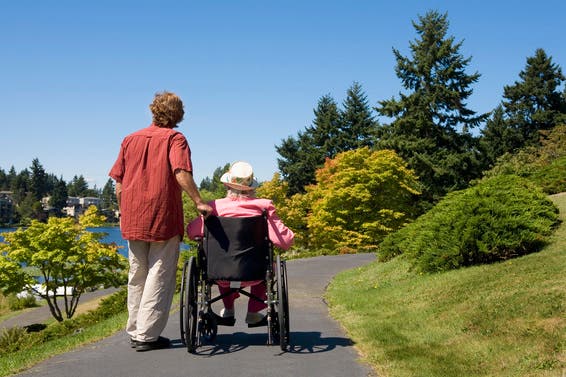
Photo © GLOW IMAGES Models used for illustrative purposes only
Thomas (Tim) Mitchinson is a self-syndicated columnist writing on the relationship between thought, spirituality and health, and trends in that field. He is also the media spokesman for Christian Science in Illinois. You can contact him at illinois@compub.org.