Politics & Government
Rep. Schakowsky, Sen. Fine, Mayor Hagerty Address Coronavirus
The congresswoman said she called the police about kids playing basketball at a park in violation of the governor's stay-at-home order.


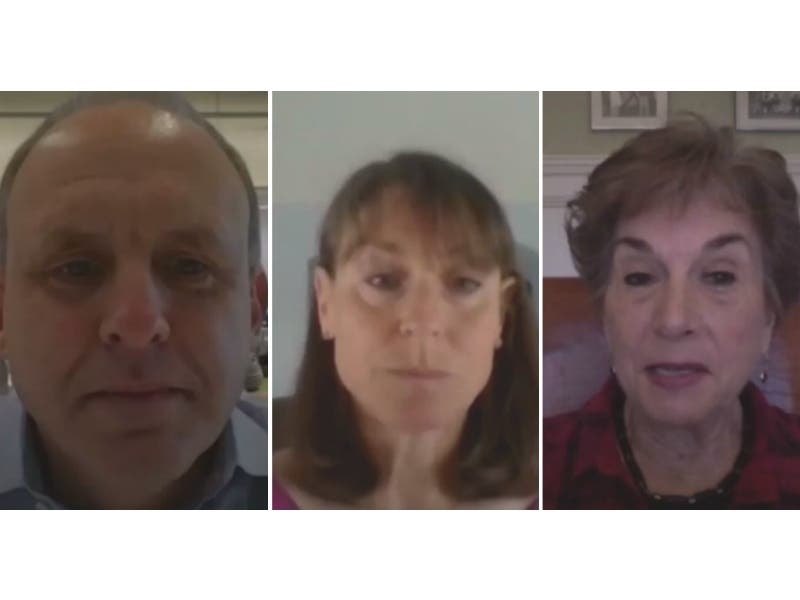
EVANSTON, IL — A local member of Congress said she called the cops on a group of young people playing sports during the governor's stay-at-home order aimed at slowing the spread of the new coronavirus. Congresswoman Jan Schakowsky congratulated residents who have stayed at home and adhered to social distancing recommendations. But the Evanston Democrat pointed out she would not hesitate to alert authorities about violators.
"I actually called the police, because — I'm not going to even mention the park — but I saw a bunch of kids out there playing basketball," Schakowsky said Friday during a question-and-answer session with other elected officials about the local, state and federal government response to the COVID-19 pandemic.
"I love kids, and I understand it," she said. "But we can't have that."
Find out what's happening in Evanstonfor free with the latest updates from Patch.
Evanston Mayor Steve Hagerty hosted Schakowsky, State Senator Laura Fine and Des Plaines Ald. Andrew Goczkowski, a grants coordinator and constituent advocate in in Schakowsky's office, in the city's sixth live "Coronavirus Q&A." They addressed economic relief programs, budget issues, supplies of personal protective equipment, mental health and the pandemic's potential silver linings. (Video below)
Don't miss updates about precautions in Evanston as they are announced. Sign up for Evanston Patch news alerts and newsletters.
Find out what's happening in Evanstonfor free with the latest updates from Patch.
"This particular disaster is affecting everybody," Hagerty said. "There isn't anybody that isn't impacted by this disaster. No one will be made whole again. There's no way we're going to make everybody whole again. I think a lot of the programs are trying to help across the board. Those most impacted, as well as big businesses that we all depend on, which is airlines and making sure they continue to remain in business after this, as well as all of our small businesses."
Schakowsky said there needed to be oversight over the federal government's economic rescue payments, including the $350 billion "Paycheck Protection Program." More than two thirds of the money, which is distributed through private banks, has already been allocated. In order to add more funding, she said, Democratic congressional negotiators are pushing for increased inclusion of smaller and more diverse financial institutions.
"Our fear is there will be some industries, companies that will want to profit, we call it the pandemic profiteering, we don't want to see that," Schakowsky said, expressing disappointment in President Donald Trump's removal of Pentagon Inspector General Glenn Fine, chairman of the Pandemic Response Accountability Committee — a group of inspectors general tasked with overseeing the implementation of the $2 trillion coronavirus relief package. "Whatever money goes out, federal dollars, your taxpayer dollars, we want to make sure that nobody's using this as an opportunity to exploit."
Democrats in Congress plan to push for a major infrastructure funding bill to provide additional economic stimulus, Schakowsky said.
"So many 'green' infrastructure projects could be done when it comes to energy in particular. Unfortunately, you know, the president is still talking about oil, but I think that now, most people in this country, and even in the private sector, we're looking at investments now that we ought to be helping," she said, describing the reduction in pollution as one of the only real bright spots of recent months. "I'm sure that people in many cities are enjoying the idea that they can go outside now and really breath some clean air. So I'm hoping that we'll also have the public behind us to maintain that."
The impact of the coronavirus crisis on state and local budgets has yet to be determined, according to Fine and Hagerty.
Fine said some estimates put the multiyear impact of COVID-19 on the state's budget at more than $10 billion, and the governor's office has estimated revenue for the current fiscal year has fallen by nearly $2 billion.
"Most of our revenue comes from sales taxes, incomes taxes and corporate income taxes, and right now because of the [job losses] and the number of businesses that have closed down, it's really creating a hardship that's expanding beyond our local borders and it's going to hit the state as well," Fine said. "We are, as a legislature now, we're working on this issue. We have formed a number of different working groups to dive into this, it's essential that we do have a budget this year, and we will get that done. We don't know what it's going to look like yet."
The state senator said she and other lawmakers were involved in a bipartisan group aimed at addressing the impact of the coronavirus crisis on the state's pension obligations.
"Our group is investigating right now: 'Where are the pension funds?' Because investments are being hurt all over, so that means the investments of the pension fund are being hurt. So what can we do as a state to make sure that we can still pay those pension payments, and still provide for the rest of the budget and the state. So this is something that we're examining right now. We're looking at all ideas across the board."
At the local level, Hagerty said city staff estimate a local shortfall of at least $10.6 million, which he said seemed low. He said Interim City Manager Erika Storlie was negotiating with the unions representing city employees in a cost-saving effort, which the City Council would discuss further on April 27.
"Everything from auto tax, to liquor tax, to hotel tax, to amusement tax are all down because of this," Hagerty said. "I've often talked about changing our tax structure to represent the modern economy — so the modern economy is rideshare and all of that — we've done that, and that's actually been a good source of new revenue as we've seen other traditional sources of revenue go down. But now no one's even using rideshare so even the modern tax that we moved to is being impacted."
The elected officials also discussed how residents can get assistance with processing economic impact payments provided by the federal government. City staff have posted information about local banks offering assistance cashing stimulus checks.
Supplies of personal protective equipment remains a concern, according to Schakowsky.
"We know this right here in Evanston," she said. "We hear about these shortages and the need for more, what we call PPE, personal protective equipment, is unfortunately still an issue here in Evanston. The head of the hospital system here, Evanston Hospital, et cetera, said he feels like he is a full-time manager trying to find the equipment."
Hagerty said a logistics team of his COVID-19 task force is charged with supplying PPE to emergency personnel, and "also as sort of an emergency backup if we need it for congregate care living facilities."
The mayor told Patch thousands of medical masks had been distributed to local facilities, and while the city's supply of N95 respirators are reserved for health care workers and first responders, per Centers for Disease Control and Prevention guidelines, city workers are allowed to wear their own at work if they so choose.
While the devastating impact of the coronavirus shutdown on the state's financials is undeniable, Fine, describing herself as an "eternal optimist" said there has to be some good to come out of the crisis.
"We're really going to look at what our priorities are in the state, and in the country, and make sure we focus on those priorities. And of many things we're seeing right now is, 'How do we care for families?' 'How do we care for the most vulnerable in our communities?' 'How do we make sure that everybody has access to health care?'" she said. "So these are things that we're really going to take a look at and improve upon so that in future generations, positive is going to come of this because we're going to learn from what our mistakes were in the past."
Hagerty, who told Patch he has been spending 95 percent of his work week on his role as mayor and 5 percent in his role as chief executive officer of the emergency management consultancy he founded, said one silver lining of the pandemic was what it has revealed about our roles as workers in the economy.
"One of the things that's positive about this lousy and terrible experience that we're going through is that it's shown how integrated we all are no matter what our profession is," Hagerty said.
"I love that 'essential' is child care workers that are taking care of our emergency responders and our health care workers, they're the baggers and the checkers at the grocery store and then they're on the other end, they're these incredibly smart scientists who are trying to develop a vaccine for this and the folks that're in forecasting and modeling," he said. "I just think that's just a nice message to remember that no matter what we do, it's important, collectively, for all of us."
Watch: April 10 COVID-19 Question-and-Answer Session from the City of Evanston »
Get more local news delivered straight to your inbox. Sign up for free Patch newsletters and alerts.