Arts & Entertainment
Nadeau's Ice Sculptures: The Ice Men Carveth
Nadeau's Ice Sculptures has crafted ice into art for more than three decades.
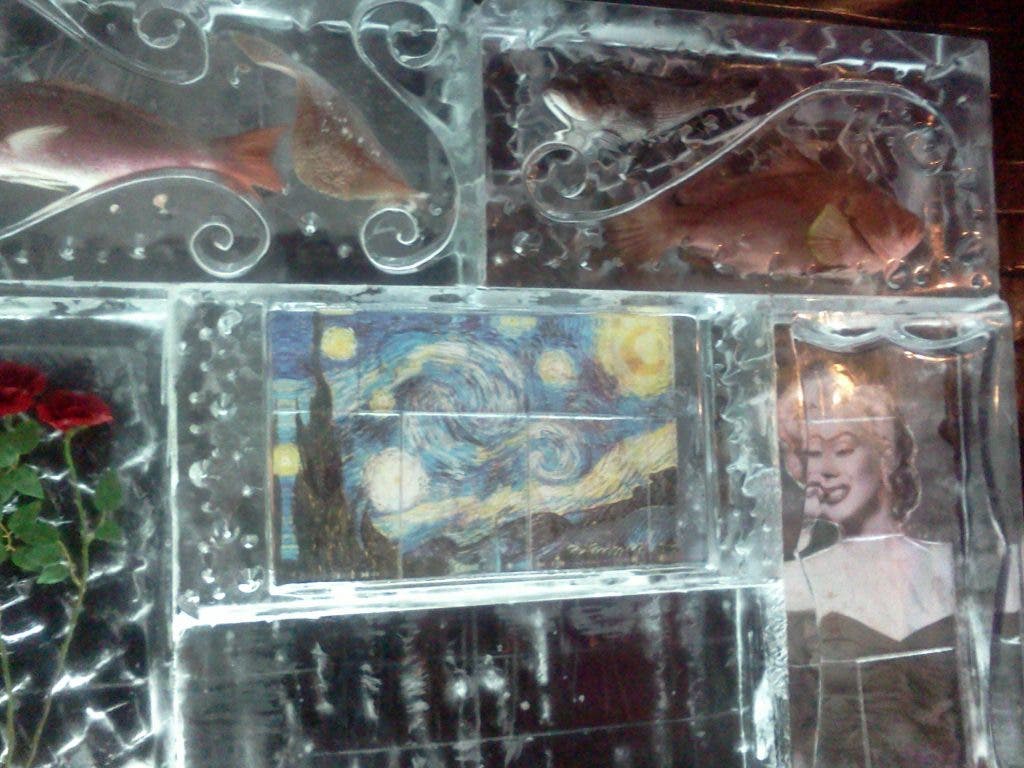


Jim Nadeau and his crew will tell you creating "art for the moment" can be a whole lot of hard work—and a whole lot of fun.
Over the past 32 years, Nadeau's Ice Sculptures has turned 300-pound crystal clear, airless blocks of ice into swans, table decorations and life-sized people sculptures that contain items from food to drink to just about anything else. What he does is create "art for the moment."
Patch got a tour of Nadeau's "factory" at 7523 W. Roosevelt Rd., including the freezer where some work is on display and where the ice is stored.
Find out what's happening in Forest Parkfor free with the latest updates from Patch.
Nadeau is a carver who started the shop and now just runs it because he couldn't carve and operate the business at the same time. One of his carvers, Hawk Ramirez, who has sculpted by hand for 25 years, sat in on the tour. Nadeau has two other guys who work with ice: Al Ramirez also sculpts the old-fashioned way; Jaime Pulido uses the Computer Numerical Control, or CNC, machine, which creates computer-generated ice into anything.
Patch: Who commissions your work?
Find out what's happening in Forest Parkfor free with the latest updates from Patch.
Nadeau: We've done ice carvings at Lincoln Park Zoo during ZooLights (the zoo's annual winter festival). (The company has donated ice to help cool down the animals at Brookfield Zoo and Lincoln Park.) We're commissioned for weddings and corporate functions. Our pieces are used by the area sports teams, the Bears, the Cubs and the Bulls.
Patch: How do you make your ice? I gather you don't put water into ice trays and stick it in a freezer.
Nadeau: It takes four days just to make a block of ice. We have to eliminate the air from the process. We have to slow down the (freezing) process. You could freeze a garbage can filled with water, but after it froze, the ice would fall apart exactly as it was formed. It has to be air-free or it would not look very good and the block would not last very long. Air deteriorates the product.
Patch: What kind of tools do you use?
Nadeau: We use power saws, routers and chisels, whatever is necessary. We take a drawing or someone supplies a rendering, and Hawk (Ramirez, one of the two scupltors) will draw it on the ice. He knocks off ice he doesn't need and then he fine tunes the piece.
Patch: How long can it take to do a piece?
Nadeau: One to three hours depending on the design of the piece. The more detailed a piece, the longer it can take.
Patch: How do you take a sculpture from here to wherever?
Ramirez: They are bagged and boxed and transported in refrigerated vehicles very carefully. Something very delicate might have stress bars placed in certain areas so it arrives intact.
Nadeau: It is not designed to last forever. Typically it's 8 to 15 hours depending on the time of the year.
Patch: What's the most difficult kind of sculpture to do?
Ramirez: The human body. It has to have perfect proportions. It can't have short legs with long arms.
Patch: Have you ever done a life-sized figure?
Ramirez: About 10 years ago we got a commission to do a life-sized figure of (NASCAR driver) Terry Labonte for a celebration after he won the Winston Cup. Labonte's called the Ice Man. The figure was complete with the Kellogg logo that he wears.
Nadeau: A camera was hooked up on Ramirez's helmet while he was carving the piece, and the recording was shown live fast-framed on ESPN in New York City. Superimposed on it were pictures of him driving. It was amazing.
Patch: What are some of the most interesting pieces you've done?
Nadeau: We carved a train that's longer than this building—100-feet long, 13-1/2 feet tall; it weighed 84 tons. It was filled with Oreo cookies. It was built like Legos and put together on site in New Jersey. This was for a Christmas party for Nabisco.
Patch: Have you gone high-tech?
Nadeau: We use a CNC. The machine is programmed to do the work. We still have to design it. And Hawk always fixes it by hand. It's hard to tell the difference between an ice-generated carving and a hand-carved piece.
Patch: How do you decide whether to use the computer or not?
Nadeau: When we need multiples of an item we use the CNC. The machine has a memory. If we have to make a lot of table centerpieces, for example, it's easier than doing it by hand. They all look good; they look the same. For weddings, where we have to do one, it's custom-made, and we do it by hand. A wedding ring carved out of ice can take Hawk 40 to 50 minutes. Jaime still has to design the piece, and it could take three to four hours to program the coordinates. Sometimes we combine talents and make a hybrid, with the work done by computer and tweaked by hand.
Patch: Is this art?
Ramirez: Yes. This is artistic. It's the process of making something beautiful out of nothing—a simple block of ice. It's a three-dimensional picture on ice.