Business & Tech
Selling the Written Word Today
The Bookstore can write its own story about surviving the turbulent changes in the publishing industry.


Jane Stroh is passionate about books. She enjoys reading them, handling them and talking about them with other readers.
It’s that enthusiasm for the written word that she abundantly shares with her customers as the owner of , 475 N. Main St. Stroh has managed the store since 1997. Vic and Rosamund DuJardin, the store’s original owners, founded the store a few years before 1960. Rosamund was connected to the publishing industry as a teen fiction author.
Before Stroh owned the store, she joined its staff in 1985 under owners Jack and Marguerite Rice, who managed it from 1973 to 1987. Stroh bought it from Barbara and Dwight Reed, who owned it from 1987 to 1997.
Find out what's happening in Glen Ellynfor free with the latest updates from Patch.
Stroh explained that the building which houses the store dates back to 1892 and was the original home of McChesney’s General Store. At one time, The Bookstore also occupied a double storefront. One part of the storefront area is the home of the knitting shop, String Theory Yarn Co.
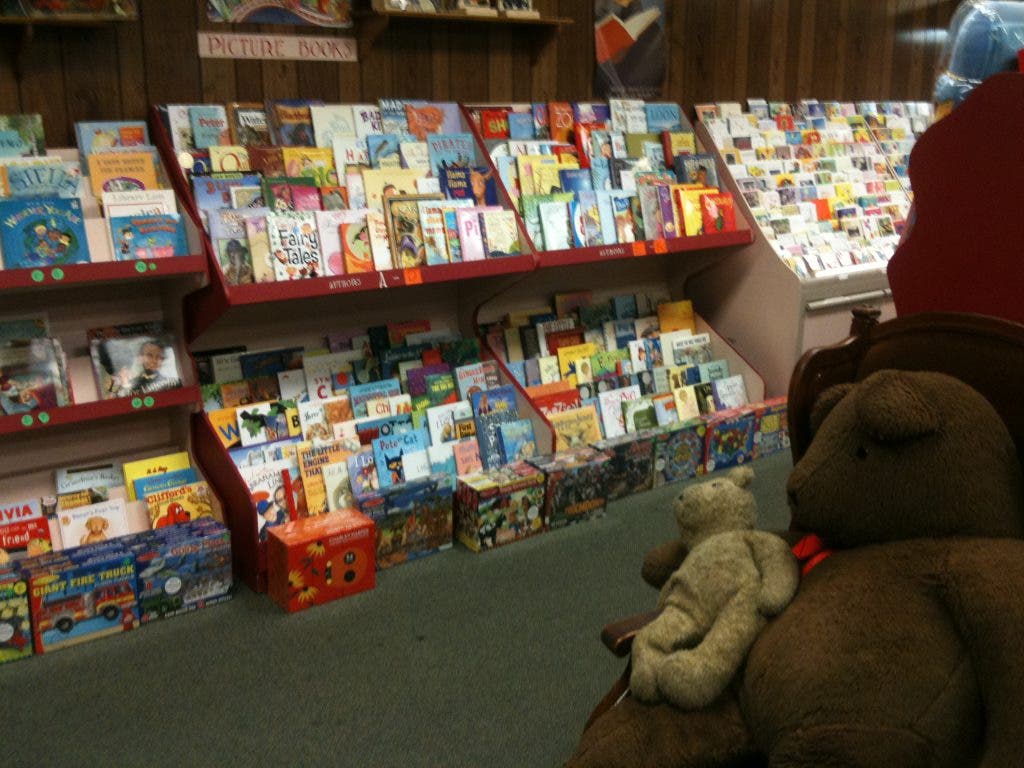
Visitors find new books, greeting cards and other items such as Melissa and Doug toys, Republic of Tea items and reading glasses.
Find out what's happening in Glen Ellynfor free with the latest updates from Patch.
Customer loyalty means a lot to Stroh.
“Our customers are all, with almost no exceptions, nice, kind and caring people,” she said. “They’re very loyal to us. The only reason we are still here is because we are in a community that understands the importance of shopping with local merchants if you want them to be around. It also helps to be in a white-collar community, to be honest.”
Competing with Other Stores
Stroh’s business has seen many trends that have affected large and small booksellers, like hers. She remembers the advent of the book discount chain, Crown, that gained in popularity in the 1980s and 1990s.
“Prior to that, everybody paid the price of the book that was marked in the book unless it was used,” she said. “Everybody paid the same price for the book, and it continues to be set by the publisher and not by the retailer.”
Stroh added that her manager said that a discounter “took the cream off the top. Before that, pretty much anybody could open a bookstore, run it and be successful, even if you didn’t have a lot of business skills and you wanted to keep that inventory around.”
The next big financial impact occurred in the mid-1990s with the arrival of Amazon.com. Stroh explained that while the company lost money during its first few years, its fortunes changed when it went after market share.
Big-box stores such as the soon-to-be-defunct Borders and Barnes & Noble also went after customers with its new and sale books, music, comfortable surroundings and in-house coffee bars, which became popular meeting places.
“They carried such a huge and diverse inventory that it was very fun to go into those stores to wander around, buy a cup of coffee and have these stores be a place for meeting and greeting as well maybe buying a book,” she said. “The combination of Amazon and the big-box stores heavily impacted independent booksellers. The number of independent booksellers dropped dramatically during those years.”
The closing of Borders is a double-edged sword. The closing of the company’s Wheaton location may give Stroh some new customers. On the other hand, it hurts the publishing industry.
“Borders was a huge outlet for books to be out there and for people to have a chance to see them,” she explained. “That now is gone and will impact the publishers and how many outlets (they choose to deliver books) and how many copies they will print. That will definitely have an impact on the industry as a whole and it’s yet to be determined what exactly that impact will be. My sense is that it will be negative.”
The secret to Stroh’s success is the years of offering services such as ordering out-of-print books, having a knowledgeable staff, bringing in local authors, presenting children’s events, helping local nonprofits such as Bridge Communities and being a part of the community.
“We’re kind of a community center and I think that’s part of what helps us stay viable,” she said. “I would say that between 25 and 30 books clubs in the Wheaton and Glen Ellyn area, we have many members who shop with us. We do a 10 percent discount to encourage people to get their books here. We try to do things like that ….The community supports us very much and that we could not be here if people didn’t appreciate what we do.”
Welcoming Harry Potter and the E-reader
In addition to the financial events that have affected bookstores, one book cast a spell on readers in the mid-1990s. Created by J.K. Rowling, the Harry Potter series, which began in 1997 and ended in 2007, had customers willing to wait in long lines for the release of every new title.
“It’s just one of the most positive impacts in the reading world,” Stroh said. “The other impact was Oprah’s Book Club. Both were huge positives in the book world.”
The mid-2000s ushered in an invention that would shake up the publishing industry: the e-reader. With Barnes & Noble’s Nook and Amazon’s Kindle hitting the market, this device let people download many books onto a simple electronic and portable pad. Stroh said that a benefit to this device is that publishers are willing to work with independent booksellers about a parity of e-book pricing.
“Approximately 80 percent of the books that you buy online, you can buy from us from our Web site or you can buy from Amazon, and, in 80 percent of the cases, those books will be the same price whether Amazon is selling them or we are,” she said. “We are both acting as agents of the publisher. The publisher is setting the price and delivering the product and we’re just the route to get to the e-book.”
To some readers, what is sorely missed is just the actual handling a book and taking in the sensory experience of flipping through pages, smelling books, sharing books and placing it on a shelf.
“A lot of people love their books and love to share them,” she said. “It’s much harder to share a book if it’s on an e-reader without giving your whole e-reader away. E-readers obviously have some advantages when you’re traveling and you want to take five books with you. It’s much easier to take one little device. E-readers are part of the market as much as I would like them not to be and I would like to have to not deal with them. It’s not realistic.”
Getting Personal Recommendations
Longtime Glen Ellyn customer Lucy Dallman, a teacher in the gifted program at Ben Franklin Elementary School, can always count on the store’s staff to give her in-depth recommendations on the latest fiction books.
She sees a difference between visiting The Bookstore and big-box bookstores.
“The big-box stores tend not to know about books,” Dallman said. “They have a list of what the greatest and latest titles are, but they can’t speak about them.”
She also enjoys seeing local and Midwest authors who make appearances at the store. One local author that she saw was Indianapolis-based writer Melanie Benjamin whose works include The Autobiography of Mrs. Tom Thumb and her historical novel Alice I Have Been.
Dallman is the type of reader who enjoys curling up with a book in hand in the literal sense.
“There’s a place for those e-readers, but I still want to see a 3-year-old sit in someone’s lap and turn the pages,” she said. “I really think it’s important. Maybe I’m a dinosaur in a dying age, but I think we’ll lose something if we all go to e-books.”