Schools
North Shore School District 112 Teachers Vote To Authorize Strike
The North Shore Education Association voted 373 to 3 to give negotiators the authority to call a strike.


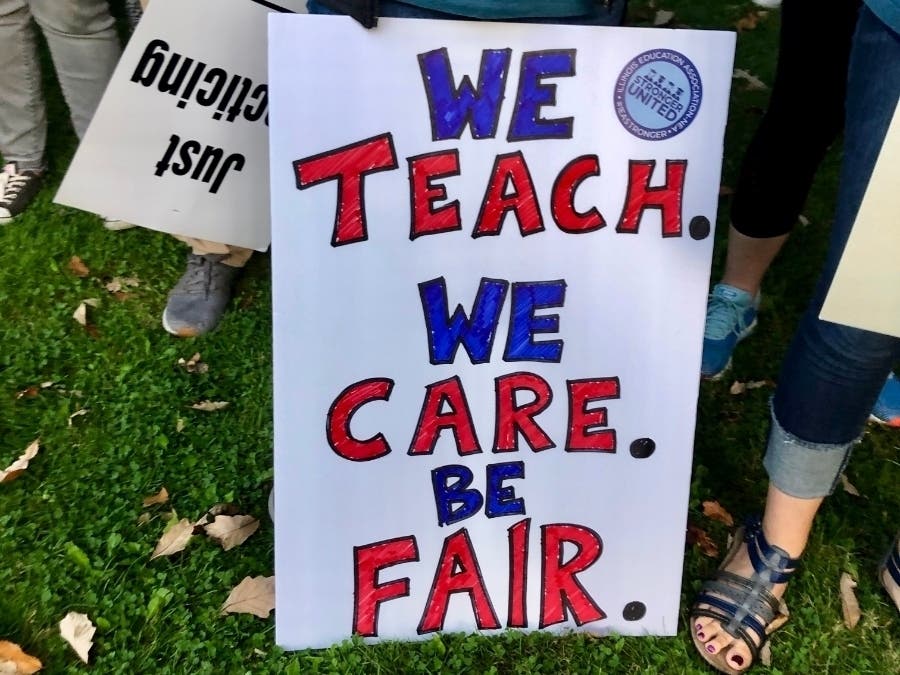
HIGHLAND PARK, IL — Teachers in North Shore School District 112 voted overwhelmingly Thursday to give their bargaining team the authority to call a strike, union representatives announced. By a vote of 373-3, members of the North Shore Education Association elected to take the first step toward a possible work stoppage if an agreement to update their expired contract is not reached.
The NSEA represents 394 teachers, special education teachers, counselors and social workers in the Highland Park elementary and middle school district of nearly 4,000 students. Its members have been continuing to work under the terms of their old contract since it expired Aug. 14, and they are continuing to get paid and receive health insurance, according to the district.
"I think the numbers speak volumes and show that our members are a united front and will not bend in terms of plan time or a reasonable salary increase," NSEA President Sheri Henkel said after the vote. She said she was proud to see turnout of more than 95 percent, considering some teachers were absent.
Find out what's happening in Highland Parkfor free with the latest updates from Patch.
Thursday's vote does not mean a strike is imminent. Under state law, the teachers union would still need to file a notice of intent to strike with the district, the regional superintendent and the Illinois Educational Labor Relations Board. Then 10 days must pass. Teachers could then strike, barring a court order from a judge.
According to both sides, the main sticking points in the negotiations have been how much of teachers' non-classroom time during the day should be directed by administrators, how much wages should increase in the final two years of an upcoming contract and what limits to place on continuing education.
Find out what's happening in Highland Parkfor free with the latest updates from Patch.
Several District 112 teachers spoke at Tuesday's board meeting about the importance of their limited plan time. According to the NSEA, the district is seeking to control 40 percent of plan time for elementary school teachers.
.jpg)
"As it is, these teachers do not have enough time in the day to get everything done. Our research shows that over 99 percent of our staff members do school work from home and on the weekends, and yet they still feel a time crunch during the contract day," Henkel said. "These same teachers come to school early and stay late in order to get everything done in a day."
The district has proposed "at least 90 and up to 120 minutes per week of collaborative team planning, which would include coordinate review of student data and targeting instruction to improve student growth," according to a statement issued on behalf of the board.
Under the expired contract, there is a limit of 30 minutes per week of administration-directed time for elementary school teachers' 300 minutes of weekly plan time and 120 minutes of middle school teachers' 400 minutes of weekly plan time.
Henkel said control of planning time is critical regardless of what grade level is being taught, but it is especially important at younger grades, where teachers less available plan time than at the middle school level.
"We believe students are more than just test scores and data. Teachers use their plan time for preparing for individual student needs, planning with colleagues, parent communication, analyzing their own data, grading papers, working on differentiation, etc.," she said. "The list can go on and on because elementary teachers have so many subjects and issues to juggle in a day. They are teaching 5-6 subjects a day. "
Then there's the issue of compensation. The teachers union says wages in District 112 have fallen behind nearby districts, making it more difficult to attract and retain quality teachers. The district has sought to tie wage growth to inflation.
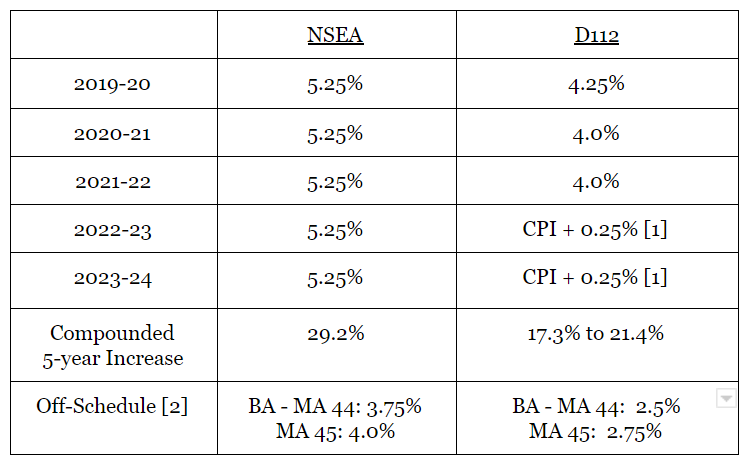
According to Article 17 of the agreement, "off-schedule" teachers received salary increases of 2 percent, while those "on-schedule" got increases of 4 percent, 4.37 percent and 4.56 percent in the first three years of the five-year deal. Educators are subject to smaller "off-schedule" salary increases once they reach a maximum number of years of experience for their level of education.
The expired collective bargaining agreement was finalized in 2015 following nearly a year of negotiations and a one-day strike. It eliminated annual "step increases" for on-schedule teachers reduced the number of "lanes" that award raises for educational advancement.
In the final two years of the deal, teachers received wage increases based on the Consumer Price Index measure of inflation, which has been 2.1 percent. The CPI is also used to cap the increase in the school district's annual tax levy under the Property Tax Extension Limitation Law.
Whether to tie teacher's wages to the inflation index has been a point of disagreement between the teachers union and the board during recent negotiations.
"This is not a salary increase. NSEA is asking for a real salary increase that will make teacher salaries competitive with neighboring districts, so that we can retain quality educators," according to a release from the Illinois Educational Association. "In the last year alone, more than two dozen teachers have resigned."
In addition to issues of wage increases and how to spend planning time between classes, the district and its teachers disagree on how to determine which continuing educational courses are eligible for credit and partial tuition reimbursement. The existing contract establishes a joint committee evenly divided between administrators and teachers to make that call.
The district is seeking to replace that process with a set list of permitted educational institutions, while the teachers union argues its members should be able to choose where to seek further education. Relying on lists such as the ones the district has proposed excludes some prestigious universities, the union argues.
Negotiations on a new contract began in March, and the two sides held seven bargaining sessions over the next five months.
"As the parties approached certain topics, discussions became more difficult," according to a joint statement from the district and union announcing in July they agreed to mediation with a federally assigned mediator provided at no cost.
A fifth session with a federally assigned mediator is set for Oct. 3.
Earlier:
Get more local news delivered straight to your inbox. Sign up for free Patch newsletters and alerts.