The remarkable Illinois Philharmonic Orchestra will perform the United States premiere of the Symphony No. 1 in D minor by Alexander Zemlinsky on the 26th of April 2014. http://www.harristheaterchicago.org/performers/illinois-philharmonic-orchestra/tab/upcoming-events
As part of a ZemlinskyFest that same week, the Friends of the Illinois Philharmonic Orchestra are sponsoring the fantastic "Trio Voce" in a benefit concert for the IPO on which they will play the Zemlinsky Trio for Violin, Cello and Piano op 3. The Trio Voce concert will be the 21st of April 2014 at Prairie State College.
Find out what's happening in Homewood-Flossmoorfor free with the latest updates from Patch.
Trio Voce, which features violinist Jasmine Lin--a very distinguished graduate of Homewood-Flossmoor High School--has made an acclaimed recording of the Zemlinsky work.
Find out what's happening in Homewood-Flossmoorfor free with the latest updates from Patch.
Now the Quiz
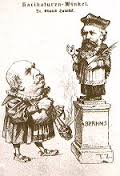
It turns out that the 1892 Vienna premiere of Zemlinsky's D-minor Symphony was reviewed by the acid-tongued critic Eduard Hanslick. Hanslick loved the pure music of Brahms and pretty much hated music coming from the camp of Wagner which represented music which he felt was adulterated by non-musical, programmatic elements. Here is a famous Hanslick quote: "Music has no subject beyond the combinations of notes we hear, for music speaks not only by means of sounds, it speaks nothing but sound."As you may remember from the previous quiz, Zemlinsky was an acolyte of Brahms--a "Brahmin" as he humorously referred to himself as a student. So this should help you get one correct. Below, match the Hanslick Quote to the piece to which it refers:
A. Zemlinsky’s Symphony No 1 in D minor
B. Tchaikovsky’s Trio in A minor
C. Rimsky-Korsakov’s Sadko
D. The Liszt B-minor Sonata
E. Bruckner’s Symphony No. 8
F. The Love music from Tchikovsky’s Romeo and Juliet
G. Strauss’s Don Juan
H. The Prelude to Wagner’s Tristan and Isolde
I. Liszt’s Mephisto waltz
J. Tchaikovsky’s Violin Concerto
1. [] is no longer played, but torn apart, pounded black and blue... Friedrich Vischer... once said, speaking of obscene pictures, that they stink to the eye. [] brings us face to face for the first time with the revolting thought: may there not also exist musical compositions that stink to the ear?
2. Interminable, disorganized and violent, [] stretches out to a hideous length. It is not impossible that the future belongs to this nightmarish Katzenjammer style--a future to which we therefore do not envy.
3. [] simply turns all the natural laws of music upside-down. Incapable of creating the beautiful by his own means, he deliberately builds up the hideous.
4. [] is program music in its most unashamed form, a product of barbarism mated with utter cynicism. Such poverty of musical thought, and such impudence of orchestration, we have seldom heard. Mendelssohn's elves, Cade's mermaids, Berlioz's Walpurgis Night and Wagner's Venusberg, all this is boiling here in a Russian brandy kettle. []… is a fanatic acolyte of Richard Wagner. [...] in Vienna, we still have a right to protest against the cultivation of such rank dilettantism in our concert organizations established for the cause of good music.
5. [He] is a pupil of Hofopernkapellmeister N. Fuchs and has already learned a thing or two, Nowadays, sadly, this counts as praise; once upon a time it was a matter of course. [. . .] The work is well scored, logically constructed, and reveals talent and temperament. Although this or that betrays the hand of a novice, on the strength of this trial a propitious future can be prophesied for []
6. This is no tone picture, but a confusion of blinding color splashes, a stuttering tonal delirium. That he, as a disciple of the Berlioz-Liszt- Wagner school, has set in motion a huge orchestral apparatus for his tone poem, goes without saying. . . The highest (and heretofore inapplicable in the orchestra) violin notes cut as sharp as glass in our ears; a glockenspiel raises every moment its childish tinkle. We might almost wish that quite a lot more of such tone pictures were composed soon as a non plus ultra of a false unrestrained direction. Then a reaction will not fail to assure a return to a healthy musical music.
7. It is impossible to convey through words an idea of this musical monstrosity. Never have I experienced a more contrived and insolent agglomeration of the most disparate elements, a wilder rage, a bloodier battle against all that is musical. At first I felt bewildered, then shocked, and finally overcome with irresistible hilarity. . . Here all criticism, all discussion must cease. Who has heard that, and finds it beautiful, is beyond help.
8. …this motive built on the alternation of two dissonant chords sounds rather like scratching a glass plate with a sharp knife. Like a cold snakeskin runs this love bliss down the spine
9. [] reminds me of the old Italian painting of a martyr whose intestines are slowly unwound from his body on a reel.
10. It belongs to the category of suicidal compositions, which kill themselves by their merciless length
Answers
1 J; 2 E; 3 I; 4 C; 5 A; 6 G; 7 D; 8 F; 9 H; 10 B