Politics & Government
Joliet Cop's Retaliation Claim Can Proceed To Jury Trial: Judge
A federal judge dismissed Lionel Allen's racial discrimination case against Joliet, but Allen's claim of retaliation can move forward.


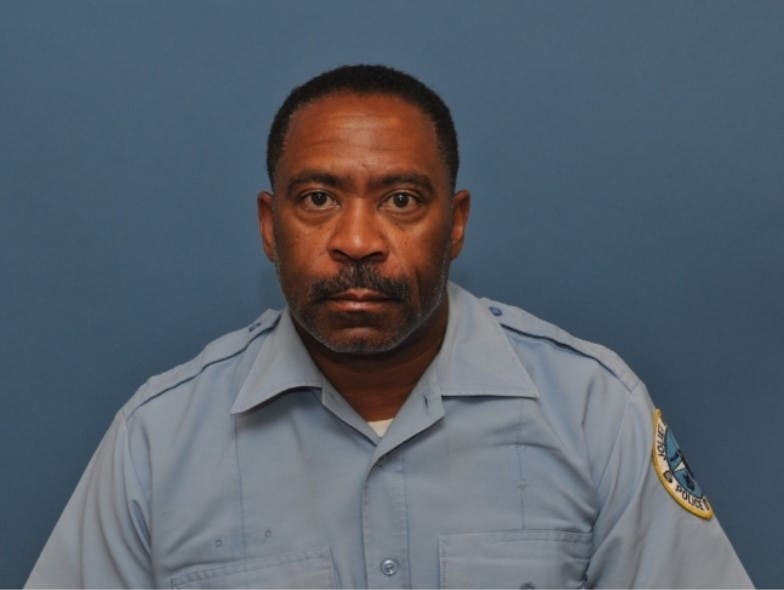
JOLIET, IL — A Rosemont law firm defending the city of Joliet and former Police Chief Brian Benton in retired police officer Lionel Allen's race discrimination lawsuit against his former employer gained an important pretrial victory in a federal judge's ruling.
In his 38-page ruling issued Friday, U.S. District Judge Steven Seeger granted Joliet's motion for a summary judgement on Allen's race discrimination claims. The judge also granted Joliet's motion for a summary judgement on Allen's retaliation claims regarding the Joliet Police Department's internal affairs investigation and Allen's suspension.
But the federal judge did not dismiss Allen's federal lawsuit in its entirety.
Find out what's happening in Jolietfor free with the latest updates from Patch.
"The Court denies Defendants’ motion for summary judgement on the retaliation claims about the Last Chance Agreement," Seeger wrote.
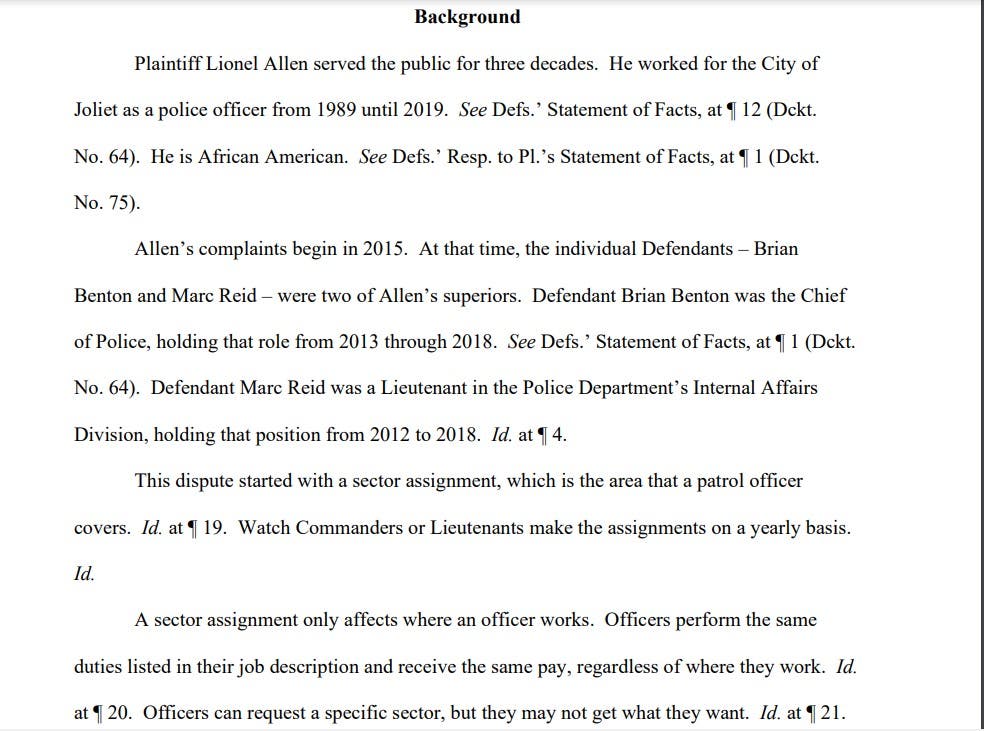
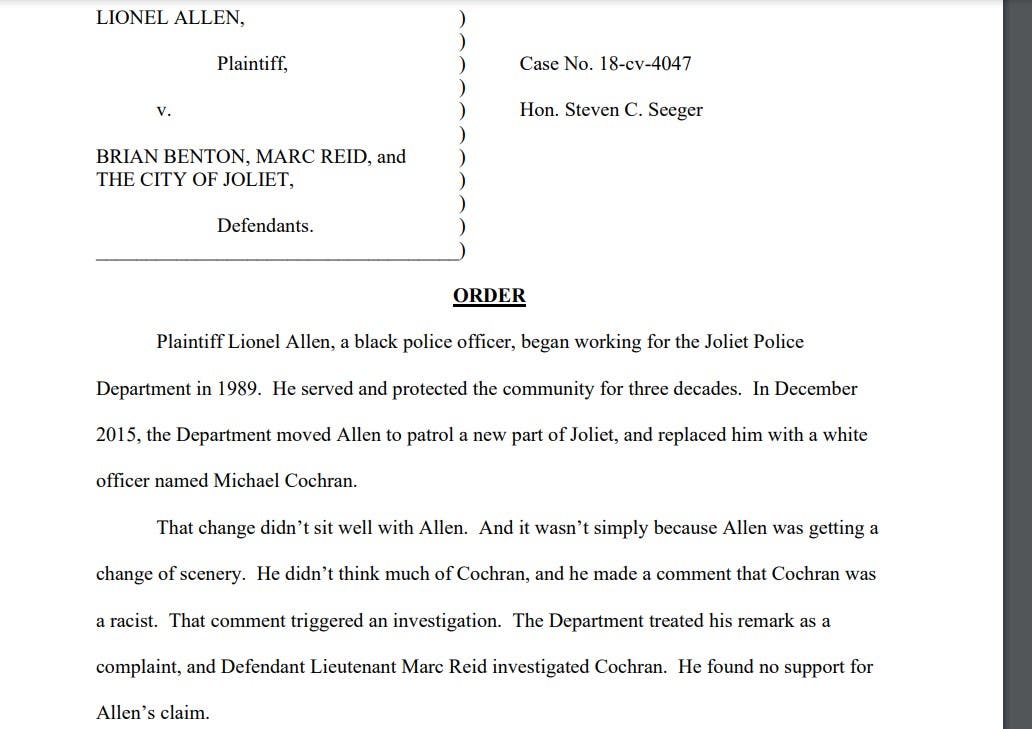
In 2018, while still on the Joliet Police Department, Allen filed his federal lawsuit against the Joliet Police Department, Chief Benton and Lt. Marc Reid, who oversaw internal affairs at the time.
Find out what's happening in Jolietfor free with the latest updates from Patch.

At the time of Allen's lawsuit, Patch reported that Allen had previously filed a discrimination complaint with the Equal Employment Opportunity Commission, on May 1, 2016. On June 16, 2016, Chief Benton "recommended that Allen be terminated" as "further race discrimination," the lawsuit stated.
Joliet's chief told Allen he would not be fired if he chose to withdraw his EEOC complaint, "agree not to file any future charges, signed a 'last chance agreement' and took a 15-day suspension," according to the lawsuit.
"The first question is whether the Defendant retaliated against Allen for complaining about racism in the workplace when the parties entered into the ominous-sounding Last Chance Agreement," judge Seeger stated in Friday's ruling. "Again, the Last Chance Agreement allowed Allen to keep his job, with strings attached. For present purposes, the most important string was the obligation to abandon the EEOC charge.
"There is no dispute about the first element of the retaliation claim, because there is no doubt that filing a complaint with the EEOC is a protected activity. The Seventh Circuit has long held that formal EEOC charges are the most obvious form of statutorily protected activity.”
According to the federal judge's ruling, "Here, Allen faced a threat of termination. That threat was not left to Allen’s imagination. Far from it — the Police Department made it loud and clear to Allen that he would lose his job if he did not drop the EEOC charge.
"The very name of the contract – the Last Chance Agreement – said it all. The Police Department gave Allen one last chance to keep his job. He needed to do everything covered by the Last Chance Agreement, or his days on the police force were over. The threat of termination couldn’t have been more direct or more dire. In effect, the agreement basically said: 'Do X or we’ll fire you,'" Judge Seeger concluded.
According to Judge Seeger, "Faced with termination as his only alternative, Allen did what he agreed to do, and dropped the EEOC complaint ... The possible adverse action was not abstract, general, and unspecified, either."
In his ruling, the judge noted the Chief Benton submitted "a declaration saying that he never intended to force Allen to withdraw his EEOC charge through a threat of termination ... And Chief Benton also says that he would never have fired Allen if he did not withdraw the EEOC charge. But the Agreement says what it says, and the language is plain as day. Allen needed to 'abide by the terms of this Agreement' to keep his job.
"The Agreement wasn’t a long-winded contract where the details could get lost in the minutiae. The Agreement was only two pages long, spanning eleven paragraphs. And an entire paragraph was devoted to the withdrawal of the EEOC charge. No one could miss it on the middle of page one."
Seeger noted in his ruling that "maybe Chief Benton was bluffing, and never intended to carry through with the threat of terminating Allen if he didn’t withdraw the EEOC charge. He can make that argument to the jury if he wants. But based on the plain text, there is more than enough in the record to support a finding by a reasonable jury that Allen faced a real threat of termination for complaining to the EEOC."
In contrast, on the issue of Allen's claims of racial discrimination, the federal judge ruled that Allen did not present evidence to support his claims.
"Allen’s entire case relies on his proposed comparators. He basically claims that he received worse treatment than other, similarly situated officers. For the reasons stated above, no reasonable jury could look at the treatment of other officers and conclude that the department suspended Allen because of his race," Judge Seeger declared. "The Court grants Defendants’ motion for summary judgement on Allen’s claims of race discrimination in Count I and Count II."
According to the judge, Allen must prove he is a member of a protected class, who was meeting his employer’s legitimate expectations and suffered an adverse employment action, and similarly situated people outside his protected class were treated more favorably.
"He does not allege that the investigation hurt him in any way beyond the eventual suspension, but that is a different claim," the judge concluded. "He does not argue that he lost pay or career prospects. And he never suggests that the process was humiliating or degrading.
"Instead, Allen focuses entirely on comparisons. He points to several non-black officers who acted inappropriately but were not investigated."
The judge's biggest problem with Allen's racial discrimination claim "is the lack of evidence. All too often, when this Court drilled down to unearth the underlying evidence, instead of hitting pay dirt, the Court came up empty. Time and again, Allen pointed to material that didn’t actually contradict the evidence put forward by Defendants," Judge Seeger wrote.
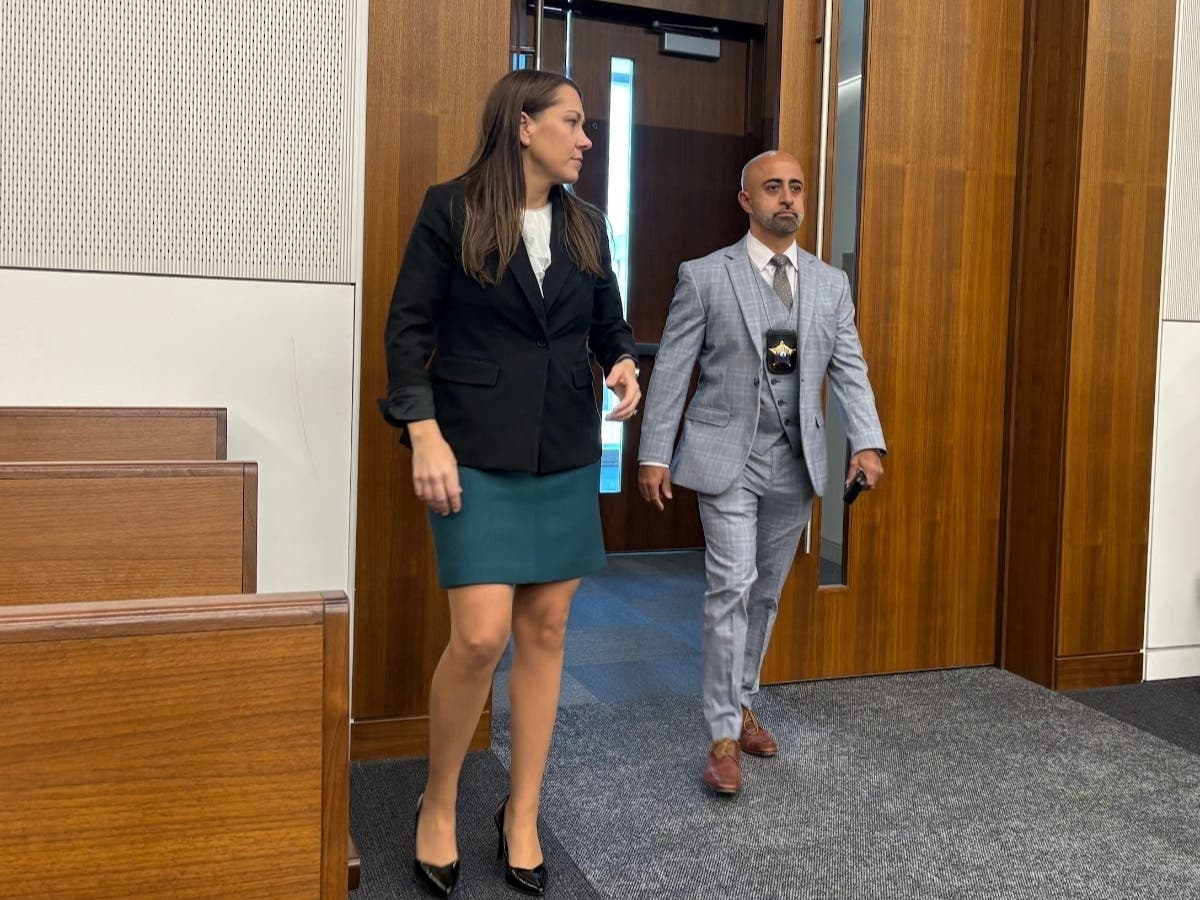
Allen is represented by Naperville attorney Aaron Rapier. The city of Joliet, former chief Benton and former Lt. Marc Reid are being represented by the Rosemont law firm Clark Baird Smith.
In January 2019, Joliet Police Chief Al Roechner announced he had fired Allen from the Joliet Police Department. However, Roechner never presented his case to the city's police and fire board during any point over the next seven months.
That August, Allen retired after 30 years on the Joliet police force.
Get more local news delivered straight to your inbox. Sign up for free Patch newsletters and alerts.