Community Corner
Tent City Home For Many Joliet Area Homeless: Ferak Column
Joliet Patch Editor John Ferak went on a guided tour of Joliet's Tent City with a long-time east side resident.


JOLIET, IL — When my Ferak ancestors left Czechoslovakia around the time of World War I, they ended up living on Joliet's east side, near the EJ& E railroad tracks. My grandparents lived on Henderson Avenue for decades, next to St. Cyril's Church. As a child, my grandmother used to tell me stories about the hobos who rode the boxcars and wandered the predominately Slovak neighborhood in search of their next balogna sandwich.
The hobos were an accepted part of the neighborhood. For the most part, they were friendly and polite. They weren't there to rob you or put a gun in your face.
On Thursday, I returned to the east side to go on a guided tour with a long time east-side resident who wanted to show me another part of Joliet that a lot of people have heard about, but few have ever seen up close and personal. (My guide asked that he not be identified for this article.)
Find out what's happening in Jolietfor free with the latest updates from Patch.
I'm talking about Joliet's Tent City. My guide told me that Tent City has been a fixture on the east side for approximately 20 years.
(Column continues below this photo.)
Find out what's happening in Jolietfor free with the latest updates from Patch.
My late-morning tour came at a time when Joliet Mayor Bob O'Dekirk has garnered lots support in the city regarding his efforts to address Joliet's rising homeless population, following the March murder inside the downtown Harrah's Casino Hotel. A transient who had just moved to Joliet and was living inside abandoned homes near the downtown has been charged with first-degree murder and robbery.
The mayor is setting up a task force of community leaders to come up with solutions that will substantially reduce the number of homeless people who have been gravitating to the city from other parts of Illinois and beyond.
The mayor has pointed out that many of the homeless are drifters with no ties to Joliet; they often come here because of the free meals and the free social services. There are two large east-side homeless shelters in Joliet, but none operate in most of Joliet's surrounding communities.
But besides those who reside at MorningStar Mission on East Washington Street and the Daybreak Shelter on Cass Street, many additional homeless people are staying at Joliet's Tent City.
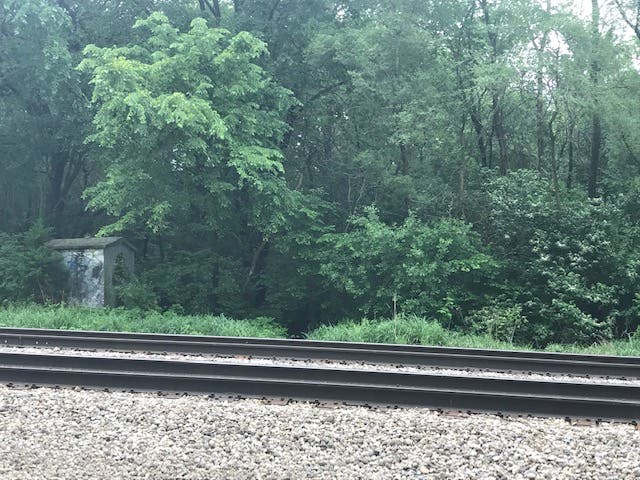
Tent City is located in a large forest bordered on one side by the back of the Mt. Olivet Cemetery and the railroad tracks along Washington Street.
It's also less than a half-mile away from Daybreak.
(Column continues below this photo.)
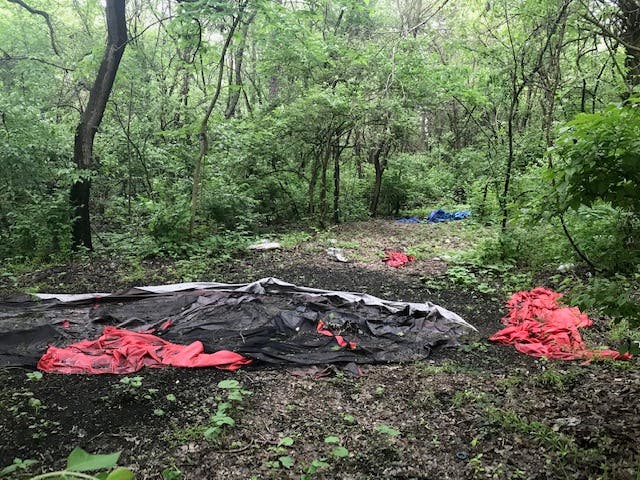
On Thursday morning, my guide and I parked our cars in an older neighborhood behind the Mike's Furniture Store. From there, we walked through the cemetery and crossed the railroad tracks to enter the large forest on the city's east side.
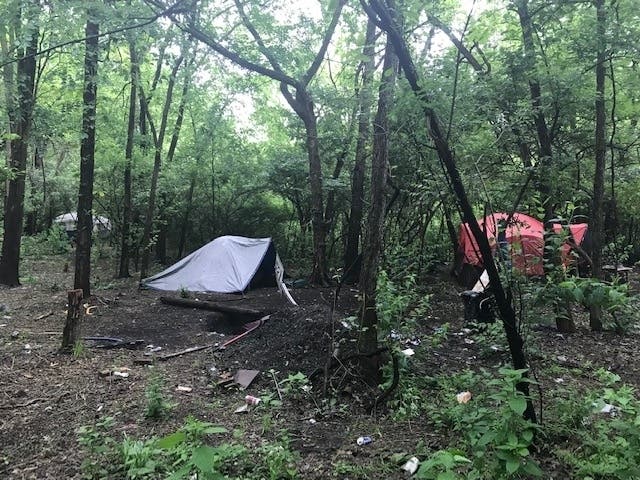
Along the walking path, we came upon several tent sites that were long abandoned and discarded.
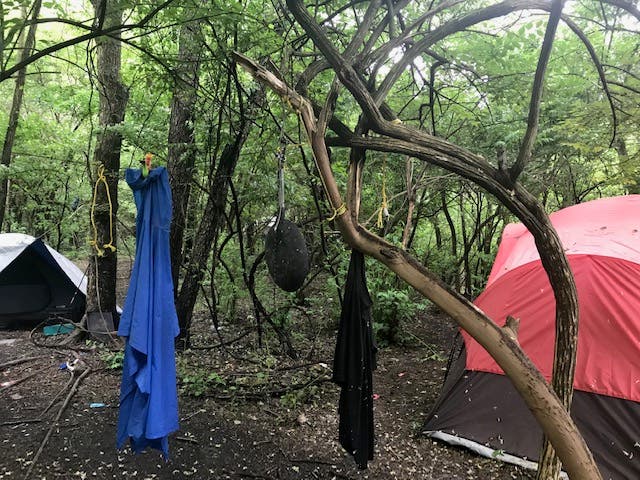
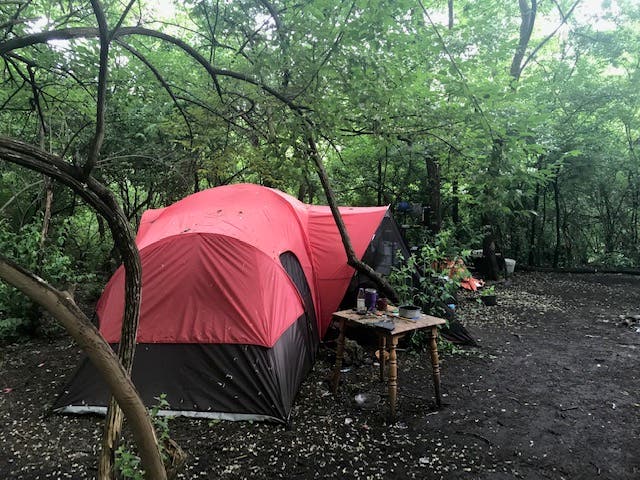
Eventually, after walking approximately a half-mile, we came upon an area inside the forest with at least a half dozen tents that looked to be well-kept. Several bicycles were parked nearby.
At one point, we announced our presence several times, but it appeared that all of the tent dwellers were already gone for the day. My guide wasn't surprised, pointing out that some of the people at Tent City will wander over to Daybreak for a free lunch and others will head downtown to hang out at the Joliet Public Library during their day.
(Column continues below this photo.)
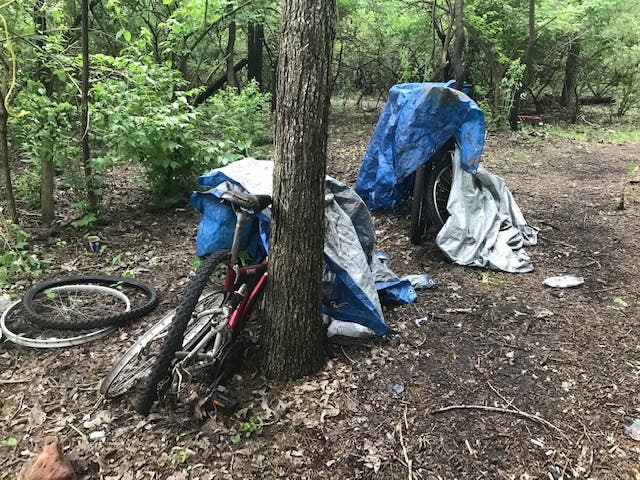
For safety reasons, my guide suggested that we turn back and not continue deeper into the Tent City forest. My guide has known a number of homeless people around Joliet who have chosen to live at Tent City over the years, but there are also several other people who end up there who are hardened ex-convicts, who could be armed with weapons.
For instance, my guide said he knew of one former ex-convict from Stateville who ended up at Tent City shortly after serving 15 years for a murder.
Afterward, my guide said we made the right call by visiting Tent City closer to lunch time rather than showing up at night when it was dark.
(Column continues below this photo.)
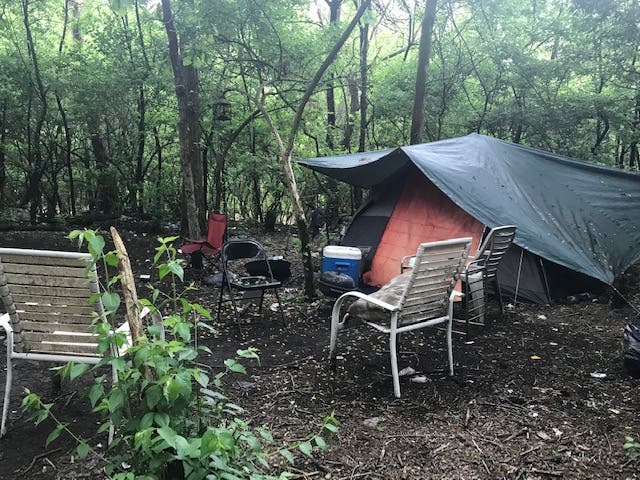
"It's a dangerous place to go on the east side for outsiders," my guide remarked. "The people who stay at Tent City are either barred from the shelters or they choose to live here."
At Tent City, everyone lives in a commune. You'll see clusters of four or five tents scattered throughout the forest.
(Column continues below this photo.)
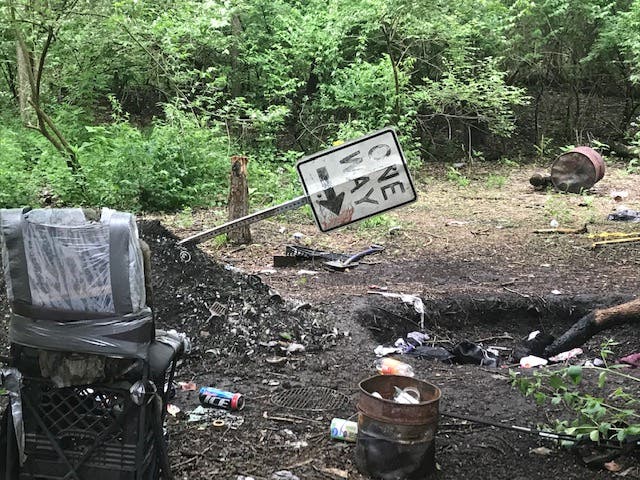
For the most part, Tent City seems pretty tranquil. The homeless people who live here often stay for months, if not years.
They find a way to get along.
I noticed some areas of the forest where holes were dug to start fires, to keep warm on cold nights. There were makeshift bicycle racks. There were areas where people hung their clothes and pots and pans for cooking their meals.
(Column continues below this photo.)
About five minutes after we finally left Tent City, a man and a woman, both white and in their twenties, emerged from the forest. At that point, my guide and I were standing outside and talking near where we had parked our cars.
When I approached the young woman about being interviewed to discuss Tent City, she became belligerent and started swearing and screaming.
Nobody needs to know about Tent City, including the police, she yelled.
"It's nobody's business. I don't want to see this in the paper," she snapped. "Stay out of there!"
(Column continues below this photo.)
My guide, who was the voice of reason, calmly told her that the Joliet Police Department already knows about Tent City.
Joliet Police, as well as ambulances at the Joliet Fire Department, have responded to emergency calls at Tent City on a number of occasions in recent years.
On a lighter note, the young man who was accompanying the woman out of Tent City then approached both of us and politely told us to ignore her.
About 10 minutes later, while I was interviewing an older African-American man whose house is near the railroad tracks that leads into Tent City, an older white man who looked to be in his mid-sixties emerged from the entrance of Tent City riding a bicycle.
The Joliet resident who lives on Clinton Street told me that he sees the homeless coming and going from Tent City through his neighborhood on a daily basis. He recalled one alarming incident several months ago when a woman showed up in his yard and asked him to call 911 because her boyfriend back at Tent City needed immediate medical attention.
The Joliet man told me that for the most part, the homeless people coming and going from Tent City don't cause any problems in his neighborhood of older homes near Cass Street. In fact, on multiple occasions, he has gone into his house and provided them with some food, he said.
All in all, I'm glad I had the opportunity to walk through part of Tent City on Thursday. It gave me a chance to see the conditions some of our poorest homeless people are living in, out at Tent City.
One piece of advice: if you ever visit Tent City, do not ever attempt to wander inside somebody's tent, my guide cautioned.
"Some of the homeless guys are very protective of their tents, and you don't want to get hurt," my guide advised. "These are people who choose to live that lifestyle, being permanently in the woods."


Get more local news delivered straight to your inbox. Sign up for free Patch newsletters and alerts.