Community Corner
What happened to mammals after dinosaurs became extinct? Find out in this Forest Preserve Q&A
Prepare for Saturday's Mammal Madness with a primer on mammal evolution by famous paleontologist and Illinois native Steve Brusatte.


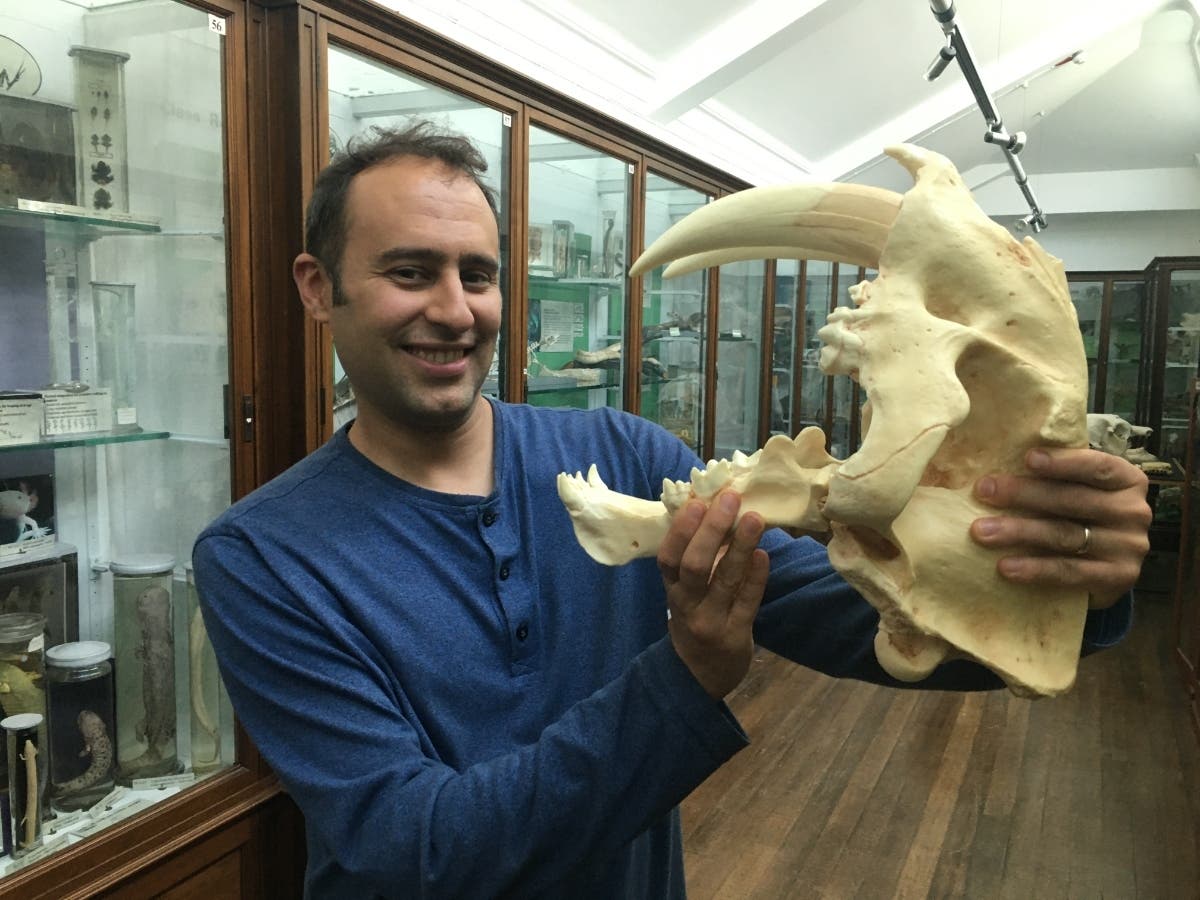
Now that the Forest Preserve District of Will County’s annual Mammal Madness is almost here, it’s time to take a leap back in time to delve into the prehistoric past of mammals.
This Q&A interview with a famous paleontologist will detail how mammals evolved to become the shapes and sizes they are today.
To take that trip back in time, public information officer Cindy Wojdyla Cain went to an expert, world renowned paleontologist Steve Brusatte, an Illinois native who grew up in Ottawa and spent time hunting for fossils at Mazon Creek in nearby Grundy County.
Find out what's happening in Jolietfor free with the latest updates from Patch.
Brusatte has gone far since his time in Illinois and he is now a New York Times best-selling author, a science consultant for Jurassic Park movies and chair of Paleontology and Evolution at the University of Edinburgh in Scotland.
After the success of his 2018 bestseller, “The Rise and Fall of the Dinosaurs: A New History of a Lost World,” Brusatte turned his attention to mammals in his book, “The Rise and Reign of the Mammals: A New History, from the Shadow of the Dinosaurs to Us.” (2022)
Find out what's happening in Jolietfor free with the latest updates from Patch.
While the Forest Preserve’s Mammal Madness on March 7 at Four Rivers Environmental Education Center will highlight modern mammals that live in our preserves and backyards today, Brusatte’s work reveals the dramatic story of how mammals survived mass extinction and evolved to thrive on our planet.
Cain asked Brusatte about the rise of mammals via email and here are his answers:
You’re known as a dinosaur expert. Why write “The Rise and Reign of the Mammals”?
When it comes down to it, I am enthralled by all fossils, whether dinosaurs or mammals or fossil leaves or shells or corals. But you're right, for most of my career I have studied dinosaurs. They are my greatest passion, and what I've mostly been trained to study. But the more I studied dinosaurs, the more I pondered: what happened after the dinosaurs went extinct? And the answer is that mammals took over the world. And I wanted to understand how that happened, how the roots of our own human story go back to our ancestors surviving that asteroid.
What were mammals like when dinosaurs ruled the Earth?
Believe it or not, dinosaurs and mammals have the same origin story. Both groups got their start back in the Triassic Period, about 230 million years ago, on the supercontinent of Pangea — the giant slab of land made up of all of the modern continents smashed together. And for the next 150 million years or so, dinosaurs and mammals lived together. Their fates were intertwined, but different. Dinosaurs went big, and T. rex and Brontosaurus and the other giants topped the food chain. Mammals, meanwhile, lived in the shadows. During all that time, they never got bigger than a house cat. But mammals were anything but failures. They were greatly successful at being small. There were digging mammals, runners, climbers, swimmers, even gliders. They were the kings and queens of the underworld during the Age of Dinosaurs.
What happened to mammals after the dinosaurs died out?
Everything changed 66 million years ago. Literally, one random day, a 6-mile-wide rock fell out of the sky, and crashed into the Earth, releasing more energy than one billion nuclear bombs. It was an asteroid, a piece of leftover space junk from the birth of the solar system, and it could have gone anywhere, but by chance it made a beeline for the Earth. And it triggered a cascade of destruction: earthquakes, volcanoes, tsunamis, wildfires. Seventy-five percent of all species died out. Gone, completely. All dinosaurs (except for birds — which evolved from dinosaurs) perished, probably because they were too big and needed too much food and couldn't shelter down easily. But some mammals survived because they were small, could hide away in burrows, could eat a lot of different types of food and could grow fast. Among them were direct ancestors of ours. If they didn't survive, we wouldn't be here. It's a remarkable thing to think about.
How did mammals evolve in the millennia after the asteroid?
Once the mammals survived the asteroid, they would have looked out on a largely empty world. T. rex was gone. All the big dinosaurs were. And now mammals had the freedom to do new things, to grow bigger, to experiment with new ways of moving, new foods to eat, new places to live. These surviving mammals started to evolve very quickly to take advantage of these opportunities. And from this manic waltz of evolution came the major groups of mammals we are familiar with today, including primates, our group. The first primate fossils turn up in rocks that were formed only a few thousand years after the asteroid hit.
Why is the jawbone such a defining feature of mammals?
Mammals, including ourselves, have weird jaws. We have just a single jawbone. That's it. Most other animals with bones have many jawbones. Birds do, dinosaurs like T. rex did as well. Frogs, lizards, crocodiles, you name it, all have multiple jawbones. But the single jawbone of mammals provides a strong, sturdy framework for large jaw muscles, which allow us to bite harder than most other animals. And it provides a solid foundation for our very complex teeth, like our molars, with all of their pits and grooves and ridges and valleys, which we use to crush and pulverize our food in a way that other animals can't.
How did mammal jawbones and ears evolve — a topic you explore in your book?
All mammals, us included, have three tiny bones in our ear. They are each about the size of a grain of rice in us, and considerably smaller in small mammals like mice or rats. They act as sound amplifiers, taking sounds collected by the eardrum and delivering them to the cochlea (the part of the ear that actually senses sound) and then to the brain. Two of these bones are former jawbones. They were large bones in the lower jaws of our distant ancestors, but then shriveled up, migrated into the ear and took on a new role in hearing. It is one of the most incredible feats of evolution.
Why are mammals important in today’s ecosystems?
When the Age of Dinosaurs ended in the fire of the asteroid, the world transitioned into an Age of Mammals. It is mammals today that have the greatest diversity of animals on land, in terms of the great variety of body types and diets and behaviors and size and roles in the food chain. Just think about the staggering variety of everything from elephants and rhinos to dogs and cats and rodents and bats and monkeys and horses. From huge elephants to tiny shrews. And of course, primates, like us. And there are mammals in the water too: whales, which evolved from land-living mammals and turned their hooves into flippers so they could swim. Mammals are fundamental to so many ecosystems today.
What surprises people most about mammals?
Unless you're a paleontologist like me, you might not know about many of the truly sublime mammals that once lived but are now extinct. There were hornless rhinos the size of elephants. There were armadillos the size of Volkswagens, and sloths that stood 10 feet tall and could dunk a basketball (if they so desired). There were once deer with antlers larger than a dinner table, and there were once lions and hyenas living in America. The mammals we see today are a tiny fraction of their wonderful diversity over time.
What is the biggest misconception about mammals?
The biggest misconception I hear is that mammals evolved to replace the dinosaurs. Yes, mammals did replace the dinosaurs, in many ways, becoming the largest and most dominant animals on land. But in order to do this, mammals had to outlast the dinosaurs. There were mammals living with dinosaurs for over 150 million years. We had direct ancestors, distant ones, but direct ones that lived underfoot of T. rex!
From a scientific perspective, what is your favorite mammal?
I absolutely love those giant sloths that I just mentioned. Imagine: a sloth standing 10 feet tall, and walking on its knuckles like a gorilla, sauntering across the land. They were totally different than the sloths that live now, the tiny and lazy and cute little ones that hang from the branches in Central America nibbling on leaves all day. And these giant ground sloths lived up until very recently, just a few thousand years ago. They became extinct as the Ice Age ended. Humans sadly probably played a role in their extinction, overhunting them and rapidly changing their environments. And here's one last crazy fact about these giant sloths. It was Thomas Jefferson, while he was the sitting vice president, who actually named and described some of their first fossil bones! Imagine that, a sitting vice president studying fossil bones and publishing scientific research papers.
Since you grew up in Illinois, is there anything noteworthy about mammals of the Midwest?
I would just encourage everyone to take a look around and appreciate the many mammals that live with us. Ones we might not think about much. Deer, raccoons, squirrels and mice of course. But there are so many bats we hardly ever see, which just come out at night. And foxes and coyotes and wildcats. And if we were here just a few hundred years ago, there would have been vast herds of bison in our backyard. And 20,000 years ago, woolly mammoths and saber-toothed tigers.
Now that you've learned about the prehistoric past of mammals, make sure you mark your calendars to attend Mammal Madness from 11 a.m. to 3 p.m. on Saturday, March 7, at Four Rivers Environmental Education Center in Channahon. The free event features live animal presentations and family-friendly activities.