Politics & Government
Earthquake Drill Prepares Illinoisans for the 'Big One'
Local residents are encouraged to drop, cover and hold on during the Great Central U.S. Shakeout Drill this Thursday, October 15.


You probably didn’t know that the Midwest is sitting on a powder keg of seismic fault rupture directivity.
In the event of the next “big one,” more than 2.5 million people in 14 states are expected to “Drop, Cover, Hold On,” in the Great Central U.S. Shake Out at 10:15 a.m. Thursday, October 15.
“Destructive earthquakes just don’t happen in the western United States, they can happen in the Midwest too,” said Lt. Art Clark, director of Oak Lawn’s Emergency Management Agency. “The shakeout drill is a great reminder for people to take steps to prepare for any kind of disaster, not just an earthquake.”
Find out what's happening in La Grangefor free with the latest updates from Patch.
Over the past 25 years, scientists have learned that earthquakes in the central Mississippi Valley are not freak events but have occurred repeatedly in the geological past.
The New Madrid Seismic Zone gets its name from the epicenter of a historic earthquake that occurred Dec. 16, 1811, when citizens were in New Madrid, MO, awakened by a powerful 7.5 magnitude earthquake.
Find out what's happening in La Grangefor free with the latest updates from Patch.
The New Madrid, MO, earthquake of 1811 caused the Mississippi River to flow backwards and rang church bells in Boston. Even President James Madison and First Lady, Dolly, claimed they felt the earth move in the White House.
The NMSZ produces frequent minor shocks and is made up of several thrust faults that stretch from Marked Tree, AR to Cairo, IL, the Shake Out website says.
The Wabash Valley Seismic Zone, located in southeastern Illinois and southwestern Indiana, produced a 5.0 trembler in Evansville, IN, in 2002. Scientists say the WVSZ is also capable of producing New Madrid-magnitude earthquakes.
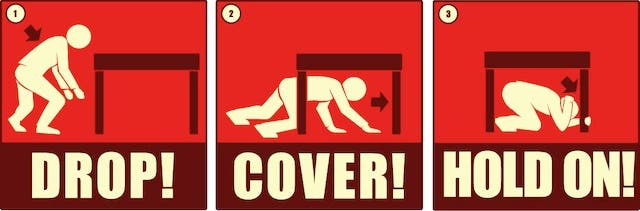
When the ground begins to shake, people have only seconds to protect themselves and their families. Practicing these Drop, Cover and Hold On steps can help you respond when a real earthquake happens:
- DROP to the ground before the earthquake drops you.
- Take COVER by getting under a piece of sturdy furniture or in a doorway, if inside.
- HOLD ON until the shaking stops.
- If you are INSIDE, stay indoors until the shaking stops and you are sure it is safe to exit. In most buildings in the U.S. you are safer if you stay where you are until the shaking stops.
- If you are OUTDOORS when the shaking starts, you should find a clear spot away from buildings, trees, streetlights, and power lines, then Drop, Cover and Hold On. Stay there until the shaking stops.
- And if you’re DRIVING pull over to a clear location, stop and stay there with your seatbelt fastened until the shaking stops. Once the shaking stops, proceed with caution and avoid bridges or ramps that might have been damaged.
Ground shaking is seldom the cause of earthquake-related injuries or deaths, it’s the collapsing walls and roofs, power lines, flying glass and debris that will get you.
Also, as with any disaster event, designate a place where you can meet up with your classmates, coworkers and family members to make sure everyone is accounted for.
Illinois’s drill is being coordinated by the Illinois Emergency Management Agency. Those who wish to participate can sign up on the Great Central U.S. Shakeout website, as well as get ideas their own earthquake drill scenarios.
Get more local news delivered straight to your inbox. Sign up for free Patch newsletters and alerts.