Politics & Government
Bee, Chicken Pilot Programs To Be Discussed By Board
Pilot programs for beekeeping and backyard chicken coops are on the agenda for the Lake Bluff Village Board Monday.


LAKE BLUFF, IL — Trustees will discuss pilot programs allowing people to keep chickens and beehives in their backyards at a meeting Monday evening. Both proposals have been crafted by the Lake Bluff Sustainability and Community Enhancement Ad Hoc Committee, which unanimously approved both plans Oct. 5.
Under the draft ordinances, residents must get permits and provide neighbors with public notice but need not obtain their permission. Chickens would need to be kept at least 10 feet from an adjacent occupied home. Currently, unincorperated Lake County, Deerfield and Evanston allow backyard chickens. Evanston also allows beekeeping, according to village documents.
The Village Board is scheduled to discuss the programs at 6:15 p.m., prior to its regular Nov. 13 board meeting.
Find out what's happening in Lake Forest-Lake Blufffor free with the latest updates from Patch.
Find outlines of the draft proposals below:
Find out what's happening in Lake Forest-Lake Blufffor free with the latest updates from Patch.
Lake Bluff Draft Beekeeping Pilot Program Outline (October 2017)
1.) Locations: All residents in the following Village Zoning districts are permitted to keep domestic honeybees and hives on their property: C-E; E-1; E-2; R-1; R-2; R-3; R-4; and R-6. Permission for districts not listed here residents can submit a request directly to the Village Board.
2.) The keeping of non-domestic bees is prohibited.
3.) Notification: Prior to establishing a hive, applicants must notify the Village by completing and submitting an application for beekeeping and proving proof they have registered with the Illinois Department of Agriculture. In addition, residents must submit written proof of notice to all adjacent property owners, in a form provided by the SEC (attached). Notification to adjacent property owners is not required for renewals by any applicant that previously complied with this notification requirement in receiving a prior valid beekeeping license from the Village, unless a new adjacent property owner has occupied residency since submission of the form to the Village (“Adjacent Property Owner” - All persons or entities that own real property that share a property line(s) with the beekeeping applicant’s property. Government owned property and/or utilities are not considered adjacent property owners).
4.) Registration: All beekeepers must register their hives with the Village of Lake Bluff and submit proof that they have registered their hives with the Illinois Department of Agriculture.
5.) Hives: All bees must be kept in inspectable type hives with removable combs, which must be kept in sound and usable condition. No more than one hive per residence shall be permitted. Hives shall only be permitted in a resident’s backyard. Hives must be a minimum of five (5) feet from any property line and must be kept a minimum of ten (10) feet from any sidewalk or publicly designated path, primary residence, and if possible, kept out of view from neighbors and the public way. Hives may not be located in the front yard of a residence. Hives must be placed in locations accessible for inspectors to safely access on a routine basis. The maximum number of hives that may be located on a property is three (3) hives, unless determined by the Village Board.
6.) Fencing and hedges: If the backyard of a residence does not have preexisting fencing, all hives must be enclosed by fencing or a hedge within no less than a 20x25 foot area with a secure gate, and signage warning of the presence of a bee hive on the property, and to act as a deterrent to accessibility from unauthorized person(s), children, or animals. Flyway barrier: The beekeeper shall maintain a flyway barrier at least six (6) feet in height consisting of a solid wall, fence, dense vegetation or combination thereof that is parallel to the property line and extends ten (10) feet beyond the colony in each direction so that all bees are forced to fly at an elevation of at least six (6) feet above ground level over the property lines.
7.) Water: Each beekeeper must ensure that a convenient source of water is available at all times to the bees so that the bees will not congregate at swimming pools or other water sources where they may cause human, bird, or domestic pet contact. The water shall be maintained so as not to become stagnant.
8.) Queens: In any instance in which a colony exhibits unusually aggressive characteristics by stinging or attempting to sting without due provocation, or exhibits an unusual disposition towards swarming, it must be the duty of the beekeeper to requeen the colony. Queens must be selected from stock bred for gentleness and non-swarming characteristics.
9.) Maintenance: It is the responsibility of the beekeeper to properly maintain and care for bees and the hives in a manner acceptable to beekeeping best practices.
10.) Nuisance: No person and/or property owner shall be allowed to violate Title 4, Chapter 1 “Nuisances” of the Lake Bluff Municipal Code. Failure to adhere to these rules constitutes a nuisance under the Lake Bluff Municipal Code. 11.) The Village Board shall have full authority and discretion to terminate a pilot program at any time.
Lake Bluff Draft Backyard Chicken Pilot Program Outline (October 2017)
1.) Housing: All residential chickens shall be kept within a pen, coop, building or other structure. The structure must have an area of 4 square feet for each chicken housed. A permit shall be obtained from the Village of Lake Bluff (“Village”) prior to the construction, addition, or modification of any pen, coop, building or other enclosure used for the purposes of housing chickens.
2.) Open Space: Residential chickens shall additionally be provided with adequate open space outside of the pen, coop, or other structure. The open space shall be provided either as a fully enclosed chicken run or a yard fully enclosed by a fence.
3.) Zoning: All residents in the following Village Zoning districts are permitted to keep residential chickens on their property: C-E; E-1; E-2; R-1; R-2; R-3; R-4; and R-6. Residents may submit a request directly to the Village Board regarding permission for districts not listed here.
4.) Participation in a formal chicken keeping course is recommended.
5.) Restrictions: i. A maximum of six (6) and a minimum of two (2) residential chickens shall be permitted on any property. Roosters shall be prohibited. ii. Residential chickens shall be kept in the rear yard (behind the home). iii. The sale of eggs shall be prohibited. iv. Slaughtering of chickens in public view shall be prohibited. v. No pen, coop, building or other enclosure used for the purpose of housing chickens shall be erected or maintained within any ten (10) feet of any occupied residence other than that of the owner. vi. Every person maintaining a pen, coop, building, yard or run for residential chickens shall keep such area clean and sanitary at all times. Any dirt or refuse resulting from the residential chickens shall be disposed in a clean and sanitary fashion. vii. All feed for residential chickens shall be kept in containers that are rodent-proof until put out for consumption by the residential chickens. 4) No person and/or property owner shall be allowed to violate Title 4, Chapter 1 “Nuisances” of the Lake Bluff Municipal Code. Failure to adhere to these rules constitutes a nuisance under the Lake Bluff Municipal Code. 5) The Village Board shall have full authority and discretion to terminate a pilot program at any time.
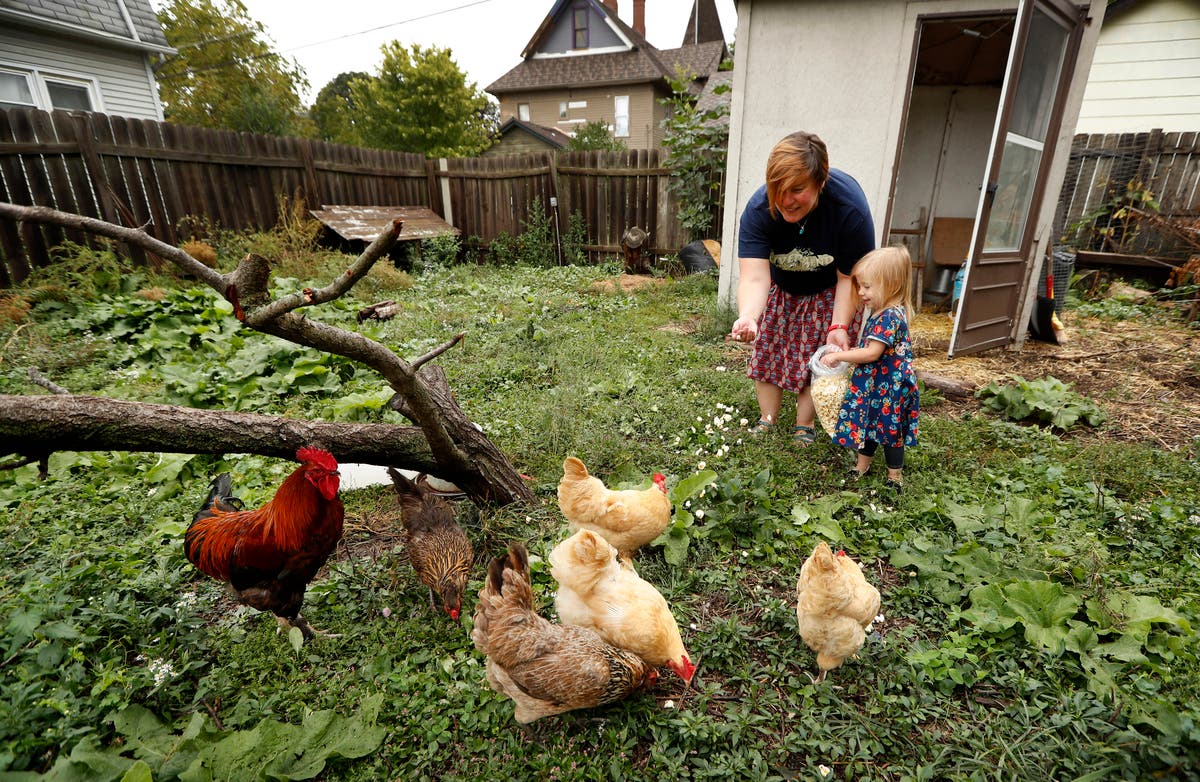
Top photo: Tanya Keith, of Des Moines, Iowa, and her daughter Iolana feed their chickens in the backyard of their home, in Des Moines, Iowa in a Sept. 26, 2017 photo | AP Photo | Charlie Neibergall
Get more local news delivered straight to your inbox. Sign up for free Patch newsletters and alerts.