Politics & Government
Navy SEAL With Ties to Great Lakes Station Receives Medal of Honor
Edward Byers was recognized at the White House Monday by President Obama for the rescue of an American doctor.


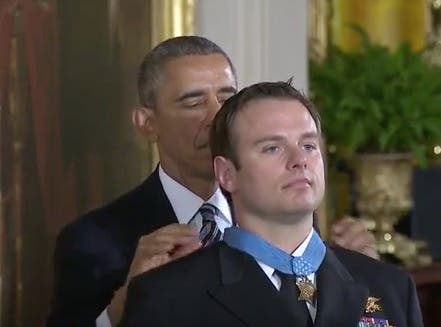
Edward Byers, the U.S. Navy SEAL presented with the Medal of Honor by President Barack Obama, worked at the Great Lakes Naval Center hospital in North Chicago before saving an American hostage in Afghanistan more than three years ago.
Byers, 36, received the country’s highest honor for valor Monday for the December 2012 rescue of Dr. Dilip Joseph, who was captured by gunmen. Joseph told NPR upon his return to the United States that “as soon as the SEALs recognized where my voice was coming from, one of them just came and laid on top of me.”
That was Byers, an Ohio native who graduated from Hospital Corpsman School at Great Lakes.
During the rescue of Joseph, Byers killed two guards and disabled a third who was protecting him. This came moments after another Navy SEAL, Petty Officer 1st Class Nicolas D. Checque, 28, had been shot and killed right there.
Byers became the sixth Navy SEAL to receive the Medal of Honor and 11th living service member to be awarded the honor for actions in Afghanistan.
Obama said the White House ceremony for Byers offered a rare public opportunity to acknowledge the work of the military’s special operations forces.
Obama described Byers’ actions thusly:
In this case, there was reason to believe that a Taliban commander was on his way to take custody of the American hostage and move him into Pakistan. So time was of the essence. From a remote forward operating base, Ed and his joint team geared up, boarded their helos, and launched. Once on the ground, they moved -- under the cover of darkness, on that cold December night -- through the mountains, down rocky trails, for hours. They found their target and moved in, quickly and quietly. Then, when they were less than a hundred feet from the building, a guard came out, and the bullets started flying.
Our SEALs rushed to the doorway, which was covered by a layer of blankets. Ed started ripping them down, exposing himself to enemy fire. A teammate, the lead assaulter, pushed in and was hit. Fully aware of the danger, Ed moved in next. An enemy guard aimed his rifle right at him. Ed fired. Someone moved across the floor — perhaps the hostage; perhaps another guard lunging for a weapon. The struggle was hand-to-hand. Ed straddled him, pinning him down. Ed adjusted his night vision goggles. Things came into focus, and he was on top of a guard.
Hearing English, Ed leapt across the room and threw himself on the hostage, using his own body to shield him from the bullets. Another enemy fighter appeared, and with his body, Ed kept shielding the hostage. With his bare hands, Ed pinned the fighter to the wall and held him until his teammates took action. It was over almost as soon as it began. In just minutes, by going after those guards, Ed saved the lives of several teammates — and that hostage.
Get more local news delivered straight to your inbox. Sign up for free Patch newsletters and alerts.