Crime & Safety
Explorers Learn Valuable Life Lessons
Lake Zurich Fire Department Post No. 343 offers hands-on experience as a firefighter to individuals ages 14-21 living in and around the village.




Lake Zurich Explorer Post No. 343, named in honor of the 343 firefighters who died during the Sept. 11, 2001, terrorist attacks, offers valuable life lessons for individuals ages 14-21 who participate in the program.
Until 2004, the post was a combined effort between the and named Post No. 2, but the two split off and that's when Post No. 343 was born.
The Explorers' training is carried out at Fire Station No. 1 at 321 S. Buesching Road — and out in the field fighting real fires — under the guidance of program coordinator Lt. Jeff Grant.
Find out what's happening in Lake Zurichfor free with the latest updates from Patch.
“The post is closely mirrored after a career in fire service — we have a rank structure with lieutenants and captains. Having the kids function in these positions starts to help them develop leadership characteristics and helps them learn to apply those qualities into the real world,” said Grant.
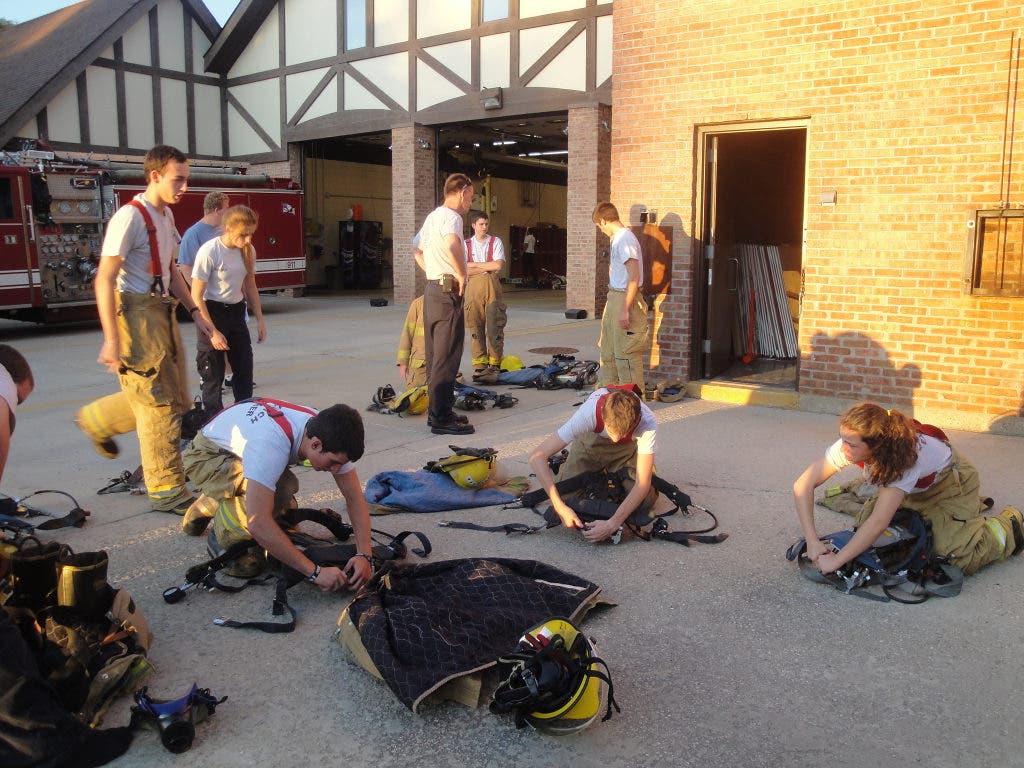
Explorers practice a number of tasks and skills repeatedly to ensure they have perfected them. Among them are "donning and doffing," which is putting on and taking off the self-contained breathing apparatus and other equipment.
Find out what's happening in Lake Zurichfor free with the latest updates from Patch.
In addition to ensuring that the breathing apparatus will work properly in hazardous situations, the Explorers also must practice putting on their boots, pants, coat, gloves, mask and air-pack in less than 60 seconds.
“It helps to prepare the kids. We give them the training they need to someday get into the fire service if that is their goal,” said Grant. “We offer them valuable guidance that puts them above others they could be competing with for a job with someday.”
Other practice drills include "tagging a hydrant," which teaches the participants how to correctly open a fire hydrant and connect it to the fire engine.
Many people may not know that the water used to extinguish fires is channeled through the engine rather than directly from the hydrant itself. This is done because the engine provides additional pressure that is vital to controlling fires.
“Like the old saying, ‘Firefighters train until we don’t get it wrong.’ That’s why we continually give training to our Explorers,” said Jim Fancher, Post No. 343 adviser.
The Explorers also have a chance to run drills through the Training Tower behind Fire Station No. 1. The tower can be filled with simulated smoke to give them experiences as real as possible to those experienced by firefighters.
In this training, three Explorers equipped with communication radios are required to carry a hose filled with water up to the second floor. Each Explorer has a specific job to perform.
One must continually watch the hose to make sure it doesn’t get tangled, which would deprive them of a water source to fight a fire. Another acts as the officer who monitors what a fire is doing, determines if there are victims who need saving, and is the first person in and last person out.
A third Explorer rescues people and extinguishes the fire.
“It opens up your eyes to the real risks that firefighters take every day,” said Diana Zvaig, an 18-year-old freshman at Harper College who has been an Explorer for the last year and is studying nursing.
After successfully working through a check-off program, participants can also be part of a ride-along to a real fire and assist in fighting the fire, Grant said.
“It gives you a lot of opportunities to see what real firefighters do, that they don’t just put fires out but also save peoples’ lives through first aid and CPR,” said Ryan Dunteman, a 15-year-old sophomore at who has been in the Explorers program for a year.
In other practice drills, Explorers also must carry emergency medical services bags and other heavy equipment, in addition to learning lifesaving techniques so they are able to understand the patient care part of a firefighter's job. They also train in vehicle extrication, forcible entry and a number of other fire-related activities.
“It not only gave me the outlet to pursue and successfully test to become a firefighter, it also gave me first-rate knowledge in knowing about the career itself,” said Jason Henrikson, Post No. 343 adviser.
Henrikson got involved with the Explorers program while attending Niles West High School, and started emergency medical technician training right after graduation. He then became a paramedic, and was hired in 2005 as a firefighter for the .
“Being an Explorer can give these young people perspective on what it is to be a firefighter — and an edge because they’ve had to prove themselves,” said Grant, “that, in addition to building confidence and self-esteem, even if they don’t go into a public safety career.”
John Miller, a Harper College freshman who is majoring in fire science, attended his first Explorers meeting Monday night.
“My impression is very positive; my goal is to be a firefighter someday, and I feel like I’m going to get the best training possible here,” said Miller.
Whether participants are looking toward a career in public safety or not, the experience is priceless.
“It doesn’t matter what the kids end up doing in life, the Explorers program gives each an idea of what their limits are,” said Fancher. “I’ve seen kids develop confidence they didn’t have walking in.”
The Explorers Post 343 meets on the first and third Mondays of each month. The program is funded by the and . There is an annual fee of $20 for each participant.
For information on how to get involved, contact Lt. Jeff Grant at 1-847-540-5080 or by email at Jeffery.grant@volz.org.
Get more local news delivered straight to your inbox. Sign up for free Patch newsletters and alerts.