Schools
Holocaust Survivor Tells His Story to Lake Zurich High School Students
The entire freshman class at Lake Zurich High School read the book "Night" by Elie Wiesel.
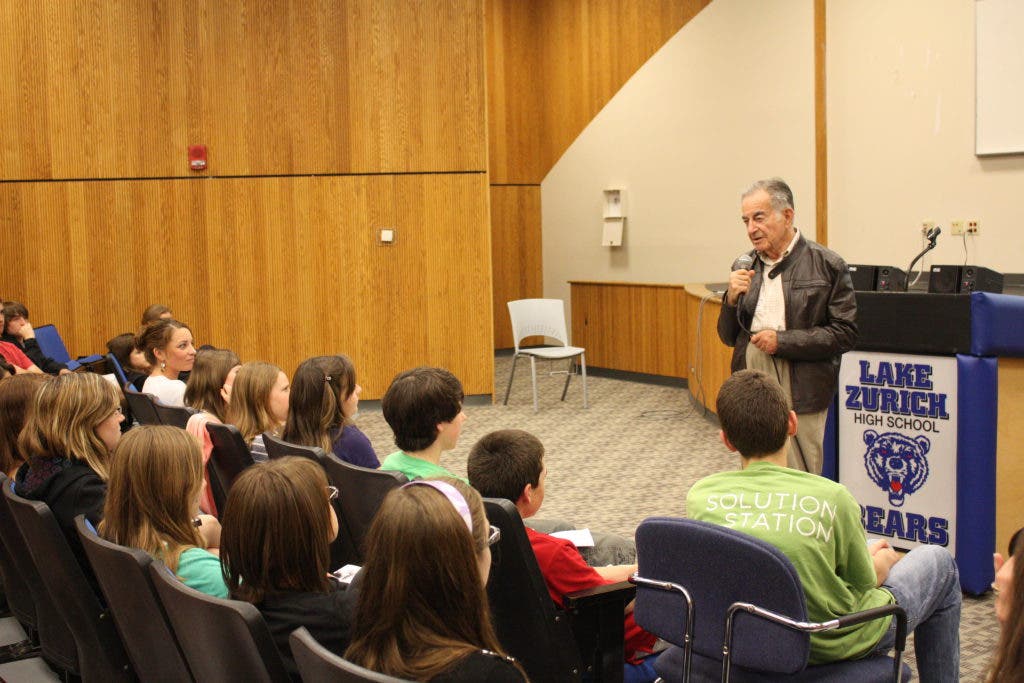


Holocaust survivor Walter Reed recounted his experience living as a Jew during World War II and being one of the children of Chateau de La Hille, a group of children rescued after World War II’s Kristallnacht, to more than 300 Lake Zurich High School freshman students.
According to Meghan Netzel, LZHS English teacher, “All 500 freshman read the book Night by Elie Wiesel and this helped them better understand the book and that period in time.”
Judith Fai-Podlipnik, speaker and presenter from the Holocaust Foundation, also spoke, giving the students a historical perspective of the Holocaust.
Find out what's happening in Lake Zurichfor free with the latest updates from Patch.
She explained how Hitler came into power during the Great Depression, promising the people of Germany - who had lived through the destruction of World War I - that he would rebuild and regain power.
“The people voted him in, as chancellor” said Fai-Podlipnik. “They were filled with desperation.”
Find out what's happening in Lake Zurichfor free with the latest updates from Patch.
Fai-Podlipnik described how, slowly, Hitler started to take away the rights of the Jews by enacting laws that prohibited them from holding certain professions, such as doctors, not allowing them to sit on benches, and eventually making them change their names if they had a German one.
Reed talked about how friends of his whom he played soccer with and grew up with in a tiny village outside of Bavaria, started to throw rocks at him, call him names, and ganged up on him.
“This was happening everywhere in Germany,” said Reed. “They called the Jews subhuman; imagine being 14 years old and being called subhuman by your teachers and hearing it over the radio.”
He showed a picture of the soccer team from the village, dressed in uniforms, posing together and smiling, before the Nazi regime.
According to Reed and Fai-Podlipnik, the real catalyst that triggered the genocide of over six million Jews was Kristallnacht, translated as “The Night of the Broken Glass.”
“Herschel Grynszpan, a Jew living in Paris, France, was so upset by the way his parents were being treated in Germany, that he killed German diplomat Ernst vom Rath,” said Fai Podlipnik. “That created an uproar.”
Synagogues were burnt to the ground, Jewish-owned stores were looted, and more than 30,000 men were taken to concentration camps.
“I remember that morning brown-shirted Nazi storm troopers pulled up to our house in a truck and yelled ‘Get the hell out’ and put my Dad and I in the truck and put us in jail,” said Reed.
He was let go three days later, but his father was sent to Dachau, a concentration camp, for five weeks and he came back “looking 20 years older and emaciated," said Reed. “He wouldn’t tell us what happened out of fear.”
Not long afterwards, Reed’s parents sent him to Brussels, Belgium as part of a children’s refugee effort led by wealthy Jewish women in Belgium.
“I was one of the lucky ones and my parents had the extreme courage to send me away and save my life,” he said.
That was the last time he saw his parents and two brothers.
It was only 90 days later that Hitler started taking over Poland, Belgium, Holland, France and Luxemburg, and Reed and 93 other refugee children were transported to France and eventually lived in a house they called Chateau de La Hille.
During this time, millions of Jews were being forced to live in ghettos in “horrible conditions,” said Fai-Podlipnik. “There were seven people to a room the size of one bedroom, and there was no running water, no flushing toilets and no garbage pick-up for years.”
The average calorie intake for a person in a ghetto was 250 and they were also expected to work.
It wasn’t until the Wannsee Conference, in which senior officials of the Nazi regime decided to have a “Final Solution,” that they decided to use the Jews to work and then kill them afterwards in concentration and death camps.
Fai-Podlipnik described in great detail and showed pictures of the gas chambers, bodies piled on top of each other, and the barbed wire- and electric fence-lined camps.
Reed spent his remaining time in France as a refugee at Chateau de La Hille with the other refugee children. He got a visa to the United States in 1941 and never looked back.
He was drafted by the U.S. Army in 1943 and was sent back to Europe to interrogate German prisoners and help with denazification.
Now 87 years old, Reed told the students, “I forgave what happened to me right when I got to the United States. I decided I wasn’t going to be a victim of the Nazis one more day.”
After her talk, Fai-Podlipnik urged the students to really think about the injustice that occurred to innocent people. “Stand up for what you believe in and make sure no one is treated this way again.”
Both Reed and Fai-Podlipnik answered student’s questions after their talks and then joined the students in the cafeteria for a snack.
“It’s so sad,” said Emma Reese, freshman. “How did the people that were doing all the killing not go mentally insane?”
“Listening to them helped illustrate the horrors of the Holocaust,” said Tyler McWhorter, freshman.
“This was so important to do because this is the last generation that is going to have the benefit of listening to a Holocaust survivor’s story,” said Jennifer Barz, English teacher and event facilitator.
Students were charged a $5 fee for the field trip in which all the money was donated to the Holocaust Educational Foundation.