Politics & Government
Illinois Public on Map Quest
Lawmakers pull out the drawing board for redistricting 2011. Now, with a few words from their voters.
What do a village trustee, civil rights leader, farmer and women rights leader have in common?
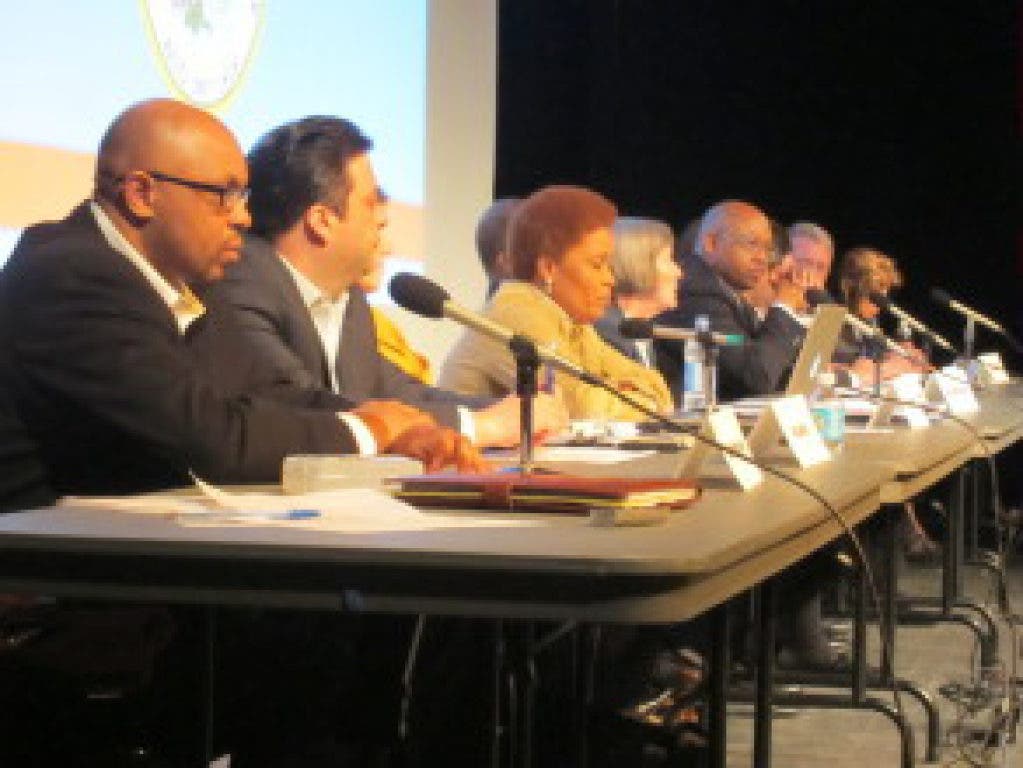
Each of them aired concerns with 12 state representatives Tuesday night during a public hearing for redistricting at South Suburban College, South Holland.
“It was pretty informative,” said State Rep. Kelly Burke (D-Evergreen Park). “We'll see how the lines shape up. Some people want one district, others want multiple.”
Find out what's happening in Mokenafor free with the latest updates from Patch.
The hearings are mandatory under the 2011 Illinois Voting Rights Act and Public Participation and Transparency Act. Supporters consider both pieces of legislation landmarks in Illinois voting rights history, requiring lawmakers throughout the state to hold at least four public hearings before maps are redrawn. A public hearing at the capitol is the last one scheduled for April.
“The main thrust,” State Rep. Will Davis (D-Harvey) said, “is to provide people information with what goes on in Springfield. We [often] don't get to speak to them about these things.”
Find out what's happening in Mokenafor free with the latest updates from Patch.
Across Illinois, boundaries for 118 state legislative districts, 69 senate districts and 19 congressional districts have to be redrawn in response to 2011 census results.
Redistricting, though necessary, is notorious for manipulating voters, politicians and minority groups.
Legislators have often redrawn maps to remove challengers or incumbents from opposing parties into another district. It's called gerrymandering, and along with discriminatory practices of cracking, packing and stacking, it's made the age-old process suspect.
“If you had a magic wand,” said State Rep. Barbara Flynn Currie (D-South Shore), “you could draw the perfect map for everyone. But even if you did that, you would not likely meet state and constitutional laws.”
Open-mic night
Asking state representatives to consider less representation, Lansing Village Board Trustee Mikal Stole stepped up to the mic and echoed concerns of other local government officials that night.
Most expressed a desire for realignment as a "community of interest," where district lines do not carve up neighborhoods, towns or separate groups of people with similar needs or interests to favor the continued election of career politicians.
Stole, like others at the hearing, wants his village to make it's own decisions. Lansing finds it difficult, though, when representatives from Chicago have a stake in the village.
“Two of our three districts extend into the city of Chicago,” Stole said. “One of our major concerns is that there is competing interest between the suburbs and the city.”
Stole pointed to the proposed Southeast Service Metra Line and the CTA Red Line.
“Lansing is extremely supportive of the proposed Southeast Service line,” he said. “Our support...may at some point come in conflict with the Red Line extension."
Like Stole, Barbra Pasquinelli, president of the League of Women Voters in Palos Heights, wants her community to have less representatation, people they can work closer with for the next 10 years.
"We prefer to be part of a community of interest," Pasquinelli said, "with our neighbor Palos Park. We don't need all of those legislators."
She also said the maps in her district need to be clearer, because they "make absolutely no sense," zigzagging through side streets and back alleys.
“I hope that when you draw a new map,” she continued, “we'll all be able to take a look at it, and [the public] will be able to respond.”
And as for Lee Deutch, a farmer from Will County, he'd like his district to be a community of interest for the next ten years.
Come election time, communities with similar interests are represented together. Their political agendas are based on social and economic ties, geography, culture, transportation and jobs.
In Deutch's case, a community of farmers may vote for a representative who supports agricultural legislation or green technology.
“I've been a farmer my whole life," he said. "We'd like to have a district where we can vote with suburban people and farming people that would be contiguous. It would be nice."
Concerns for black voters
After discussing issues that have plagued minorities in redistricting since full-voting rights were granted, the African American Bar Association of Cook County promised their own maps for legislators.
“We're going to be in the Atlantic Building,” said Lawrence Hill, president of the association, “drawing maps. We can have them in days, hours.”
These maps, Hill claimed, will increase transparency and help adequately represent the needs of African American voters.
He also argued that legislators must establish communities of interest throughout districts heavily populated by black voters, using public opinion and relevant data, not generalizations.
Legislation under the 2011 act has key ingredients -- namely, -- for the betterment of community-based districts, but not without active support.
Lack of transparency can lead legislators to disenfranchise black voters by packing: when legislators over-concentrate a large minority population in few districts it constricts minorities ability to influence the outcome of an election in the greater number of districts.
“We understand redistricting is political,” he said. “[African Americans] simply do not wish to be its pawns.”
David Lowry, president of the South Suburban NAACP, said representatives are not doing their jobs in areas like Ford City, Markham and Harvey.
“The community out here is dying,” Lowry lamented. “I ask these politicians, you are leaders, what are you doing?”
If redistricting does not fairly represent the needs of black voters come October 5, when the maps are redrawn, Lowry said he's prepared to take legislators to court.
“If politicians are giving the people what they need,” he continued, “I'd like to help them get unelected.”