Community Corner
The Past is Alive at Riverside Cemetery
Before embarking on the village's annual cemetery walk on Oct. 5, read this for some history of Riverside Cemetery, and the people buried there.


In 1841, Daniel Gray, the founder of Montgomery, lost his oldest son Dewitt.
It was a tragedy compounded by the fact that DeWitt was engaged to be married to Angeline Van Alstine. He died two months before they were to be married. After a suitable period of mourning, Angeline eventually married DeWitt's cousin Rufus.
After DeWitt's death, Daniel Gray deeded an acre of his land to the village of Montgomery for use as a cemetery. A tall monument marks the Gray family plot at the southern end of the cemetery.
Find out what's happening in Montgomeryfor free with the latest updates from Patch.
A record at the Kane County Recorder’s office shows a large donation of land in 1852 by the Chicago, Burlington and Quincy Railroad. It is unclear whether the Cemetery Association, which was founded in 1869, actually purchased additional land from the heirs of Rufus Gray, as reported elsewhere. The cemetery today covers 32 acres.
An original civil war cannon is displayed among the graves of civil war soldiers. There are approximately 40 known graves of civil war soldiers buried in the cemetery.
Find out what's happening in Montgomeryfor free with the latest updates from Patch.
The veteran’s area—with a towering monument surrounded by flags, and boasting one of the few eternal flames in the area—was the idea of the late Jake Mall, head of the VFW. He began the fundraising efforts, and the list of donors is impressive.
On July 4, 1990 it was finished and dedicated. The war veterans wasted no time in making a special place to honor their fallen comrades. It is one more reason to be proud of our Montgomery veterans, past and present.
Four times a year the cemetery roads are lined with flags. It is a very moving sight. The monument base is inscribed, “In Honor of the Men and Women who have served in the Armed Forces of the United States of America.”
On June 14, nationally known as Flag Day, the roads inside the cemetery are always lined with the flags. The very founder of this day is buried in Riverside Cemetery. He is Dr. Bernard J. Cigrand, an Aurora dentist. He died in 1932, before he could see his dream of a national Flag Day officially designated by legislation.
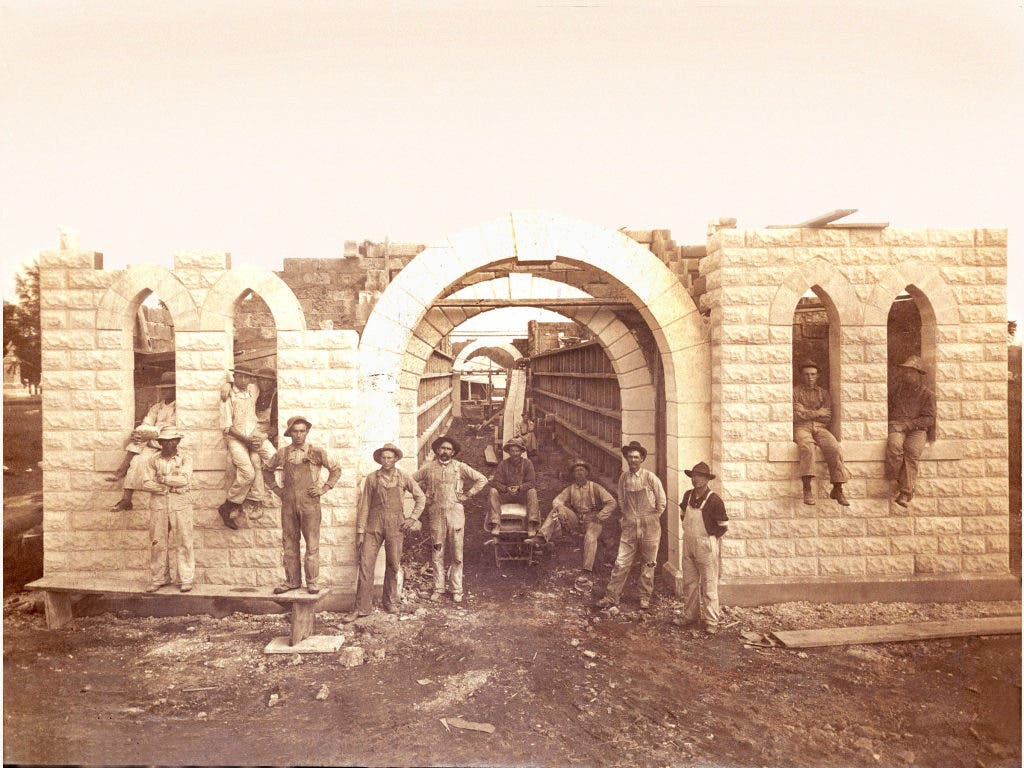
“Riverside Mausoleum a Marble Palace for the Dead,” reads the newspaper headline from the June 7, 1911 Aurora Daily Beacon, announcing the dedication of the new mausoleum. It was said to be the fourth mausoleum to be built in the country.
At the dedication ceremony, the speaker praised the new mausoleum as being much more sanitary than underground burial, stating that it was “proven beyond a doubt that most dreaded diseases are transmitted from buried bodies.” Of course these claims were false, but they did manage to sell many lots with such fears.
At that time there was a major nationwide movement to encourage people to purchase burial vaults to bury loved ones. Promoters pushed the above ground burial as aesthetically pleasing, and much easier on the grieving families than having shovels full of dirt thrown on loved one’s remains. They had no trouble filling the vaults when people heard these words.
The mausoleum was famous for miles around. It was a rite of passage for an older sibling to take a younger one and sneak inside the cold marble structure to read the names on the tombs. It was a dreaded experience, but one that every youngster bragged to friends about. Inside, even on a warm day, it seemed cold and bought goose bumps to the flesh.
Here and there a vault would have a small oval glass-encased photo of the person interred within, and it was truly eerie to look at the photo, read the names, and try to imagine the person lying in the vault behind it. Should this initiation happen around Halloween time, so much the better! This was the year-round spook house, the real deal, and an event never to be forgotten.
The mausoleum fell into disrepair after 40 or 50 years, and had to be condemned, much to the disappointment of the thrill seekers. It was torn down in 1976, and the graves were relocated elsewhere.
Long ago, it was not unusual to see families picnicking alongside the graves of their loved ones. Early immigrants brought the custom to this country from Europe, but it has since disappeared.
In the past, before organized sports and video games, boys found the cemeteries to be great places to roam, and hunt for gophers. Practicing high jumps over the gravestones was great fun as long as they didn’t get caught. The cemetery was always a fascinating and forbidden place to play.
You will soon have the opportunity to attend the third annual Cemetery Walk. On Oct. 5 at 7 p.m., the Historical Preservation Commission will present four sets of actors, each standing at the graveside of a person from Montgomery’s past.
As the audience surrounds the grave, the light from the flickering torches that line the paths will create a magic atmosphere. There is a feeling of being transported back in time as the actors, wearing period costumes, tell their unique stories.
The surrounding darkness and the faint outlines of the gravestones, combined with the floating shadows, as the many small lights in the audience move from one performance to another, together produce an unforgettable experience.
On the bill this year, a couple of talented actors from previous years will be returning in the roles of Vine Watkins and his wife Catherine (Gray). John Aman and Jeanne Lee will portray the interesting couple. They have received wonderful reviews for their past performances. Every year, a bit of history is presented in a unique fashion. Cemeteries can be fascinating places.