Community Corner
Graveside Ceremony Honors Emmett Till's Legacy 60 Years After His Murder
Family members and dignitaries gather at Burr Oak Cemetery to honor murdered teen and his mother on 60th anniversary of his death.


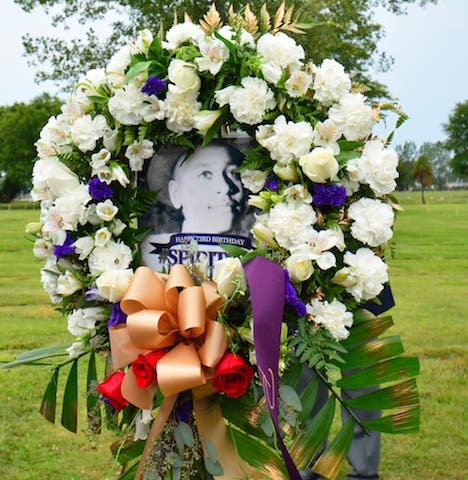


Photos by Claudia Parker: Wreath and gravesite; Wheeler Parker Jr., Emmett Till’s cousin; Congressman Bobby Rush; members of the Mobley and Till family, and the mothers of Tayvon Martin, Amdou Diallo, Jackie Johnson and Sandra Bland.
Against the background of hissing summer cicadas, family members, politicians and celebrities gathered at Burr Oak Cemetery in Alsip, to remember a 14-year-old Woodlawn boy with a suitcase full of jokes whose death 60 years ago ignited the American Civil Rights movement.
On August 28, 1955, Chicagoan Emmett Till, visiting his great uncle in Money, MS, was roused out of bed in the middle of the night and kidnapped by two white men, Roy Bryant and his half-brother J.W. Milam, because Till had wolf-whistled at Bryant’s wife.
Find out what's happening in Oak Lawnfor free with the latest updates from Patch.
Four days before, Till and his cousins had stopped at Bryant’s Meat and Grocery that sold “snuff-and-fatback” to the local black sharecroppers. There, after buying two cents worth of bubble gum, Till whistled at Carolyn Bryant, sealing his fate.
Milam and Bryant were acquitted by an all-white jury a month later and never did prison time for Till’s murder or kidnapping. They would later confess to a Look magazine reporter their own version of the 14-year-old Chicago boy’s offenses, that Till had grabbed Carolyn’s hand and waist, telling her he had been with white girls before.
Find out what's happening in Oak Lawnfor free with the latest updates from Patch.
After abducting Till from his bed, he was tortured, beaten and shot on the banks of the Tallahatchie River. The white men tied a 75-pound gin mill fan around the dead boy’s neck with barbed wire and rolled him into 20 feet of water. Three days later, some boys fishing saw Till’s feet sticking out of the water.
Milam told Look magazine: “We were never able to scare him. They had just filled him so full of that poison that he was hopeless.”
Gatherers on Friday also came to remember Till’s mother, Mamie Till Mobley, whom Congressman Bobby Rush called “the mother of the civil rights movement.” The graveside service is one of several events planned this weekend commemorating the 60th anniversary of Till’s death.
Mamie insisted that the casket containing her only son’s remains be left open because she wanted “the world to see what they did to my boy.” Photos of Emmett Till’s engorged face beaten beyond recognition appeared in Jet magazine, and introduced white Americans of the 1950s to the horror and inhumanity of the country’s racial conflict.
Following Friday’s graveside ceremony at Burr Oak, lifelong Summit resident Wheeler Parker Jr., who was 16 when he boarded a train with his cousin Emmett to visit his grandfather and Till’s great uncle, Mose Wright, in the Mississippi Delta, says he doesn’t hate the men who killed his cousin.
“They came to my room first. I thought they were going to kill us,” Parker says of that night 60 years ago. “You get past that. I tell kids I can’t afford the luxury of hate. Hate destroys the hater … I refuse to hate and that’s the way we have to go through life.”
The 76-year-old Parker, a pastor at the Argo Temple Church of God, said the only way for a black person to have survived in the south during the 1950s was to “abide by its mores and stay out of harm’s way.” Nobody in the family felt that Emmett was capable of doing that. He was too much of a jokester, fun loving and free spirited.
It was Wheeler who telephoned his mother in Chicago the next morning, who informed Mamie at 6427 S. St. Lawrence, that Emmett was missing after being abducted.
“My grandfather [Till’s great uncle] came to visit and was going back, so I was going to go back with him,” Parker said. “They didn’t want Emmett to go. He shouldn’t have ever gone because what did happen is what they thought could happen. They knew he didn’t fit in with the south. It’s mind boggling to think that all of these things went on and nobody of any importance said anything.”
Is he surprised at the relevance of his cousin’s death 60 years later, especially in light of the deaths of Kendrick Johnson, Kadiatou Diallo and Sandra Bland, who’ve become national symbols of racial injustice and police brutality?
“It’s a hard sell to come from slavery and to be sold and become an equal,” Parker said. “It’s innately in us. It’s American as apple pie, you got to visit this racism all the time. We’ve made a lot of progress, we just got a lot of work to do. Our family still stands behind the fight for justice.”
Get more local news delivered straight to your inbox. Sign up for free Patch newsletters and alerts.