Arts & Entertainment
Author Touts His Obama Book at Orland Park Library
Bookstore owner-turned-community-organizer read from his Obama campaign book, Mr. and Mrs. Grassroots, and answered some questions for Patch.
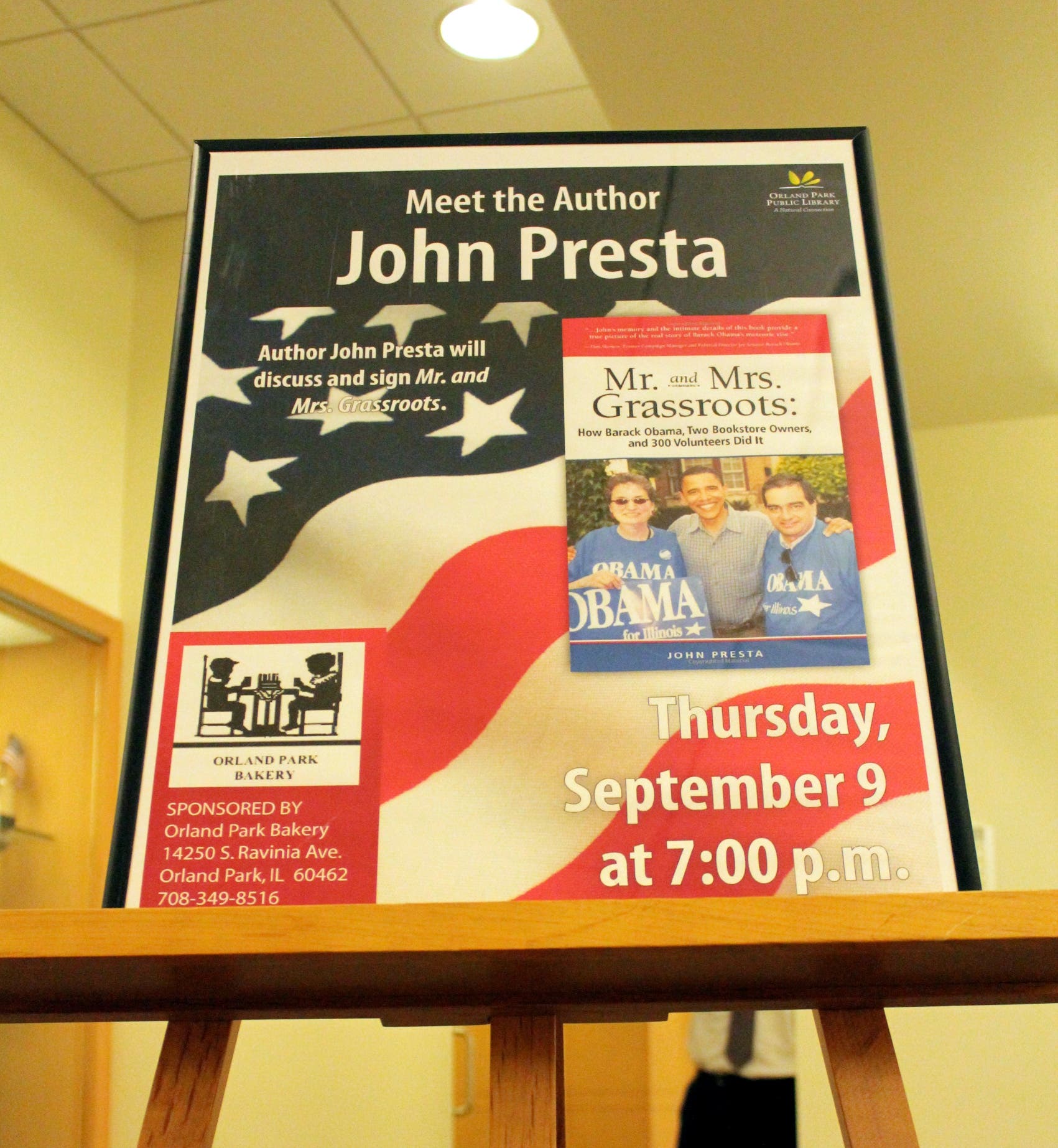

John and Michelle Presta were community activists in Chicago long before Barack Obama's congressional campaign sought their help.
But after losing a Democratic primary bid in 2000 to unseat U.S. Rep. Bobby Rush, John, Michelle and 300-some volunteers slowly and steadily mounted a grassroots movement, both on the sidewalks of Chicago and on the Internet, that propelled "the skinny guy with a funny name" to the U.S. Senate.
Early this year, John Presta released a book chronicling how the Prestas, independent Beverly bookstore owners, became political foot soldiers. He read excepts from and signed copies of Mr. and Mrs. Grassroots: How Barack Obama, Two Bookstore Owners, and 300 Volunteers Did It last week at the Orland Park Public Library.
Find out what's happening in Orland Parkfor free with the latest updates from Patch.
Orland Park Patch recently asked Presta about the nuances of grassroots organizing, whether he ever had any doubts about Obama and if he has changed since leaving Chicago.
You set out to write about books, bookselling and political organizing with Obama as the backdrop. On which shelf in the bookstore then does Mr. and Mrs. Grassroots belong?
Find out what's happening in Orland Parkfor free with the latest updates from Patch.
It would be on American history, I think. And one of the reasons is The Bridge, which was written by David Remnick (editor of The New Yorker) recently. He used my book for research and he interviewed me for it. There's going to be some books coming out that also use my book. When David Remnick read my book, he said, "You S.O.B. I wrote my whole book and I have to go back and change it all. I see that grassroots movements were important in the Obama campaign and I'm giving credit to (campaign strategist David) Axelrod and all these other people."
Is this just another Obama book and are you offended by the title?
No, not at all. We were one of the first ones to be out and we're very proud of it, but there's so many of them out there. It's a compliment.
Your book has an eclectic style, combining narrative with letters, newspaper clips and photos. Why did you choose to write it this way?
I wanted it to be easy to read. I wanted it to be a combination of my own perspective and a little bit of journalism, a little bit of history. It was just sort of a combination of all of that.
Explain you and your wife's transformation from booksellers to community activists?
In 1992, we had our window broken at our store. Someone broke it in the middle of the night, and that happened not once but like three times. And I think the third time we said, "You know what? We're going to have to do something about this." So we got involved in our community policing program. We got involved with our local community groups instead of just being a bookstore that sits there. We weren't going to take it anymore.
So we got involved and that's actually how the Obama campaign found us. They heard of our activism. We didn't just stay in our neighborhood; we went to other neighborhoods. We were involved with marches against gangs and drugs, that kind of thing. Since '91 we've owned a bookstore. I didn't consider myself much of a literary person before that. It just kind of came and evolved. It just kind of exploded.
How did you meet Obama and what did you see in him at the time?
The first time I met him was March 7, 2000, and I already heard quite a bit about him and I liked his book. So I had a little bit of an idea, but it was pretty stunning. He was pretty charismatic and charming and he looked you right in the eye.
Did you really stick your neck out for "the skinny guy with a funny name?"
Yes, because we were in the 19th ward. Especially during the senate campaign, but not so much for the congressional, when he lost. But the one that he won—because he was running against our homeboy, Dan Hynes—you were sort of expected to support the local candidate and we didn't. And (Hynes) was the overwhelming favorite going into it.
In January 2003, when Obama announced his run for the senate his rating was in the single digits, and Dan Hynes already had high statewide recognition because he had won statewide office at that point, so he was a known candidate. He had the organization; he had the money; he had union support. And here we were with this guy that everyone kept telling us was going nowhere, and we just stayed with him.
Did you ever doubt him?
No, I didn't. Not once.
What is your current relationship and how has his vision and character changed since leaving Chicago?
I see the same man. When I watch him on television I see the same guy that I stood there talking to about the campaign and the issues and all that stuff. I see the same man. We haven't seen him since he's been elected, though.
I talked to Jim Cauley, who was Obama's (senate) campaign manager, a couple weeks ago and I asked him if he's seen Obama since the campaign and he hasn't seen him either. So I don't feel left out. I'm sure at some point he will (visit). There are a few people from (the neighborhood), like Mike Jordan, who I talk about in the book. He has been to the White House about six or seven times. (Obama) has asked about the book, I heard. I just want him to have a public comment on it. That would be nice.
Explain the difference between "grassroots" and "netroots" organizers?
Grassroots is (political campaigning) on the ground, and netroots is (campaigning) on the Internet—people that are organized, but organized on the Internet, like the Daily Post or all the different blogs. And it's not just progressive or liberal. It is conservative and tea party. It's everything.
If there's any difference, it's the Internet versus the ground: different formats, but they're both tools. Grassroots was a tool and so was netroots. I'm not sure anyone knew that word back in the 2004 campaign. It really didn't come out until people started hearing more about Howard Dean and people like that. But we did it effectively.
That's how I'm approaching selling my book—through grassroots efforts and netroots efforts—and it seems to be working.
You credit yourself and some-300 people with putting Obama into his Senate seat in 2004. Do you deserve credit consequently for his successful presidential campaign?
No. I'm going to say no. But I think (we deserve credit for) the presidential (campaign) only in the sense that the Senate seat led to the presidential seat, and the model we set up back then for the Senate had a lot to do with how they set up the presidential campaign. It was almost from—and a lot of people don't know this—the minute he became a United States senator he started planning his presidential campaign. He was looking forward.
At least he thought 2008 might be the year, after Kerry lost. He started sending people out to Iowa and to check it out and see what the landscape was there. He started reading those notes. In that sense, we weren't the hands-on people (for that campaign), but they used the same Illinois people volunteers—about 10,000, I think, from Chicago all the way downstate—to work in the Iowa caucuses, which is what propelled him to the next stage. New Hampshire, he lost.
It wasn't an easy race, but Iowa is where it started. Michelle Obama said during the campaign that if he lost Iowa, "We're out of here. It's over." And she really meant that. She is not someone who just says things. They knew that if they didn't take Iowa it was over.
Had Obama lost in 2004, what would be your involvement with the man today?
I'd be hanging around the bookstore and seeing him around the neighborhood every once in a while. He was on several different committees back then, like the Annenberg Foundation, and I was on some boards. I didn't even know it was him, but prior to when we met him I did actually have some indirect dealings that we didn't know about.
We probably would have seen him in the neighborhood, seen him at 57th Street Books in Hyde Park. I'm sure he would have stayed there. Anytime he came in the neighborhood he probably would have looked us up and other people.
Do your politics differ on any particular issues?
I would like to see us out of Afghanistan. I would have liked to seen us out of Iraq faster. I think we're definitely going in the right direction. There's about 80 percent we agree on.
You're hoping to make a series of Mr. and Mrs. Grassroots books?
I'm going back and doing more books about the bookstore and the book business, interviewing celebrities on what book changed their life and why, and interviews with bookstore owners.
Also working on a seven rules of grassroots organizers—sort of a rules for radicals kind of book. That'll be a lot smaller. That is based on The Art of War (by Sun Tzu). I actually knew a man that Saul Alinsky worked with (Joe Meegan). We spent hours and hours just talking about community organizing and activism and what you're supposed to do and all that. That'll be a book down the line, too, a profile of different obscure Chicagoans who impacted the world.
I'm also going to put out a children's version of Mr. and Mrs. Grassroots: one for 9 to 12 year olds and one for toddlers.
When can we expect the children's book?
Probably by next summer. The picture book (for toddlers) is going to be a little more challenging. Believe it or not, it only has to be 24 pages but it's kind of brutal. I have a lot of respect for children's authors and illustrators. I'm not an illustrator so I have nothing to do with that.
No small plans?
No small plans. I'm not just going to put out a book to develop a reputation or a name. One can put out any kind of garbage, and I don't want to do that. I want each one to be a quality work. In fact, I want to update this book I have at some point.