Politics & Government
Barber Shop History: Orland Plaza Business Unsure of Its Future
Former and current owners of the Orland Plaza Barber Shop, as well as patrons, reflect on a 50-year history.


Pete Santucci walks to the back of his quaint barber shop and stops shy of the bathroom. In one hand he carries a thick cut of bread mounted with salami. With the other he points to the floor.
“She parked right here,” he says through an Italian accent. His lips, pursed in thought, are quiet for a moment. “Destroyed everything. Like a missile.”
In 2000, a sedan came barreling through the Orland Plaza parking lot and through the front of the local barber shop, Santucci says. Glass, brick, scissors, chairs went flying. A water pipe had been torn and soaked the floor. The was closed that Monday and would remain so for another five weeks.
Find out what's happening in Orland Parkfor free with the latest updates from Patch.
Not by mistake, this barber shop will be destroyed again. Next time the demolition will come by bulldozer and wrecking ball. It will be no less painful for the owner, former owner and denizens of this 50-year-old shop, whose first clients strode in on horseback.
Hanging on one of the barber shop walls today is a painting of boxer Luis Ángel Firpo knocking Jack Dempsey out of the ring. The referee, his finger downcast, begins the count. The crowd looks excited, agitated. Firpo would lose the fight, but not before he caught Dempsey hard on the chin, causing him to cut his head during the fall.
Find out what's happening in Orland Parkfor free with the latest updates from Patch.
In 2008, the village contended it needed the entire plaza for the expansion of roads that would help create a modern, walkable city center around the . A judge agreed, though a fair price for the property has yet to be determined.
“That's Pete,” a customer hollers, motioning towards Firpo’s stately image with a darker complexion than Dempsey. Others hold their tongue as they wait for Santucci, 78, to give his blessing.
“That's right,” he responds, and raises his clippers into the air.
War and Blindness
There are worse fates, and Santucci knows this well. He grew up during Benito Mussolini’s fascist reign in Abruzzo, Italy, a small town between Naples and Rome. He says he remembers “every thing, every step” of World War II, but wouldn't elaborate, except to note that his father had been forced to serve in the Italian army. After the war ended, his father fled to South America. The post-war Italian government refused to let him back in for years.
Santucci would also spend time in South America before coming to Chicago, where he spent years working in train yards and steel mills, and then entered barber school. In 1982, he got word of a barber shop in Orland Park that needed a new partner and met George Motzer, a blunt and mischievous man brimming with opinions and friends.
“I was a legally blind barber and nobody knew it, except me,” he says.
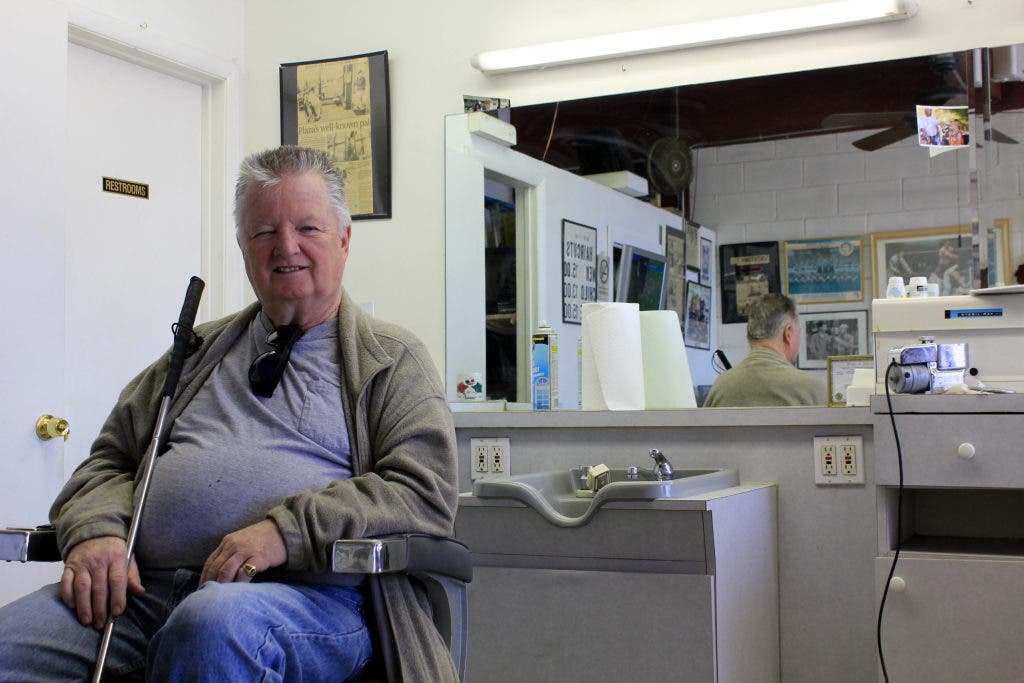
Motzer, 74, was diagnosed in 1972 with Retinitis Pigmentosa, a genetic degenerative disease of the eyes, though he would cut hair for another 17 years. Today he can tell whether it’s day or night, make his way around shapes and shadows, and board the pace bus that takes him to and from his home to the Orland Plaza.
He hails from Markham and, like Santucci, worked a series of blue collar jobs before entering barber school. He then took a position as an apprentice at a shop along 143rd Street in Orland Park, just over the west side of the railroad tracks. That shop moved into the plaza in 1961 and within two years Motzer was running it. He sold his share of the assets to Santucci in the late 80s, though he manages to visit the plaza and his old friends most days of the week.
On the edge of a barber chair, brooding over his cane, Motzer opens the floor to questions and like a reverse arcade begins spitting his two cents.
“It's a dirty, rotten crime that he's been allowed to get away with what he's done,” Motzer says of Mayor Dan McLaughlin and his ideas for transforming the plaza.
How about the Village Board of Trustees? “They think they're God.”
How about the term "blighted" used to describe the plaza? “That’s disgusting.”
And John, Paul, George and Ringo? “The long hair killed us…We used to have a lot of young people, the high school kids. And when the Beatles came over, they were getting hair cuts every six weeks. Now they get a hair cut every six months.”
The faces around the room brighten. But just as quickly they darken.
“Seeing this place (go) will be the worst thing of my lifetime,” Motzer says, his eyes gazing into oblivion. The village is “going to make it more difficult for me to get groceries. They're taking away Lang Lee's restaurant, the bakery—all the things I thought so much about.”
When asked what he’ll do on the day the plaza is demolished, Motzer hesitates, drops his head. After an hour of name-calling and expletives, finally he musters the word few expected.
“Cry,” he says, softly. The sudden gulf in sound is filled only by a hair dryer.
Closing Remarks
Four customers have come and gone, and much of the floor is littered with hair. A fifth customer sits in a barber chair awaiting his cutting cape. No one has reached for a broom. They’re too busy reminiscing and taking playful jabs at one another, even as they lament.
Santucci says he wonders why the village couldn’t have worked the Main Street Triangle design around the existing businesses. “But there's nothing you can do. I feel sad because after so many years...” He doesn't complete the thought, and goes on snipping quietly at hair.
Jim LaSalvia, a customer who comes to the plaza for the “old-time feel,” chimes in.
“What bothers me is this is kind of historical for Orland Park, and yet that's how they treat history,” he says. “This is one of the first shopping centers in Orland Park. It just blows my mind how there's no consideration...these people have suffered.”
In addition to state and federal relocation assistance, the village is offering to waive certain permit and inspection fees if the . Unimpressed with the program, LaSalvia calls it a “no-brainer.” Santucci says he would like to stay in Orland Park but can’t begin looking for another store front until he leaves this one.
Santucci and Motzer volley jibes back and forth, both sharing relentless senses of humor. At times throughout the years, these two friends worked not just with one another, but for one another.
“He was a pain in the neck,” Santucci recalls. “Pain. In. The. Neck.”
“Yeah,” Motzer retorts, “a pain in my neck—wasn’t it, Pete?”
They laugh together and turn their attention to a newspaper photograph of Motzer, hanging next to Rocky Marcianno and other Italian-American athletes, movie stars and prize fighters. Suddenly an auction begins. Motzer offers a buck for his own image. Santucci weighs it over, his eyes widening, his lips concentrating.
“Better than nothing,” he says, smiling contently.