Neighbor News
Decoding CO2's Influence on Global Warming
The Role of Carbon Dioxide in Earth's Climatic Shift
Science before Politics
Global warming intertwines science and politics. Scientifically, we endeavor to understand the empirical evidence surrounding changes in the physical world. Politically, we deliberate the implications of this knowledge and the necessary governmental responses. This analysis explains the science of global warming, leaving the debate on governmental response for another occasion.
Anthropogenic Global Warming is Settled Science
A 2021 survey found that 100% of climate scientists actively publishing in refereed scientific journals agreed that human activity is causing climate change [1], and a 2021 article assessing studies published between 2012-2020 found that 99.53% supported anthropogenic global warming [2].
Because there is no scientific doubt, anthropogenic global warming is designated “settled science.” That is, scientists accept its existence as they move forward with hypotheses and experiments related to its exact nature and its implications.
Find out what's happening in Orland Parkfor free with the latest updates from Patch.
And, because anthropogenic global warming is settled science, we can move forward to examine the physics underlying the relationship between atmospheric CO2 and the Earth’s temperature.
The Physics of the Relationship between Atmospheric CO2 and Earth’s Temperature
The fact that there is a relationship between CO2 and temperature has been known for almost 200 years. Eunice Newton Foote’s groundbreaking laboratory experiments in the 1850s demonstrated the distinct heat-retention properties of CO2. Foote placed different gases, including CO2, in glass cylinders and exposed them to sunlight. Through her observations, Foote concluded that CO2 trapped more heat than other gases [3] Her work was a precursor to the subsequent research that quantified the direct relationship between atmospheric CO2 concentrations and global temperature. And, led to the development of the physics explaining why it occurred, the subject we consider next.
Find out what's happening in Orland Parkfor free with the latest updates from Patch.
As explained by atmospheric physics, Earth receives energy from the sun in the form light energy called “solar radiation.” Some of this energy is absorbed by the Earth's surface, changing it into heat energy and warming the Earth. The rest, which is still light energy, is reflected back into space with no consequences for Earth. The absorbed energy, which is now heat energy, is re-radiated from the Earth as infrared radiation [4].
Certain gases in the Earth's atmosphere, most prominently carbon dioxide, have a unique property: they absorb and then re-emit infrared radiation. Here's how this process works. When the Earth's surface emits infrared radiation, CO2 molecules in the atmosphere absorb some of this energy. This makes the molecules vibrate and move more energetically, increasing their temperature. The energized CO2 molecules then re-emit the absorbed energy in all directions. Some of this re-emitted energy goes back to the Earth's surface, making it warmer than it would be otherwise [5].
Lacking greenhouse gas, the Earth’s average temperature would plummet drastically, with estimates suggesting temperatures as chilling as 0°F, in contrast to our current relatively stable average of about 59°F [6].
So how is the right balance maintained? Prior to the industrial revolution circa 1850, atmospheric CO2 remained relatively constant, thereby supporting a stable Earth temperature. This equilibrium resulted from the “natural carbon cycle,” a system where carbon continuously cycles between the atmosphere, oceans, and living organisms, with as much cycling up as cycles down [7].
However, human activities, especially fossil fuel combustion, disrupted this balance. The natural carbon cycle cannot offset the extra CO2 introduced by human actions. As CO2 levels rise, more infrared radiation is absorbed and re-emitted, causing global temperatures to increase. Consistent with this, for every atmospheric CO2 doubling, there is a 3°C rise in global temperature [8].
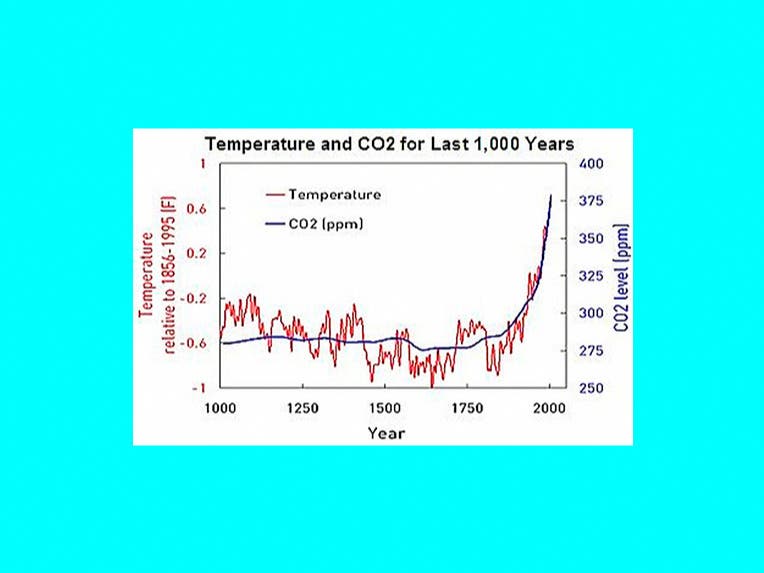
Consider the opening graph detailing CO2 levels and global temperatures over the last millennium. You’ll observe that both atmospheric CO2 and temperature began their accelerating increase around the industrial revolution’s onset. This escalation correlates with the proliferation of fossil fuels and the resultant increase in atmospheric greenhouse gases.
Politics Informed by Science
Addressing the consequences and potential solutions for global warming involves political decision-making informed but not controlled by science. These concerns range from mitigating greenhouse gas emissions to preparing for and adapting to the already evident climatic changes, such as extreme weather events.
Determining the responsible entities and the most effective strategies for dealing with anthropogenic global warming is a topic for intense and extensive political discussion and debate.
But, arguments over whether anthropogenic global warming exists or not is a tale told by idiots, full of sound and fury, signifying nothing [9].
References
1. Myers, K. F., Doran, P. T., Cook, J., Kotcher, J. E., & Myers, T. A. (2021). Consensus revisited: quantifying scientific agreement on climate change and climate expertise among Earth scientists 10 years later. Environmental Research Letters, 16(10), 104030. https://iopscience.iop.org/art...
2. Lynas, M., Houlton, B. Z., & Perry, S. (2021). Greater than 99% consensus on human caused climate change in the peer-reviewed scientific literature. Environmental Research Letters, 16(11), 114005. https://iopscience.iop.org/art...
3. Lorenz, R. D. (2019). Exploring Planetary Climate: A History of Scientific Discovery on Earth, Mars, Venus and Titan. Cambridge University Press. ISBN 978-1-108-47154-1. https://books.google.com/books...
4. Columbia Climate School. (2021, February 25). Carbon dioxide and global warming. https://news.climate.columbia....
5. Columbia Climate School. (2021, February 25). Carbon dioxide and global warming. https://news.climate.columbia....
6. NASA Earth Observatory. (n.d.). The Causes of Climate Change. https://earthobservatory.nasa....
7. Energy Education. (n.d.). Natural carbon cycle. https://energyeducation.ca/enc...
8. Future of Life Institute. (n.d.). If atmospheric CO2 doubles, how hot will it get? https://futureoflife.org/recen...
9. Shakespeare, W. (n.d.). Macbeth, Act 5, Scene 5. https://shakespeare.mit.edu/ma...