Neighbor News
The Meticulous Path Scientists Tread to Understand Our Climate
From Initial Observations to Consensus: The Journey of Climate Research Unveiled!

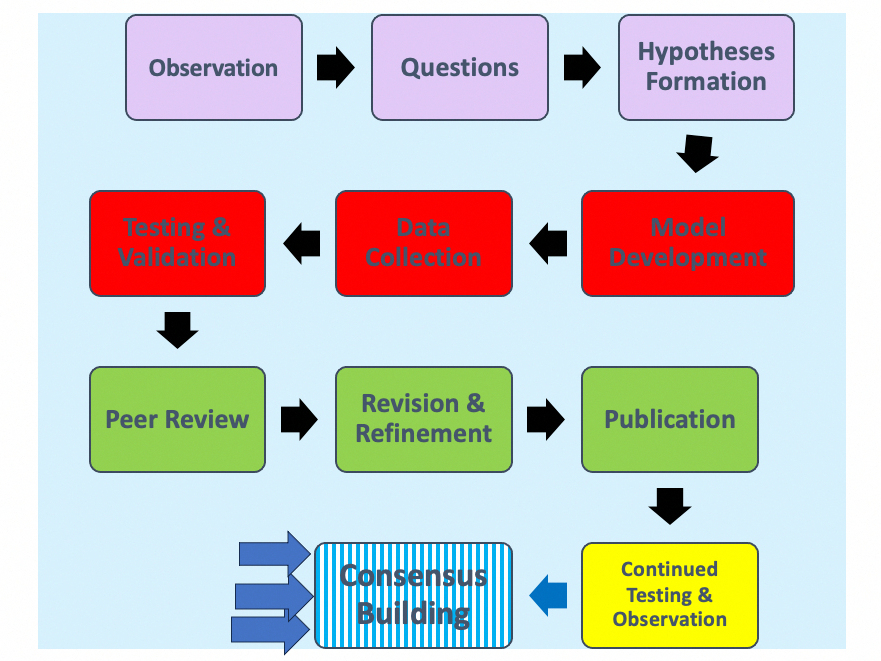
It's crucial for everyone to grasp how research scientists arrive at their findings. This understanding will enable us to assess the validity of scientific outcomes more accurately. Scientists employ precise and intricate quantitative methods that remain untouched by politics or biased views. They base their conclusions on comprehensive evidence, rather than only considering one perspective. Before their findings can be published in peer-reviewed scientific journals, they must adhere to stringent standards set by fellow experts. Here's a simplified breakdown of how scientists conduct their research:
- Observation: It starts with observations. For instance, scientists might observe that average global temperatures are rising over a span of decades after being relatively constant for millennia.
- Questions: Observations lead to questions such as, "Why are global temperatures rising?"
- Hypotheses Formation: Based on previous knowledge, researchers form hypotheses. For instance, given the well-known greenhouse effect of certain gases, a hypothesis might be that increased concentrations of these gases in the atmosphere are causing the observed warming.
- Model Development: Researchers then develop models to test their hypotheses. Due to the complexity of the climate system, multivariate mathematical models are almost always used. These models estimate how global temperatures are affected by greenhouse gas concentrations after accounting for other influences such as solar radiation, ocean currents, atmospheric water vapor, variations in earth’s orbit, and volcanic eruptions.
- Data Collection: Researchers collect data themselves and use data collected by others to test their models. This will usually involve data from many sources. For example, officially recorded levels of greenhouse gases and temperatures that have been collected for the last century and a half, many types of information from ice and benthic cores to measure climate characteristics for the last billion years, and so on.
- Testing and Validation: Once a model is developed and data collected, it's tested against historical data to see if it can accurately reproduce past climate changes, and accurately predict future changes not available when the initial model was estimated. This step represents the heart of the scientific method. Until a model is tested and validated with actual data, we are dealing with speculation, not science.
- Peer Review: Before research findings are published, they undergo peer review. This is a rigorous process where other experts in the field scrutinize the research methodology, results, and conclusions.
- Revision and Refinement: Based on feedback from peer review, theories and models might be revised and refined, and sometimes tested against additional data.
- Publication: Once a study has been peer-reviewed and accepted, it's published in a scientific journal. This allows other scientists to review the findings and build upon them.
- Continued Testing and Observation: Science is an iterative process. New observations or data might challenge existing theories or models, leading to further refinements. As new technology and methodologies develop, they can provide more accurate or comprehensive data, which might lead to adjustments in current understandings.
- Consensus Building: Over time, as multiple lines of evidence converge on particular conclusions and as models consistently predict observed changes, a consensus forms within the scientific community regarding climate change. The theory of human-caused climate change, for example, is currently supported by a vast and diverse body of many kinds of evidence. It is universally accepted by actively publishing climate science researchers [1], so it is considered settled scientific theory.
_____________________________________
1. We know this because of the 88,125 articles published on anthropogenic global warming in refereed science journals between 2012-2020, 99.97% were in agreement, and the remaining 28 articles (0.03%) were published in minor journals. Mark Lynas et al 2021 Environ. Res. Lett. 16 114005 DOI 10.1088/1748-9326/ac2966.
Find out what's happening in Orland Parkfor free with the latest updates from Patch.
By subscribing, you agree to Patch's Privacy Policy and Terms of Use.