Neighbor News
From Skepticism to Solutions: Rudy and Darold Discuss Climate Change
Adapting to our Changing World: Comprehensive Climate Resilience Planning



Rudy Perez of North Orland Park provided a thoughtful comment in the NextDoor thread that originated with my reply to JoAnn (https://nextdoor.com/p/GbgKZnkHcT2y/c/1008942646). He highlighted several pivotal concerns that I believe resonate with many of our neighbors. Below, I've repeated each of his points and offered my responses. –Darold Barnum, PhD
Rudy: I do believe the topic of climate change is far beyond the scope of the average citizen and we would have to defer to the expertise of scientists, much like we do for medicine and health.
Darold: I concur with your sentiment, Rudy. However, it's essential to note that not all scientists have the same depth of expertise in climate change. Thus, we should prioritize the insights of those actively publishing in peer-reviewed scientific journals, as their work undergoes rigorous scrutiny. [Reference: (https://patch.com/illinois/orlandpark/99-experts-confirm-human-caused-global-warming-nodx)]
Find out what's happening in Orland Parkfor free with the latest updates from Patch.
Rudy: However, what’s never clear is who is paying for this scientific research, who benefits from the work and potential solutions? Scientific research and journals have a stringent vetting process to challenge theories and evidence, but who motivates the gate keepers before publishing? We are human after all and very few work for free or because it’s a calling. So what’s the motivation? follow the money. The money is being funded by those who are in line to provide the solutions (green energy) or escape scrutiny ( big oil ).
Darold: Rudy, you raise valid concerns about the sources of funding and potential biases. While certain entities, such as fossil fuel companies, may have profit-driven motivations that can influence research outcomes, there are many reputable institutions that strive for unbiased, genuine findings. I served as a research professor for 46 years at prominent Carnegie R1 Doctoral Universities, publishing over 100 peer-reviewed papers. From this vantage point, I can attest to the integrity of the academic research culture. Most academic researchers prioritize knowledge and reputation over financial gain. In many instances, their salaries are modest, especially when compared to their potential earnings in industry. They might utilize grant money to replace part of their institutional salaries, but there are stringent restrictions against profiting beyond their designated annual income. Similarly, my interactions with government researchers have shown that their primary aim is the pursuit of knowledge without a vested interest in promoting a particular side of an issue.
Find out what's happening in Orland Parkfor free with the latest updates from Patch.
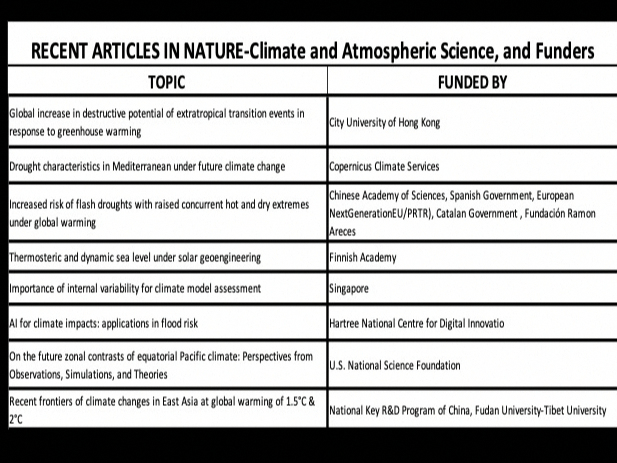
You might be less concerned if you’ll take a look at the three attached images. The journal Nature and its sub-journals (Nature—Climate Change, Nature—Climate Action, and Nature—Climate and Atmosphere Science) are among the most prestige places to publish, so those publishing there are at the top of the climate science field. The pages give sample article titles and funding sources for the three sub-journals. I just picked some of the most recent articles, but I think they are representative of climate research and funding sources.
Rudy: Worse the politicians who say it’s our number one issue, and are not scientists, have even less credibility since it’s likely a donor behind the words. That’s how we get statements like “the world is ending in 12 years if we don’t do something”. This adds zero value and of course the people gag and retract, can’t blame republicans when it’s littered with doubt.
Darold: Rudy, you're right in suggesting that politicians, regardless of their affiliations, often lack the scientific background to speak authoritatively on such matters. They sometimes prioritize political agendas over genuine concern.
However, I do hold the Republican leadership accountable, and here's my perspective: Until 2000, both Republicans and Democrats emphasized the importance of environmental concerns. The main environmental legislation was championed by presidents Nixon and George H.W. Bush. Yet, in the 2000s, a strategic shift used climate change as a divisive tool against the Democrats, drawing parallels to the tobacco industry's dismissal of links between smoking and cancer. Since then, national and state Republican leaders have consistently downplayed the urgency of climate change, despite overwhelming evidence to the contrary. It's reminiscent of tobacco company executives ignoring clear scientific findings about smoking's health risks.
Rudy: We need a commission, not beholden to any master or government, to retain climate scientists and other experts in a room representing a global view, to present only what is supported with clear evidence, not generalities like “cow farts.” Then develop real action plans against those points and how it should be funded and by whom. The results should be transparent, conflicts of interest explained, proposed solutions vetted, before any tax dollars or monies is distributed under the title of climate change. That’s like funding world peace or hunger. It’s an endless pool of possibilities and uses that shouldn’t exist. I’m pessimistic this will ever happen, because that would mean we relinquish control of the people and can’t control the narrative.
Darold: Rudy, your emphasis on creating a truly independent and evidence-based commission is both commendable and necessary. It's evident that you value transparency, rigorous vetting, and clarity in the allocation of funds, all of which are paramount when tackling global issues like climate change.
We do have several structures that are close to what you're envisioning:
- The Intergovernmental Panel on Climate Change (IPCC): Sponsored by the United Nations, the IPCC gathers scientists from around the globe to evaluate the latest scientific findings relevant to understanding climate change. Their reports are among the most authoritative sources on climate science, even if they are guided by the UN's directives.
- National Climate Assessments: Many countries publish periodic national climate assessments created by a broad spectrum of experts. These offer in-depth, evidence-based overviews of current climate states and future projections.
- World Meteorological Organization (WMO): This global body monitors climate trends and extreme weather, providing evidence-based information for worldwide consumption.
- Research Institutions and Universities: Globally, academic entities engage in rigorous climate change studies, producing peer-reviewed papers that furnish evidence-based insights into the multifaceted aspects of climate change.
To address your concerns more directly:
- Development of Action Plans: While entities like the IPCC offer assessments, a dedicated commission, as you suggested, can focus on creating actionable steps derived from these assessments. Such steps could range from infrastructural developments to policy recommendations.
- Funding Transparency: Before the allocation of any funds, it's imperative that the commission provides clear, publicly accessible documentation of how and where funds will be used, ensuring accountability.
- Conflict of Interest: This is crucial. The commission should maintain a transparent log of all participants, their affiliations, and potential conflicts of interest. This way, stakeholders can assess the credibility and impartiality of recommendations.
- Vetting Proposed Solutions: Before any implementation, proposed solutions should undergo thorough vetting for feasibility, effectiveness, and long-term sustainability.
In essence, an independent commission like the one you've proposed, which builds on and complements existing structures, might be the way forward to ensure global, evidence-based, and transparent action against climate change.
Rudy: Until then, we do what humans have always done, adapt. Move to cooler climates, move in land, less coal, less petrol, build better homes, and prepare for a bumpy ride.
Darold: Absolutely, Rudy, adaptation and resilience are crucial strategies as we navigate the challenges of a changing climate. Here's a more comprehensive plan partly based on your ideas:
Comprehensive Climate Resilience Plan:
1. Coastal and Water Management:
- Sea Walls and Barriers: Invest in engineering projects like the Netherlands' Delta Works to shield vulnerable coastal areas from rising sea levels and storm surges.
- Mangroves and Wetlands: Restore and protect mangroves, wetlands, and other natural barriers that absorb floodwaters and protect coastlines from erosion.
- Water Harvesting and Storage: As drought becomes more common in many areas, developing large-scale water harvesting and storage systems will be essential.
2. Urban Planning and Infrastructure:
- Elevated Buildings: In flood-prone regions, promote the construction of stilted or elevated buildings.
- Green Roofs and Walls: Introduce vegetation on buildings to absorb rain, provide insulation, and reduce the urban heat island effect.
- Permeable Surfaces: Implement permeable pavements in urban areas to allow water to seep through, reducing flooding.
- Redesigning Urban Drainage: Upgrade urban drainage systems to manage increased rainfall and prevent flooding.
3. Agricultural Adaptations:
- Drought-resistant Crops: Promote the use of crops that can thrive with less water or in higher salinity in areas prone to drought or coastal saltwater intrusion.
- Efficient Irrigation: Transition from traditional irrigation to more efficient methods like drip irrigation.
4. Natural Disaster Preparedness:
- Early Warning Systems: Invest in technology and infrastructure to detect and forecast extreme weather events.
- Public Education: Conduct public awareness campaigns on how to prepare for, and respond to, natural disasters.
- Emergency Response Infrastructure: Strengthen and train emergency services to respond to extreme weather events, and ensure they have the equipment and infrastructure they need.
5. Land Use and Relocation:
- Regulated Coastal Development: Implement strict regulations for construction near coastlines and floodplains.
- Managed Retreat: In areas that are highly vulnerable and where engineering solutions are unfeasible, consider relocating communities. This is a last-resort measure, but may be necessary in some regions.
6. Health and Safety Measures:
- Cooling Centers: Establish public cooling centers in urban areas to combat heatwaves, particularly for vulnerable populations.
- Disease Surveillance: Strengthen public health surveillance and response systems to manage the spread of climate-sensitive diseases.
7. Energy Infrastructure:
- Decentralized Power Systems: Transition to a mix of centralized and decentralized (like community solar grids) energy systems to reduce vulnerability to extreme weather events.
- Reinforced Energy Infrastructure: Design and retrofit energy systems (like power lines and substations) to withstand extreme weather conditions.
8. Ecosystem Restoration:
- Reforestation: Plant trees and restore forests to act as carbon sinks, reduce landslides, and counteract the loss of biodiversity.
- Protect Biodiversity: Safeguard wildlife corridors to assist species migration and adapt to changing climate zones.
While mitigation – slowing and ultimately stopping the changes to our climate – is crucial, as you rightly said, adaptation is an equally important strategy. With proactive measures, communities can safeguard themselves from the direst effects of climate change and ensure a more resilient future.
The good news is that we already have a congressional representative successfully addressing many of these issues. U.S. Congressman Sean Casten has been a staunch advocate for addressing climate change, making it his top priority in Congress1. He has utilized his experience in running clean energy companies and his scientific background to create jobs and better our planet. In the 116th and 117th Congresses, Rep. Casten served on the Select Committee on the Climate Crisis, where he played a key role in developing a report that served as the blueprint for the Inflation Reduction Act – the largest investment in climate action in American history.
Rep. Casten has introduced numerous bills related to climate change and U.S. energy policy. Notable among these are the bipartisan Clean Industrial Technologies Act and Better Energy Storage Technology Act, both of which have been signed into law. He also introduced the End Oil and Gas Subsidies Act, which aims to eliminate nearly a dozen of the most egregious tax breaks enjoyed by the oil and gas industry.
Furthermore, Rep. Casten launched a viral “Hot FERC Summer’’ campaign to bring more attention to the Federal Energy Regulatory Commission, an important federal agency in our fight against the climate crisis. He recognizes that addressing climate change is an opportunity to invest in the energy infrastructure of tomorrow, making our businesses more productive and our economy more competitive globally.
I’ve campaigned for Rep. Casten in all three of his elections, with his climate change motivation and acumen being important factors. You can check him out here: https://castenforcongress.com/homepage/
If you or any other reader is interested in volunteering with Sean, either right now or in the future, please let me know and I will facilitate the process. Darold Barnum, daroldbarnum@gmail.com, Talk or text: 708-714-1876