Neighbor News
Unraveling the Past to Explain the Present: Historical Climate Changes
Insights from Millennia of Climate Variability Shed Light on Modern Global Warming

Understanding the Significance of Past Climate Variability
The notion that Earth's climate has undergone constant changes throughout its history is an incontestable fact. From periods of glaciation to warmer epochs that defied conventional expectations, these shifts have left indelible imprints on the planet's geologic record. Over the past 700 thousand years, the cyclical occurrence of ice ages has shaped the landscape, punctuated by notable periods like the medieval warm period and the little ice age.
Deciphering the Scientific Underpinnings
The study of past climate variations offers invaluable insights into the complex interplay of factors that drive these changes. Geological evidence paints a multifaceted picture, with forces such as plate tectonics, volcanic activity, the Earth's carbon cycle, and orbital dynamics converging to shape the climate trajectory. Orbital variations, articulated through the Milankovitch Cycles, contribute to the transitions between glacial and interglacial phases, albeit in conjunction with other climate feedback mechanisms.
A Central Role: The Slow Carbon Cycle
Central to understanding climate dynamics is the role played by the slow carbon cycle, often referred to as Earth's thermostat. This intricate process involves the exchange of carbon between immense geological reservoirs and the atmosphere. Notably, the fossil fuel deposits (including coal, oil, and gas) and limestone reservoirs act as vital carbon storage systems that have persisted for millions of years. However, these storage mechanisms can be perturbed, releasing carbon through a range of geological processes.
Find out what's happening in Orland Parkfor free with the latest updates from Patch.
Carbon Release Mechanisms
Processes such as rock erosion, metamorphism triggered by high temperatures and pressures, and volcanic activities can lead to the release of carbon from geological reservoirs. Notably, volcanic eruptions, driven by plate tectonics and associated with magma migration, can release substantial amounts of carbon dioxide from the Earth's mantle. Contemporary estimates indicate that volcanic emissions contribute a fraction compared to anthropogenic emissions from human activities.
A Historical Case Study: The Siberian Traps Eruptions
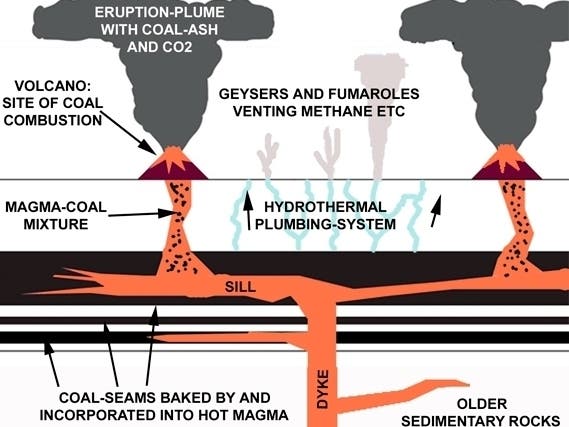
An illustrative example from history is the Siberian Traps eruptions that occurred around 250 million years ago. This event occurred in a vast sedimentary basin in Siberia, where immense coal, oil, gas, and salt deposits were present. The ascending magma encountered these deposits, resulting in the release of significant amounts of carbon dioxide and other gases. The eruption's consequences were profound, with rapid global warming and a mass extinction event recorded in the fossil record.
Find out what's happening in Orland Parkfor free with the latest updates from Patch.
Lessons for the Present
Drawing parallels with the present, the current extraction and combustion of ancient carbon reservoirs mirror historical events. The annual carbon dioxide emissions generated by human activities align with the emissions from the Siberian Traps eruptions, reinforcing the stark warning that history imparts. The narrative of past climate shifts reveals nuances that underscore the urgency of addressing contemporary climate challenges.
In Conclusion
The refrain that the climate has transformed before is a valid one, but the devil is in the details. Understanding the intricate mechanisms and consequences of past climate changes elucidates the gravity of modern-day global warming. As we grapple with the complexities of our rapidly changing world, history serves as a poignant reminder that our actions today have ramifications that extend across geological epochs.
____________________________________
This article was written by OpenAI's ChatGPT-4 with editing and checking for accuracy by Darold Barnum, based on information found in https://skepticalscience.com/c...