Health & Fitness
Future engineers, scientists design wind turbines at Shepard
Physics students design wind turbines at Shepard High School

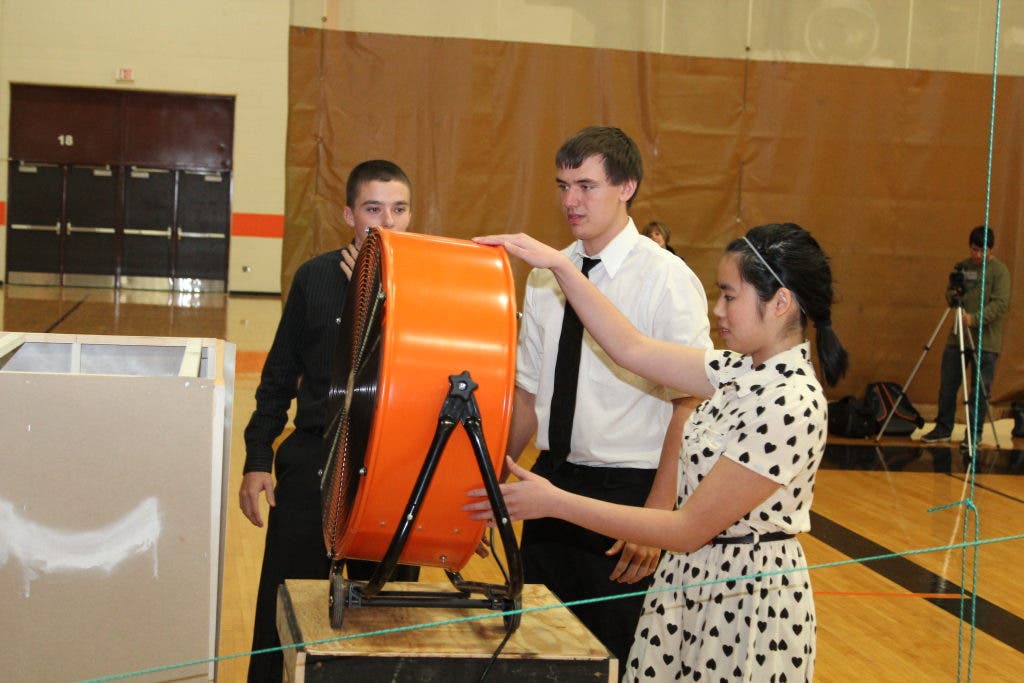


Dressed in the black-and-white motif of the Chinese philosophy of Yin-Yang and, some might say, like a NASCAR pit crew, physics students at Shepard High School stood ready.
All the hours of theoretical debate, design, manufacture, and trial of their wind turbines funneled to one moment: Could they generate enough power to lift a five-gallon bucket to the ceiling of the gym?
Excited, a little anxious, and mock taunting one another, the teams attached pulleys to their machines and, after adjusting the position and angle of the fans providing the wind power, watched the bucket rise more than 30 feet.
Find out what's happening in Palosfor free with the latest updates from Patch.
Teacher Brian Sievers, who also designed his own turbine for the project, applauded the effort, enthusiasm, and performances. Perhaps most importantly, he watched students solve problems and think creatively to find solutions.
“One team realized that while their large fan design worked well, it also allowed for more air leakage pathways. This resulted in a re-evaluation of the construction,” Sievers said.
Find out what's happening in Palosfor free with the latest updates from Patch.
The second team encountered an even larger problem.
“Their wind turbine performed poorly when they placed both fans together on the same side. However, they realized if they put fans on the opposite sides of each other, one in front and one behind the turbine, and pointed one fan low and the other high, their turbine's performance improved astronomically,” he said.
For the Advanced Placement students, many of whom will pursue degrees in engineering, physics, and other sciences, such projects provide a glimpse of their futures.
“Students benefit several ways. One way is by learning the trial and error involved in design. Students develop an idea and test it. Then refine their design to optimize performance,” Sievers said.
And they learn that failure – or at least imperfection – comprises an important part of the learning process.
“It’s invaluable in life, not just engineering. As with any idea, you see how it works, and make changes to improve. So you can say a project like this goes beyond engineering, it prepares them to not only be inventors and designers,
but evaluators also,” Sievers said.
Designing and building the wind turbines involved the application of many physics principles, including energy conversion, rotation, wind power, torque, and. They also need to account for energy loss from friction.
Applying principles through hands-on projects greatly enhances learning.
“Students love to design and build. All too often, students today do not ‘tinker’ with tools and build things. That is one of the great losses in education today,” Sievers said.
Students also learn what to do when things go awry.
“Students need to learn and see failure and be allowed to refine their design. If a student builds a machine and truly analyzes its performance, that student is developing good reasoning skills that will serve them well in life,” Sievers said.
Thomas Edison would approve, Sievers argued.
“He was once asked how many light bulbs he built before he succeeded. Edison said 1000. To that he added, ‘it was not a waste because I now know 999 ways how not to make a light bulb.’”