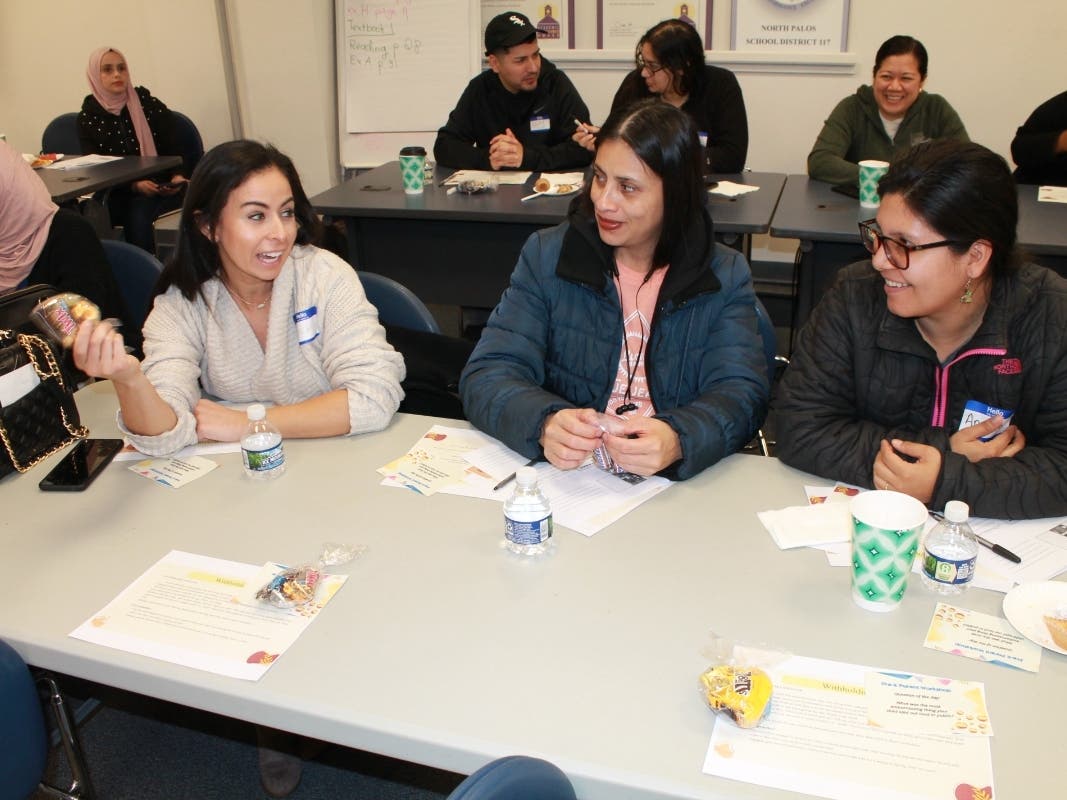
More than three dozen parents attended an NPD117 workshop Tuesday morning aimed at helping increase their children's English language skills through various strategies.
With most of the parents in attendance speaking at least two languages, they were urged to continue speaking to their children in their native language at home.
"The more proficient children are in their native language the stronger they will be in English," said Caitlin Parduhn, a speech language therapist with Carney Speech & Feeding in Palos Hills. "There is about a one- to two-year lag time to catch up to their English-speaking peers. Eliminating your native language will be detrimental to your children.
Find out what's happening in Palosfor free with the latest updates from Patch.
"Students adapt more easily than adults. I would suggest keep speaking in your native language," she said. "Children learn to speak from their parents speaking to them."
Parduhn and Katie Carney, also a speech language pathologist, presented the workshop.
Find out what's happening in Palosfor free with the latest updates from Patch.
Carney said children learn to read through listening to their parents and others. She said talking to your children and reading books to them is a great way to help develop their speaking skills.
They mentioned several milestones for children 3 and 4 years old. They include: Talking in five-word sentences; using pronouns like 'he' and 'she'; being able to describe items (blue ball, etc.); using time concepts or quantity (tomorrow, etc.); playing in small groups and engaging in complex play (pretending to be a doctor or nurse).
Nena Awad, the District's Pre-School Program Coordinator, said children who can play on their own build higher creativity and imagination skills. She said children also need to learn how to play at home to help ease the transition into pre-school. That means playing with parents and siblings and other relatives.
"Get on your hands and knees and play with your children" she said. "Play is how kids learn."Awad urged parents to "be silly" with their kids. "Kids will remember silly things," she said. "Kids will imitate that silliness."
Parents were also urged to remove or limit the amount of "screen time" children have. They said children under the age of two should not be allowed any screen time while 3- and 4-year-olds should be limited to one hour per day of "quality programming."