Neighbor News
WWII Vets Served Across The World, Now Neighbors At Peace Village
WWII veterans Steve Sostarich and Frank Stefansko discuss their years in the service, find themselves neighbors at Peace Village.
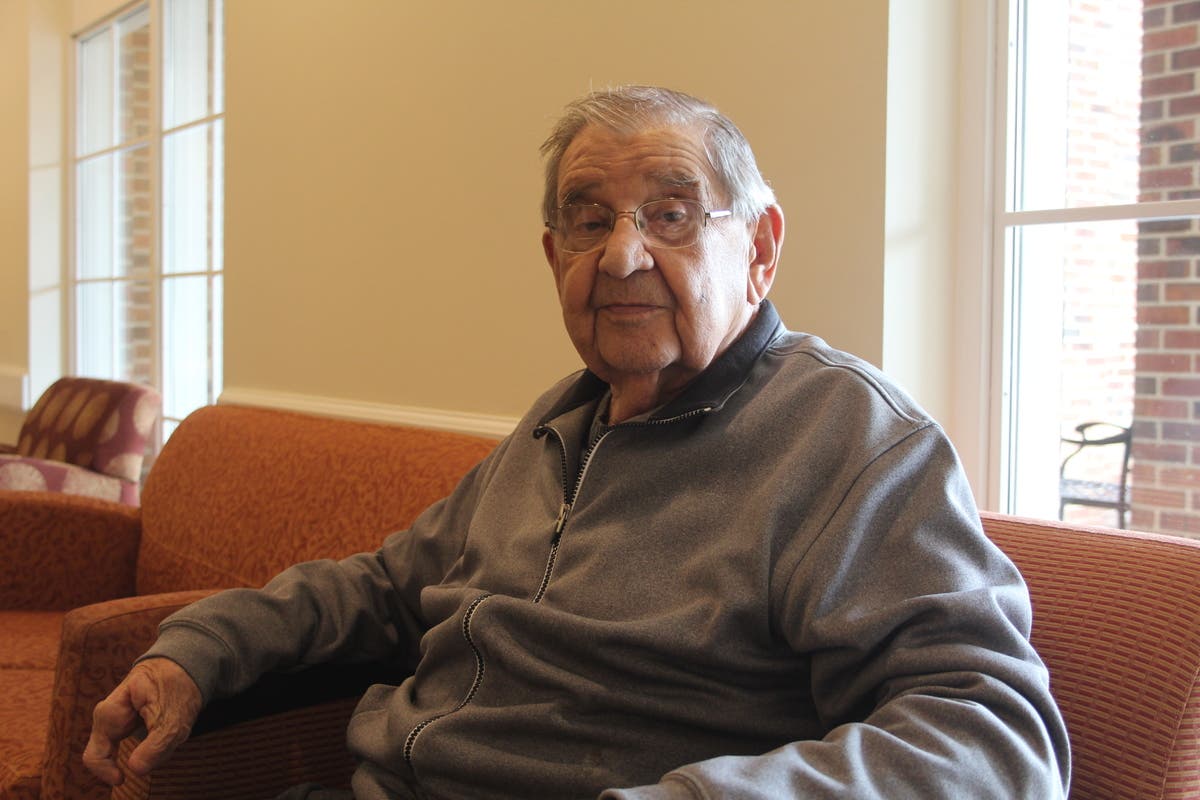

Palos Park - When Japan attacked the United States at Pearl Harbor on December 7, 1941, Frank Stefansko and Steve Sostarich were in high school. While these boys knew the country was now immersed in World War II, they didn’t realize that the War would change their lives as well.
Stefansko says, “We were offended because the Japanese had been so sneaky. Instead of declaring war, they went around our backs and attacked us, and on a holy day, a Sunday. It was very upsetting.”
“Everything changed,” he continued. The focus of everything became the war with manufacturers that made consumer products now making products for warfare. “Everyone was working around the clock, and women entered the workforce.”
Find out what's happening in Palosfor free with the latest updates from Patch.
Sostarich, attending Harrison High School in Chicago, wasn’t yet 18 years old when he graduated from high school spring of 1942. He registered for the draft after his 18th birthday on October 7, 1942, and was called to serve in the United States Army the following spring.
Stefansko celebrated his 18th birthday on November 15, 1943 while still attending Chicago’s Gage Park High School and remembers that military personnel came to the school for him that fall. “My principal told them that I wasn’t going anywhere. He said that I had to finish high school before they took me,” he said. “So I was able to graduate, but two weeks after graduation in 1944, I was in the Navy.”
Find out what's happening in Palosfor free with the latest updates from Patch.
“We all had to go,” Sostarich said. “There was no choice.” Stefansko agreed. “We didn’t enlist - we were drafted. My father did not want me to go. We had just lost my mom and my dad was indignant. “Now I’m going to lose you too?”, he said. But the government said we had to go. We had to do what we had to do.”
Sostarich headed to Arkansas’ Camp Joseph T. Robinson for basic training, spent time at Fort Sam Houston in Texas, and then was shipped to Camp Patrick Henry in Virginia to board a ship for Europe. “It was a big British luxury cruise ship,” he remembers. “It was about 50 years old, but they had commandeered every ship available to move troops as fast as they could. We got to Europe in just 7 days. I was sick the whole way over.”
Stefansko completed his basic training in Farragut, Idaho and was then deployed on the USS LCI 475 as a Gunner’s Mate in the South Pacific. There were about 75 men on the ship, and they “become like brothers,” he says. “Everyone was your best buddy. Before I left, my dad said, “make sure you help one another”, and I always subscribed to that.”
“Everyone had their own chores to tend to when we weren’t fighting. The method for the Navy is clean, clean, clean.” He remembers eating a great deal of scrambled eggs. “They were easy to prepare,” Stefansko notes. “To this day, I still love scrambled eggs. That’s a real good food.”
Sostarich landed in Casablanca as part of the 349 infantry, 88th division. “The Blue Devils!”, he emphasizes. They spent weeks learning to mountain-climb and then traveled to Naples. It was here that his military future took a drastic turn.
“I was in digging a trench and felt someone take my .45 out of my belt. I turned around and there was this kid spinning it around in his hand.” Sostarich shook his head. “This kid wasn’t quite right. He should never have been in that trench in the first place. I said, “Give that back to me,” and he started to hand it to me, muzzle first. Muzzle first! All of a sudden, it went off and blew a hole through my hand.”
He shakes his head again. “I had to have surgery of course, and there was an inquiry because they thought maybe I shot myself to get out of active combat. The doctor, the surgeon, is the one who helped me through that. He told them that the injury couldn’t be the way it was if I shot myself, that the shot came from too far away for me to have done it. If I had done it, he told them, I would have torn my whole hand off.”
Sostarich was re-assigned as a truck driver, hauling supplies and soldiers around the Italian war zone, including Rome and Florence. He was a part of the Salerno invasion when a close friend was captured by the Germans and held for nearly 20 months. “We were on our way to Sicily, but Patton got there first, so we didn’t have to go.”
Stefansko says he was “very scared during his first invasion. Our commander said “Just bombard that beach so the soldiers can get there and don’t look to the sides. Sometimes, I worry if I shot anyone on our side and I feel sorry about it. We were told to shoot at will, and I hope God forgives me for that.”
He was a part of seven invasions, including the capture and occupation of Guam, the Leyte operation, the Luzon operation and the assault and occupation of Okinawa. His gunner crew shot down two Japanese planes during combat. He also helped to liberate the Philippines. “In Manila, I remember the people there were so poor, with very little clothing. One small boy had taken a 100# potato sack and cut holes in it for his head and arms. I gave them an extra shirt and pair of pants. I didn’t want anything in return, but they gave me a chicken and two eggs. They were so happy that we were able to assure them their freedom.”
Stefansko recalls a funny occurrence. “We had been at sea for many months. When we finally docked and got off the boat, we just kept swaying from side to side even though we were on land, really like drunken sailors.”
Sostarich and his unit were preparing to go to Japan when, on August 6 and 9 of 1945, the United States dropped the bomb on Hiroshima and Nagasaki. “At first, we were happy because it meant the war was over,” he says. “I don’t think we should have done it, but they had to. Things would have turned out a lot worse if they didn’t.”
Now that it was over, the military began the long process of moving out. Sostarich recalls, “When we got back to base, the ships were waiting there to take us home. It was the “Wasp” and the “Monterey” They shipped us home in aircraft carriers, ships that were too big to fight.”
Sostarich arrived home and began working in a meat packing plant in Chicago. “Then the place folded suddenly,” he says. “And the guy still owes me a month’s salary.” He smiles ruefully. “You don’t forget stuff like that.” He met Margaret while working and married her February 15, 1947. “It was my license plate all those years, the day after Valentine’s Day. I spent sixty-three wonderful years married to her.” Margaret died in 2010. “I still dream about her all the time,” he says.
Stefansko managed to make it through WWII “without a scratch” and his unit only lost one sailor, during a loading accident. He was awarded medals for the American Campaign, the Asiatic-Pacific Campaign, the WWII Victory, the Navy Occupation Service, Philippines Presidential Unit Citation and the Philippines Liberation. After Stefansko was discharged, he landed in San Diego. He stayed with an uncle for a short time and then took the trains home. “Everyone was very nice to me as I traveled home.”
He began working in banking, married Stella Kissel in 1948 and had five children. Daughter Patti Stepniak remembers how her dad’s war experience was a part of their lives. “He didn’t really talk about the war itself, but he stayed friends with those guys all his life. They visited across the country, they sent letters and Christmas cards.” Stefansko became very active in the VFW’s Darius Girenas Post at 44th and Western and the Knights of Columbus. Stepniak recalls Christmas parties, parades and other events in which her dad played a leading role.
Stella passed away in 1986. Two years later, he married Stell Jerum, a widow in the neighborhood. “She said to me, “you lost yours and I lost mine, so let’s get married.” So I married her,” he laughs. They were married until Stell passed away in 2004. Stefansko smiles at being married to two women with such similar names. “That’s a lot of Stells, don’t you think?”
Stefansko says he wishes there were a better solution for global conflicts than war. “You leave a kid and you come back a man, but war is not good. I wish leaders could sit down, think twice and talk out all the problems.” When asked about Hitler and modern leaders in the same vein, he says, “Hitler was a bad person, that’s for sure. The good leaders should take out the bad leaders, the troublemakers. They should be able to put these guys in jail and that would stop the wars.”
Sostarich believes that leaders today aren’t as committed to public service as they should be. “If I was elected to help people, I would help people.”
Stefansko recommends the VFW to younger veterans now returning from combat. “The VFW can help these guys get back on their feet and help them get jobs.”
As they reflected on all the places they’ve seen and lived, both veterans expressed their happiness with Peace Village Assisted Living. “It’s pretty good here,” says Sostarich. “They take very good care of me here.” Stefansko points at the grounds beyond the window. “It’s beautiful here. I wouldn’t leave here for the world. This is a wonderful place.”