Community Corner
Lambert: 20th Century Village Green a Hub of Activity
After falling out favor during the Electric Park years, the downtown park found new life over and over again during the 20th century.


The Inquiry
Last week, a Plainfield Patch reader asked: “When was the Village Green park donated to the Village? What, if any, restrictions have been placed on buildings in the public park? What is the history of the Village Green?”
Here's the second in a three-part series on the history of the downtown park. To read the first installment, click .
Find out what's happening in Plainfieldfor free with the latest updates from Patch.
The Facts
With the opening of the privately managed in 1905, Plainfield’s only public park was used less frequently for public gatherings. Electric Park had larger grounds and novel amenities that were well-suited for more elaborate community celebrations and exhibitions.
Find out what's happening in Plainfieldfor free with the latest updates from Patch.
Consequently, during the heyday of Electric Park, most village events were moved to the grounds of the streetcar resort.
Within a few years, the “public commons” — set aside by town founder — were in poor repair and underutilized.
A Park Transformed
Beginning in the summer of 1907, Sunday evening chime concerts rang out from the belfry of the Methodist church, one block east of the park. Local residents gathered at “the commons” where they listened to the newly installed 10-bell chime.
Typically, the concert repertoire consisted of classical and religious selections. Occasionally, popular tunes of the era were included in the semi-regular presentations.
Seizing upon the renewed activity at the public park, village President John Prescott established a park committee to oversee the disheveled block. Prescott was a contractor-builder who lived on the west side of the neglected public park.
Prescott’s park committee initiated many improvements, such as installing a popular croquet court and sturdy, wooden benches. Several “swings” (lawn gliders) provided a place for relaxation and conversation, particularly for women and small children. A man was hired to mow the grounds on a regular basis. The local tennis club installed a crushed stone tennis court. New horseshoe pits were installed.
Still, in keeping with Ingersoll’s original restrictions of 1835, no structures were erected on the park land.
The numerous improvements made the public park a popular gathering place once again. About this time, the term “Village Green” became the favored name for the nearly 75-year-old public park.
Within a few years, a small, wooden bandstand was erected for local and travelling brass band concerts. It was the first structure erected on the property since 1835. However, as recorded music became more popular, the bandstand was used less frequently and was removed during the Great Depression.
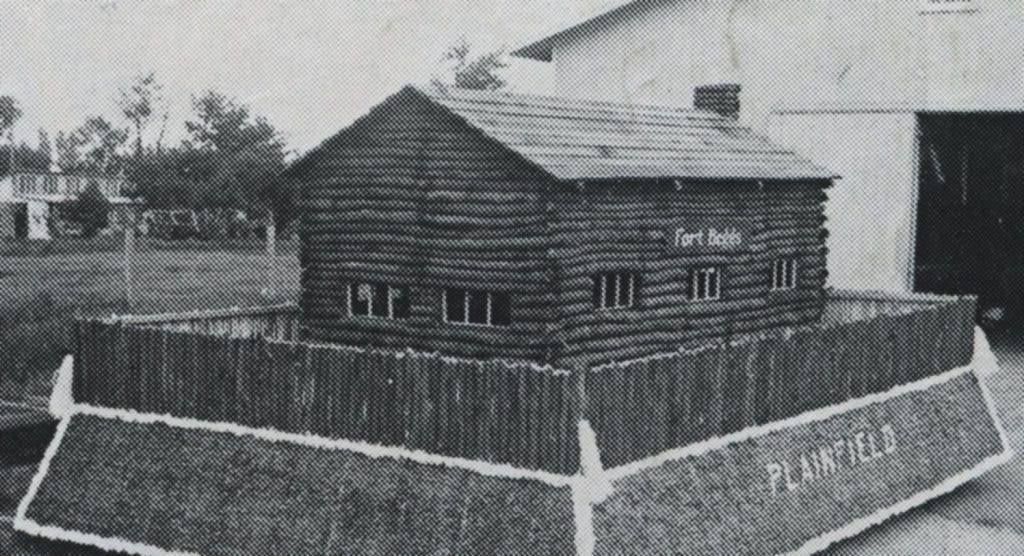
In 1936, a large replica of Fort Beggs — salvaged from Plainfield’s entry in the Will County Centennial parade — was permanently installed at the Village Green. However, by 1940, the local newspaper was chiding children and their parents to “have the common sense to stay off” the structure to assure its preservation. The replica was removed during the late 1940s.
Following World War II, the first playground equipment was installed in the park: a metal slide and a swing set with wooden seats. A short time later, a push-powered “merry-go-round” was added.
New Life in a Modern World
During the 1950s, many new, community activities were introduced to the Village Green grounds.
Beginning in the mid-1950s, class picnics at “the Green” marked the end of the school year for elementary students attending Central School (present-day Plainfield Academy).
In 1952, when the tradition of Plainfield’s Homecoming was introduced, the Village Green and surrounding streets served as the staging area for the newly instituted parade until Plainfield High School was built in 1956.
When they discontinued their popular street carnivals, began hosting annual summer carnivals “on the Green” during the 1950s. Held each June, shortly after the school term ended, the highly anticipated event featured games of chance, food and amusement rides by Dispensa Amusements (see: http://www.dispensaskiddiekingdom.com/Dispensa_s_History.html).
The annual tradition ended in the early 1970s.
During the early 1950s, the Village Green became the home to Plainfield’s Little League baseball games -- nearly a hundred years after the first “base-ball” games had been played on the grounds. Concurrently, Dutch Elm disease caused the loss of many stately trees along village parkways and within the Village Green itself.
With the loss of trees and the increasing interest in baseball, a diamond, backstop and bleachers had been installed at the park's northeast corner by 1956. From early spring until the start of the school year, the chants of “play ball” resounded from the continuously active diamond for more than two decades.
The Plainfield Township Park District was formed in 1967, and the new governing body assumed care for the Village Green.
About that time, the first enclosed structure was erected on the Village Green, contradicting Ingersoll’s original decree that no buildings should be erected on the public park land. A small, concrete block structure, housing restrooms and a drinking fountain, was constructed to meet the demands of players and fans using the adjacent ball diamond.
In 1971, the Plainfield Lions Club funded a picnic pavilion, the second structure erected on the public park grounds. For many years afterward, the Lions Club hosted a popular chicken barbeque that, later, included an art show.
By the mid-1970s, the Village Green was a hub of community activities that ranged from athletics to cultural events. In spite of its community-wide appeal and year-round popularity, new ideas were formulating that would change the park as a generation had come to know it.
Next Week: The Village Green: A New Era
Have a question about Plainfield’s history? Send your inquiries to Michael Lambert via Plainfield Patch.