Community Corner
Lambert: Why Do Houses Line 'Commercial' St.?
It may not look like it now, but the road was lined with commercial and industrial enterprises in the mid-1800s, including a foundry, blacksmiths and cabinetmakers.


The Inquiry
It seems like an odd name for a residential street, so what is the origin of Commercial Street?
The Facts
Find out what's happening in Plainfieldfor free with the latest updates from Patch.
Commercial Street was not included in the original town of when laid out the village in 1834. In fact, despite being the location of the earliest homes in the original town, the roadway did not exist until after 1846.
Ingersoll laid out 13 blocks in his original village that stretched from present-day Route 59 on the east to the DuPage River on the west and from present-day Lockport Street on the north and Ottawa Street on the south.
Find out what's happening in Plainfieldfor free with the latest updates from Patch.
Ingersoll left us a geographical primer of northeastern Illinois when he named the streets of his new town.
In 1833, pioneer settlements were sparsely scattered across the prairies of northern Illinois that stretched from Peoria to the shores of Lake Michigan. With the exception of a few boom towns, such as Galena along the Mississippi River, northern Illinois boasted few communities of any size before 1834.
The city of Ottawa, at the confluence of the Fox and Illinois rivers, had been settled as early as 1823. As “the gateway to the Fox River Valley,” Ottawa was the point from where many of the first settlers in this region began their frontier journey. Coming northward from southern Illinois, the early pioneers of Walkers’ Grove had settled, for a time, at Ottawa.
Emerging from the land surrounding Fort Dearborn, the city of Chicago had been founded in 1833, the year before Ingersoll established Plainfield.
So, Ingersoll named the two east-west streets of Plainfield for the two principal cities of northeastern Illinois that lay north of Peoria: Chicago and Ottawa.
When Ingersoll named the five north-south streets of his village, he chose the names of local rivers: Illinois, DesPlaines, Fox, Kankakee and DuPage. Illinois and DesPlaines streets remain, today, as does Fox River Street.
According to research done by Mike Bortel, president of the , Ingersoll vacated his original town plat west of Fox River Street in 1841, the year he and his immediate family relocated to Homer Township.
Consequently, the westernmost streets of Ingersoll’s Plainfield existed as un-named thoroughfares until the 20th century. At that time, James Fairbanks laid out a subdivision and re-named the former Kankakee Street as James Street and the former DuPage Street as Vista Lane.
By the mid-1840s, the roadway at the north edge of Ingersoll’s original town became known as DuPage Street. However, after the opening of the Illinois & Michigan Canal in 1848, the regionally important thoroughfare was commonly referred to as “the Lockport Road.”
Commercial Street Emerges
After Ingersoll left the Plainfield area, he turned over much of his remaining Plainfield property to his son-in-law, Thomas J. York. But when the majority of the local Ingersoll clan departed for the California Territory in 1847, they sold their property to John D. Shreffler, a recent arrival to Plainfield.
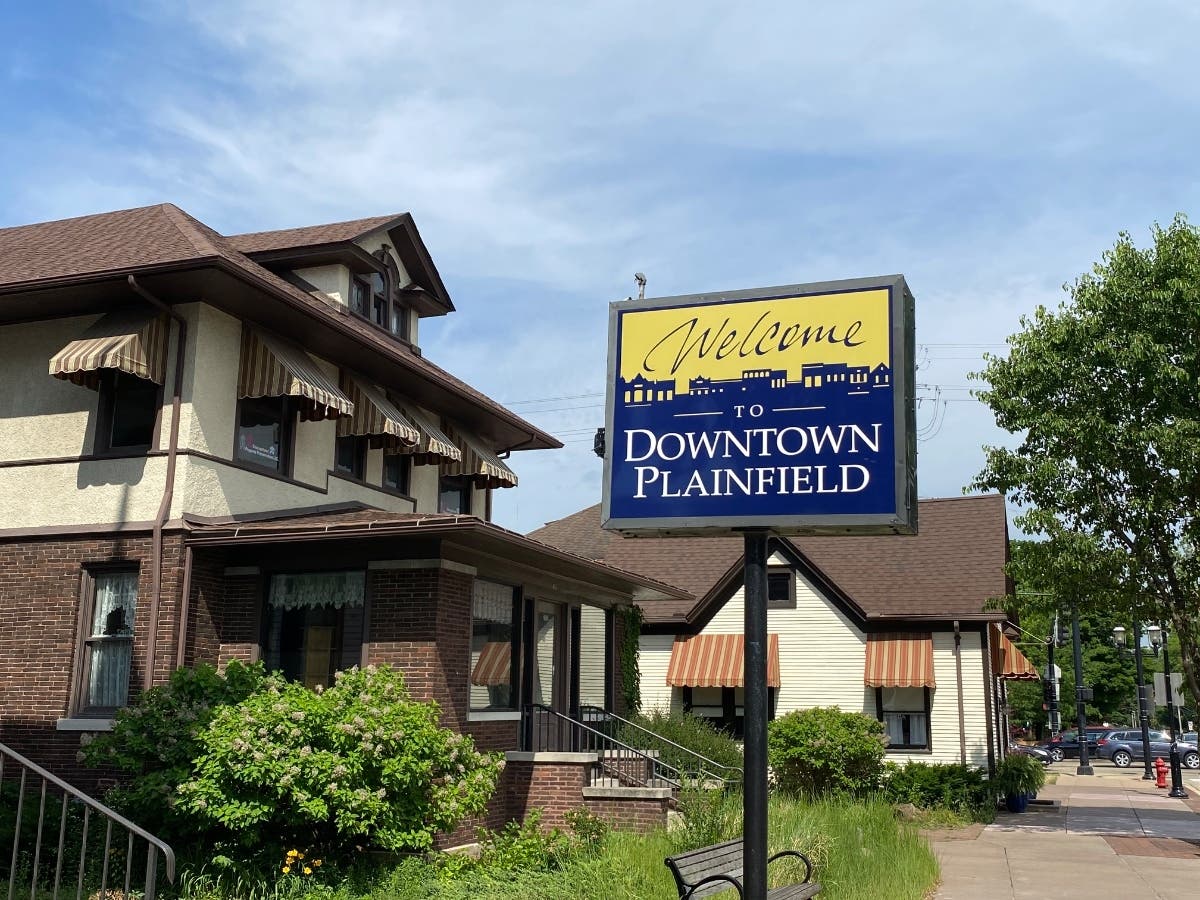
Shreffler acquired the two homes of the Ingersoll and York families and laid out a formal street to the south of those homes that still stand to this day.
A fitting name for the new street might have been Ingersoll Street, York Avenue or Shreffler Street. However, the street remained un-named for four or more years.
Eventually, the new roadway became known as “Commercial Street,” in recognition of the commercial and industrial enterprise developing at the intersection of the new street and the Joliet Road.
At the intersection, a small general store had been in existence since the mid-1840s. The Dillman Foundry was established there in 1849. Other small businesses, primarily blacksmiths and cabinetmakers, opened along the street as well.
Although Commercial Street is, today, cut off from present-day Route 59 and Joliet Road (U.S. 30), the history behind the street name reminds us of the historical development of Plainfield and the importance of this early pioneer intersection.