Neighbor News
A Cantor's Journey: From the USSR to Chicago
Maxwell Street Klezmer Band features Vocalist Cantor Pavel Roytman
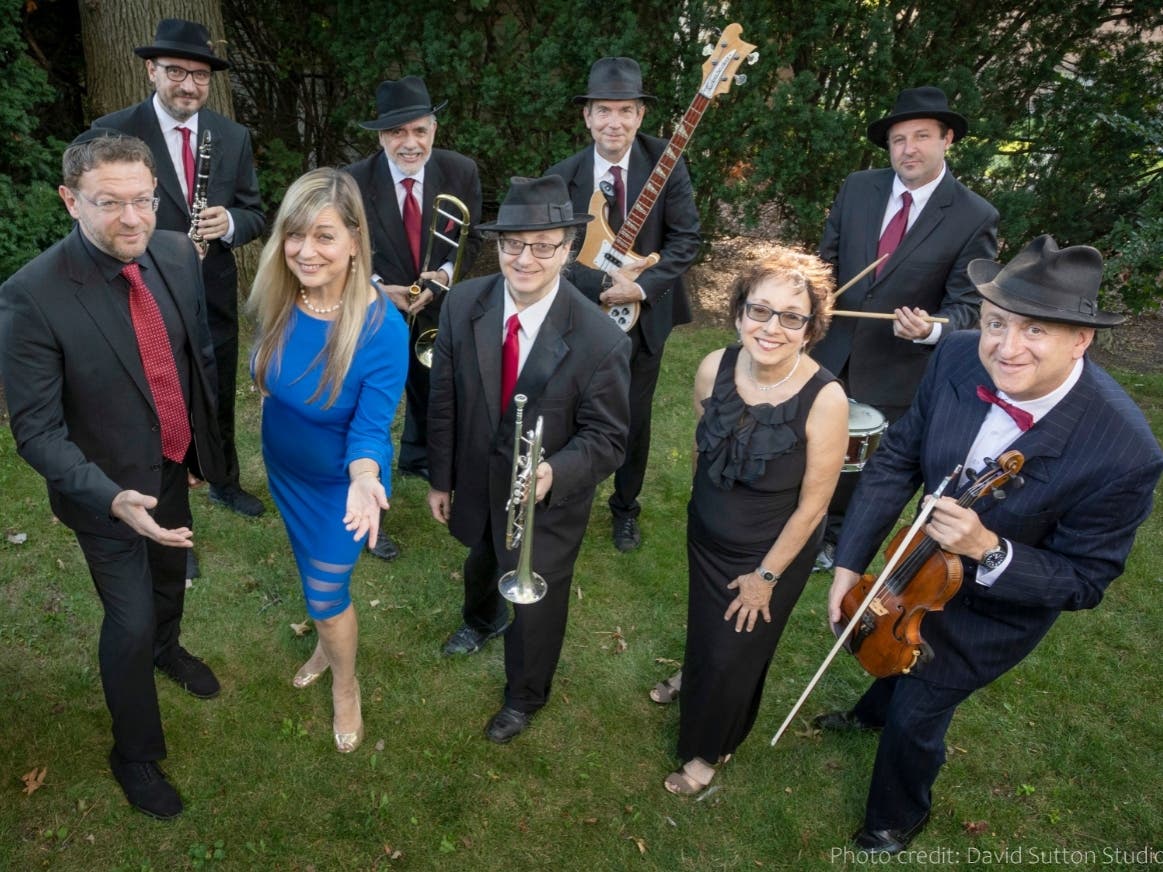
Maxwell Street Klezmer Band has been joined by vocalists including Cantor Pavel Roytman, Broadway vocalist Lisa Fishman, and Natahsa Bodansky in its concerts this summer.
The 10-piece big band features Pavel Roytman, who is the Cantor of Beth Hillel Bnai Emunah in Wilmette; plus the laughing clarinet of Shelley Yoelin, the evocative violin of Alex Koffman, and a rollicking horn line. When Eastern European Jewish music, called "shtetl" music, met American jazz in the 1920s, this gave birth to a buoyant musical style that Maxwell Street Klezmer Band recreates and expands on.
Although the band takes its name from Chicago's Maxwell Street Market, its roots are firmly planted in Eastern Europe. For example, Cantor Pavel Roytman's musical journey took him from the former Soviet Union to Chicago in the 1990s. With the encouragement of band founder Lori Lippitz, Roytman found a new home for his talent on stage with Maxwell Street Klezmer Band.
Find out what's happening in Skokiefor free with the latest updates from Patch.
"Some people learn Yiddish and klezmer as art forms simply because they like them, or learn them as part of a music revival. As an Eastern European Jew, Yiddish music was my Judaism. We didn't have organized religion in the USSR, so Yiddish music brought the Jewish community together in song. It is part of my identity--and when music is part of your identity, the expression on stage is heartfelt."
For musicians in the former Soviet Union, there was a shortage of materials like sheet music, music books or recordings. Most exposure to music was either through official state-approved musicians and groups (which were heavily vetted), or through "underground" sources, such as pirated recordings. There were also homegrown songs in Yiddish and Russian: music they would create for themselves, blending humor and neighborhood gossip into songs for everyone's enjoyment and amusement. These "street songs" would sometimes be elevated into well-known modern folk songs when they were performed with an ensemble, shares Roytman.
Find out what's happening in Skokiefor free with the latest updates from Patch.
Roytman describes Maxwell Street Klezmer Band's style as uniquely American, as one who has experienced this music in the "Old Country." For example, on Chicago's Maxwell Street in the 1940s-60s, Jews and African Americans were living, working, and sometimes even making music together.
"In the larger American sense, this was at the genesis of the American songbook," says Roytman. "Maxwell Street Klezmer Band is a reflection of that trend of immigrants getting immersed into the American sound, and creating whole new genres of music." For example, the Tin Pan Alley was created by mostly Jewish musicians who absorbed and interpreted jazz played by African-American musicians, shares band founder Lori Lippitz.
Roytman points to the band's Musical Director and Violinist, Alex Koffman, who immigrated from Belarus in 1989. A classically-trained musician like Roytman, Koffman is not only proficient in klezmer music, but also in jazz and pop music. When the passion and sensitivity with which Koffman plays is accented with ecstatic bursts of joy, the energy is palpable. A highlight of the stage show often includes Koffman performing the athletic Russian dance known as the "kozatsky."
Roytman shares that, while a number of klezmer revival bands organized around the time that Maxwell Street Klezmer Band formed in 1983, the Chicago music element, characterized by a jazzy horn line comprising clarinet, saxophone, trumpet and trombone, sets this band apart. "Anytime we tour outside of Illinois, it's clear we have our own Chicago sound," says Roytman. "Klezmer is often done in a simple folk style, and Maxwell Street expresses that aspect of the music, but in this band, you also have highly-educated musicians who improvise freely in the style of jazz."
As Cantor at the synagogue Beth Hillel Bnai Emunah in Wilmette, Roytman has founded a program to help Jewish music flourish called "Beit Musika"--Hebrew for "House of Music." "First and foremost," says Roytman, "we look at music as an essential component of synagogue life. We imagine the Jewish community as a combination of many elements: a house of worship, social energy, and education, so music is an essential part of it."
The synagogue hosts and nurtures four ensembles: the Jewish Klezmer Orchestra, the Kol Zimrah Jewish Community Singers, and the Wilmetsky Orchestra, a community band of congregants, and a congregational choir. The Junior Klezmer Orchestra, a band of young klezmer musicians, and the Wilmetsky Orchestra, are run by Klezmer Music Foundation, a not-for-profit organization with lessons led by Maxwell Street Klezmer Band musicians.
At Beth Hillel Bnai Emunah, the extra-liturgical musical projects of the Cantor are endorsed and supported. "Congregants really get involved in music in many ways, and see it as an important component of congregational life," says Roytman. A conductor of the Kol Zimrah Jewish Community Singers, he was drawn to working with choirs not only as a vocalist himself; but he also "liked the idea of harmonizing with other people, and being at the helm of a 'live' instrument: the choir."
Roytman says he feels very fortunate to have the flexibility and encouragement from his congregation to perform in the larger community. His skill set includes composing, conducting and singing, and the congregation appreciates the Cantor's many skills and involvement with a larger Jewish and musical community.
As a performer, Roytman shares how magical it is to connect with an audience. "If it happens, the audience and I become connected somewhere, in the clouds--there is a special communication from the stage to the audience and back to the stage. Sometimes, the word 'performance' conjures up the image of separation, such as someone on stage who performs while the audience reacts. However, my goal is circular energizing between the audience and the stage.
"It is even more magical when Roytman is backed by Maxwell Street. "I can just cut loose emotionally and vocally, and I know that the nuances, tempi, and emotion coming out of me will be amplified by the band in the most cohesive and organic way. It's a blessing to be performing with these musicians...we just become one on stage. The feelings we want to share with the audience, it just flows."
For more information, visit klezmerband.com.
Photo credit: David Sutton Studios