Neighbor News
Diverse Housing for a Diverse Skokie
Skokie needs an inclusionary housing mandate, a housing study, and a Housing Commission to make its affordable housing policy a success.

The following column amalgamates public testimonies to the Plan Commission and the Village Board from Skokie Neighbors for Housing Justice. Shelli Patt, Charlie Saxe, and Emi Lynn Yamauchi contributed.
Skokie Neighbors for Housing Justice, a grassroots group of Skokie residents, believes that our Village deserves a unified housing policy that meets human needs and promotes community. The Village Board is ready to adopt a set of affordable housing recommendations, some which will help preserve and improve our limited existing affordable housing. But what will they do to increase the supply? We advocate here for key policy initiatives which are absolutely essential but currently missing from the menu. These would provide systemic Village oversight of inclusionary housing for residents and workers whom the market neither accommodates nor values.
Find out what's happening in Skokiefor free with the latest updates from Patch.
Background: Time-out on the upscale, private-amenity housing “communities”
By popular demand last December, the Skokie Village Board unanimously authorized the Plan Commission to undertake an “affordable housing policy” inquiry after Westfield LLC announced that it would apply for approval to create a luxury 350-unit self-contained “rental community” in Old Orchard Mall. It was the latest in a series of high-rent apartment developments, many of which had obtained approvals and zoning exemptions with little community benefit in return. The question we posed to the Village was this: Shouldn’t we make a stand for affordable housing and use Village leverage to create a much-needed mixed-income development in the mall? And if not here, where?
Find out what's happening in Skokiefor free with the latest updates from Patch.
We call for an end to the pattern of building exclusive, luxury apartments at the expense of affordable housing. During the last five years, over 1,100 such units have been built or newly approved in Skokie, in one project after another. The Village’s prioritization of new development for wealthier niche markets has negatively affected families with children, low- and moderate-income residents who are often retirees on fixed incomes, people of color, people with disabilities, minimum wage or seasonal workers, and new immigrants.
What became a four-month hearing process, starting last January, culminates on May 1st with a Village evaluation and vote on a set of recommendations. We are pleased that several of the measures and programs that we suggested in our comprehensive memo, including a Community Land Trust and stronger oversight of landlord/tenant rights and responsibilities, have been mentioned in this set of policy recommendations to the Village Board.
However, the proposals before the Village Board are weak and lack key elements that would help ensure that Skokie offers a wide variety of safe, quality, accessible housing options at an affordable price.
We would urge the Village Board to put the following three recommendations on the front burner for legislative action at its meeting on May 1st:
- a meaningful inclusionary zoning ordinance,
- a strong Skokie Housing Commission, and
- a comprehensive housing study of Skokie’s needs, trends, and options.
Inclusionary Zoning
Nearly one in three Skokie households brings home under $50,000 a year, according to the latest 2021 American Community Survey (Census) figures. These 7,000 households include older people on fixed incomes, or those working as preschool teachers, store clerks, cab drivers, waiters, artists, or nurses. These Skokie residents are spending more than they can afford in order to live here. They are sacrificing food, clothing, or medicine to live close to work, ensure their kids can graduate with their friends, or take care of aging relatives. Ultimately, some must pack their bags and leave – as 3,000 of them did over the past 20 years. Skokie used to be home to nearly 10,000 families at this $50,000 income level, or 43 percent of our Village. Now we are at 30 percent.
The Skokie that welcomes everyone is turning into a Skokie that welcomes only the everyones with incomes over $95,000.
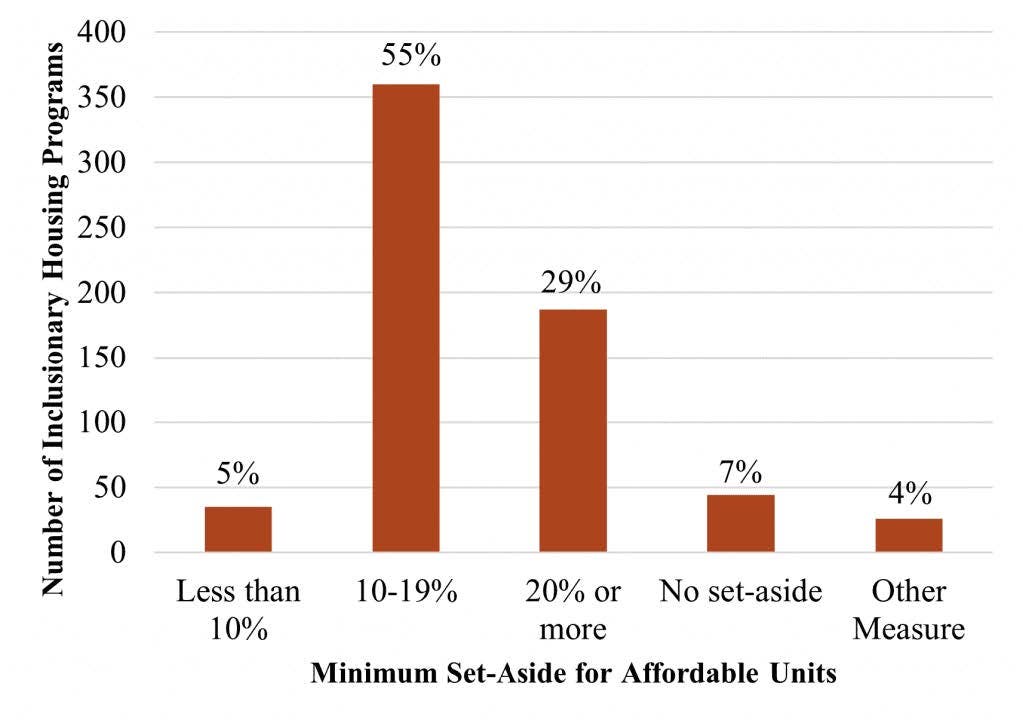
If enacted, the inclusionary housing policy now under consideration by the Skokie Village Board would be the weakest in the northern suburbs. The proposal calls for a mere 5% affordable housing set-aside for developments of 11-150 units, and 10% if larger. Indeed, the parameters of this ordinance are below the national average, as documented by Shelterforce Magazine (2021) in their study of the “over 258 inclusionary housing programs” which have “reported creating about 110,000 affordable homes.”
Moreover, Skokie’s definition of “affordable” will help virtually none of our essential workers, retirees, or single parents. “Affordable” units would be split evenly for households at 60-80% of the area median income. This means half the units would be for those earning under $62,000 a year, and the other half would be for those under $84,000, depending on family size.
This draft inclusionary housing policy also ignores the roles our fixed, moderate, and low-income residents play in the economy. Affordable housing development is key to economic development. When we have a workforce who live near their jobs, families, or schools, we have a healthy producer and consumer economy. We have a more engaged electorate of people who have set down roots here. People whose housing is stable, affordable, and well-maintained make for a welcoming Village, and can use their housing status as a stepping stone to saving, investing, consuming, and improving a community’s quality of life. It is part of a cycle that is still the American Dream.
We advocate for an inclusionary housing ordinance that calls for at least 15 percent, preferably 20-30 percent, of a new residential or mixed-use development to be affordable, and to be affordable at 50-60% of the Area Median Income (AMI). The latest Census data shows that the most housing-burdened Skokie residents and workers are those earning under $50,000 a year, or 50-60% of AMI. This should be our affordability standard for rental housing.
This is also the standard that rental developers themselves have sought since 2021 when a new affordable housing incentive was passed by the State of Illinois. This incentive was part of a bill package intended to increase (and preserve) the number of affordable units in expensive areas. In Cook County, this is administered as the Affordable Housing Special Assessment Program.
It's important to note that to qualify for the Affordable Housing Special Assessment, a development must have at least 15% of its units affordable. Moreover, "affordability" is defined as “at or below 60% AMI.”
Given that the Village of Skokie wants to make it easier for developers to include rental units for low- and moderate-income households, it is essential for Skokie's Inclusionary Zoning Ordinance to steer developers (or rehabbers) to take advantage of this incentive.
This is yet another reason to set the floor for Skokie's new inclusionary zoning ordinance to 15% affordable, with affordability defined for renters at 60% AMI.
Housing Commission
A Housing Commission should be the hub of research, brain-storming, recommendations, and follow-up for the Board’s initiative to establish an affordable housing policy. It would collaborate with other Village commissions such as Plan, Sustainability, Economic Development, toward a holistic vision for Skokie’s future.
Each public hearing brought to light a common recognition that housing is foundational to a healthy community. We all want to meet diverse housing needs providing an array of options across the spectrum of household incomes. We also recognize that the current housing environment is dynamic and complex. We are encouraged that the Village is looking at long-term strategies including creating new opportunities to increase Skokie’s affordable housing supply.
Many of the recommended actions from the Village Plan Commission would normally fall under the purview of a housing commission. In the northern suburbs, all the municipalities that have made the strongest commitment to affordable housing have housing commissions. That’s because these commissions serve to simultaneously institutionalize and direct balanced housing development and housing support programs.
A housing commission would actively enlist the community in a continuing conversation through regular outreach, and would provide leadership in establishing the organizational framework and institutional relationships necessary to pursue alternate housing development strategies such as a community land trust.
Establishing a housing commission would be at no cost to Skokie, since all commissioners are volunteers. It would bring together subject matter experts and provide important leadership in identifying goals and measurable outcomes, recommending policy options, and making specific program recommendations. The commission would also provide a long-term perspective, monitor trends and developments, and leverage the experience from initiatives in communities throughout the country in shaping a robust housing policy in Skokie.
Mayor Van Dusen often cites Skokie’s boards and commissions as a model of community engagement in municipal government. We have commissions for sustainability, beautification, public safety, public health, family services, telecommunications, etc. Given this array of boards and commissions, and the recognition that housing is fundamental for a healthy community, the absence of a housing commission is conspicuous.
One of our members, Charlie Saxe, serves on the Sustainability Commission. Based on his experience working with Village staff, elected officials and members of the community, we can say, unequivocally, that Skokie has the capacity to create a strong, effective housing commission composed of qualified individuals. We also know there is a clear need for an intentional focus on creating, implementing, and monitoring housing policy in our community. We would therefore urge the Village Board and Mayor to create this commission to provide critical leadership in building a Skokie that truly welcomes everyone.
Comprehensive Housing Study
We strongly support Village staff’s recommendation to study and assess the ongoing supply and demand for inclusive affordable housing, particularly in relation to the current housing needs of Skokie residents and of workers who are employed in Skokie. At the time that Skokie’s current Consolidated Plan was created, nearly 38% of Skokie households were "cost-burdened" -- meaning they could not afford their own housing, with thousands of households paying over half their income in housing costs. Our lower-income homeowners as well as renters are the most stretched.
We strongly urge that the steps toward creating an affordable housing policy in Skokie include a examination not only of the number of units and their cost, but a qualitative assessment of what housing is available to Skokie residents and workers, the size, location, and living conditions of these units, and whether they are accessible for people who have physical disabilities and mobility impairments. We hope this study will examine not only the needs of Skokie’s current residents, but of people employed in Skokie who are as vital to our community as those who already reside here, and form the backbone of our Village economy. The study should also explore creative options for land use, financing, and examine how other Cook County suburbs have created affordable, accessible housing.
Once this study is complete, we urge the Village Board to use this assessment of current resident and worker needs as the foundation for creating sound, data-based policies that will meet our community’s affordable housing needs, and that will be updated annually under the auspices of a new Housing Commission. We hope the Village Board will continue to listen to the voices and stories of the Skokians who struggle to remain in the homes they love. Together we can create an inclusive Skokie that offers ample affordable housing options to people from across the income spectrum. Only then can we truly say “Skokie Welcomes Everyone.”