Neighbor News
From Houses to Homes: Toward a Humane Housing Policy in Skokie
With public hearings launching this week, we have a chance to unify Skokie's disparate housing policies into one that prioritizes inclusion.

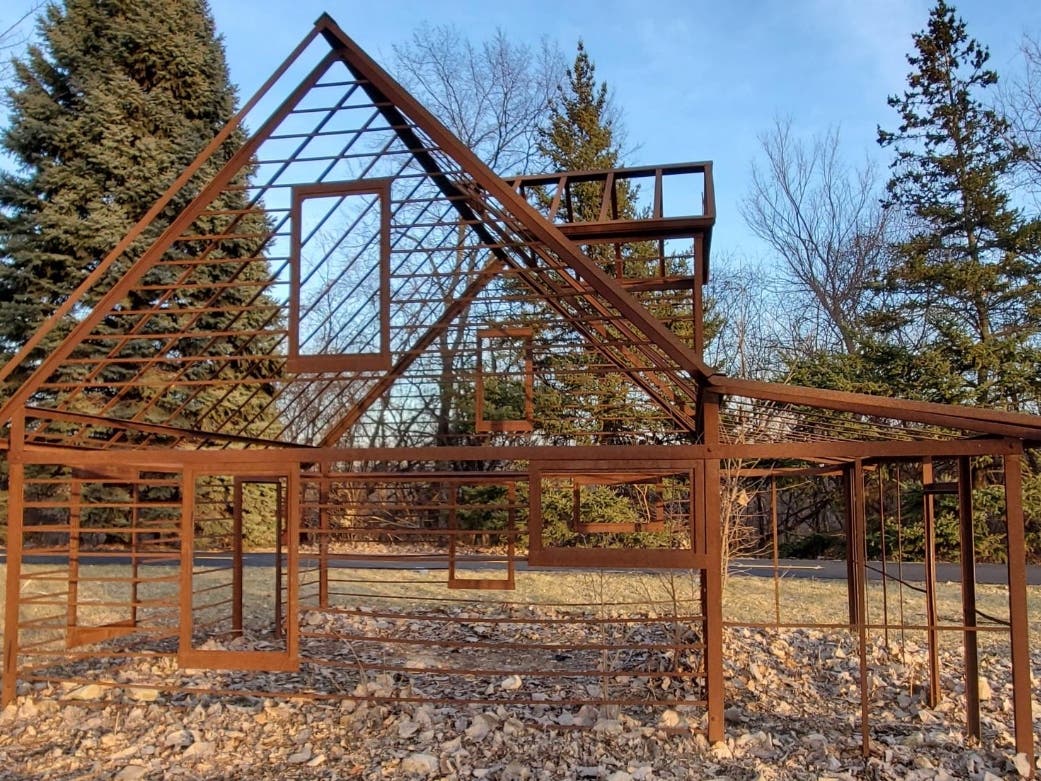
We hammer wood for a house,
but it is the inner space
that makes it livable.
-- Tao Te Ching, from chapter 11, trans. Stephen Mitchell
It is 1961 in Skokie. A white woman and man are crouching in a house to avoid bricks thrown through the windows from outside. Police watch silently. This is what Bob Basker described to me years ago of his experience fronting as the buyer for the first Black homeowners in the Chicago suburb. The two couples had decided strategically that it would be better for Basker and his wife to take the flak the first night. This remained a vivid memory for Basker, even decades after he divorced and moved to San Francisco where he extended his civil rights activism to gay rights.
When you consider this anecdote symbolically, you perceive a house that is simultaneously a stake in a white bastion, an investment, and a bunker. None of these is particularly appealing in the context of community. In fact, these images are antithetical to community. Perhaps the most notable aspect of this story is the aftermath: the family just wanted to make Skokie home, and they succeeded. Open the door and here are the people.
Today, over 900 Black families own homes in Skokie. Half of Skokie’s population is now composed of people of color and live in 43% of the Village’s households (2020 Census). This is a source of pride for Skokie, as evidenced by its popular annual Festival of Cultures and two recent Skokie Community Forums.
Find out what's happening in Skokiefor free with the latest updates from Patch.
But Skokie as a destination and not a way-station, something clearly desired by residents of all backgrounds in these Community Forums, has not been reflected in the Village’s recent housing development decisions. The Village Board approved eight developments (a total of 1,100 apartments) in the last five years, catering almost exclusively to well-off commuters or “empty nesters,” to the dismay of a critical mass of residents who would have preferred mixed-income housing, myself including.
Now the Village Board has given us a chance to take a fresh look at Skokie as home – a place for us in all our diversity to live out our lives within a friendly and open community – rather than as a collection of commodified units. In November, Skokie adopted an Environmental Sustainability Plan, which states as the very first item under “Land Use and Housing,” to be completed in Phase 1: “LH1-1: Assess the community’s affordable housing needs and determine how housing for low and moderate income households can become sustainable in accordance with the Sustainability Plan.”
Find out what's happening in Skokiefor free with the latest updates from Patch.
Then last month at its December 19th meeting, in response to persistent pleas from residents, the Village Board authorized the Plan Commission to come up with an “affordable housing policy” for Skokie by the end of March. This was initiated by Trustee Keith Robinson, who also happens to be the first Black Trustee to serve on the Village Board. He prefaced his introduction of the motion to pursue the plan, which passed unanimously, by saying:
“I didn’t want to go into the new year without expressing my shared concern about affordable housing in Skokie... I cannot accept the fact that there is no current ordinance that governs affordable housing in Skokie. I think it’s time to formally explore it, interrogate it, identify who we are as a community, and understand the intent and impact on affordable housing in Skokie."
This Skokie affordable housing planning process will consist of a “Listen & Learn” session on Thursday, January 19th with affordable housing developers, two public hearings on February 2nd and March 2nd, and policy recommendations presented by the Plan Commission to the Village Board on March 20th.
It’s up to us – the people who live, work, worship, or study in Skokie – to make sure that the housing issues explored are broadly defined, and that the Village conducts affirmative outreach to all populations for their input.
First, we must pull back and recast the question more broadly as, “How do we make sure families of all backgrounds can experience ‘home’ in Skokie?” This takes the conversation out of the narrow confines of, “How do we create and sustain affordable housing?” Phrased in this way, the Village can look at housing comprehensively with attention paid to:
- A full spectrum of housing types from which to choose;
- Keeping families of choice together, and options for living near work or school;
- Housing access and home modifications for older people and people with disabilities;
- Fair housing compliance (the largest number of discrimination complaints are based on disability, race, and presence of children) and feeling safe and accepted;
- Rental housing rights and responsibilities (28% of Skokie’s housing stock is rental);
- Racial and economic integration;
- Cultural sensitivity in housing design (for example, intergenerational households are the norm for many ethnic groups);
- Common spaces and neighborhoods rather than “gated communities” of privatized amenities and social isolation;
- Walking, biking, and public transit rather than cars;
- Shopping locally, which recycles residents’ dollars;
- Income boosts in the form of housing subsidies; and
- Ensuring that new development does not result in the displacement of vulnerable families.
Taking a broader look at housing also ensures that Skokie has one unified housing policy rather than multiple policies that bear no relation to one another. The reality is that Skokie has allowed itself to be guided by a marketing study it commissioned in 2016 of the Concord Group focused on affluent households that are small and childless. Ironically, that very same marketing study tells another story. It is that households earning under $50,000 have been leaving the North Shore because they are spending nearly half their incomes for housing. This is also documented by the Village of Skokie itself in its Consolidated Plan:
The greatest problem is housing cost burden, where almost 40% of Skokie households have housing costs that are >30% of household income…. There are over 4,000 Skokie households with a housing cost burden of greater than 50% of household income… [emphasis in original]
But the Village’s one-sided housing agenda over the last five years – inspired by the Optima Towers 665-unit luxury development in 2007 – has resulted in a growing economic divide in Skokie. Households earning over $100,000 a year doubled since 2000, with those pulling in $200,000 or more rising over 237%, while those at every other income level declined:
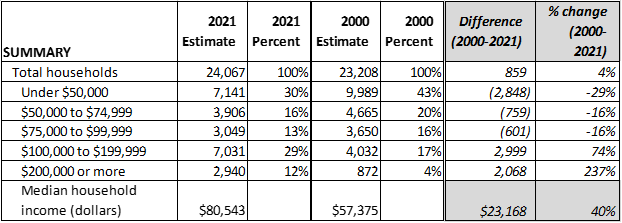
(Source: Census and American Community Survey)
With one housing policy, the Village would have the ability to evaluate the impact of a proposed development and make equitable decisions that do not benefit some at the expense of others.
Mixed-income developments also provide a healthy climate for civic engagement. Most new luxury developments privatize amenities, which makes it all too easy for the residents of these buildings to remain segregated from community life.
Secondly, the process must be inclusive. Less than half (46%) of Skokie residents speak English only at home. Yet there is only one announcement about these housing hearings, and it is in English.
Moreover, the two hearings are at the Village Hall, which can be physically impossible to get to for people with mobility impairments, or else generally intimidating. Even the American Planning Association instructs governments to “meet people where they are.” According to ICMA (International City/County Management Association), of which Skokie is a member, maximum participation by residents involve “multiple opportunities to engage,” accommodating various languages spoken, and using a variety of tools such as online surveys.
Skokie is on the right path, and the timing is with us.
The immediate future augurs a Westfield proposal to build a 350-unit luxury “community” where a vacant Bloomingdale’s stands at Westfield Old Orchard Mall. What could be more just than for the Village to wield its new unified housing policy to ensure that Westfield accommodates the low-wage workforce at the mall? In The Emergence of Stable Racially and Ethnically Diverse Urban Communities: A Case Study of Nine U.S. Cities (1997), Loyola University’s Phil Nyden and co-authors raise the importance of “social seams” in providing for stable, integrated communities:
“Social seams” are those points in the community where interaction between different ethnic and racial groups is “sewn” together in some way—a concept used by Jane Jacobs in The Life and Death of Great American Cities (1961). The most common seam is a grocery store or a strip of stores. Even where people of different races and ethnicities may be living within small clusters of blocks, these seams can bring them together.
Let’s use our social seams rather than dismantle them. A Westfield representative told the Chicago Tribune, “The strategy we’re rolling out here, we’re rolling out on a national basis.” Westfield has 80 malls. How wonderful it would be if Skokie would establish a precedent of stewarding mixed-income, open communities in these malls.
But first thing’s first. We need a set of principles and a policy for housing in Skokie that has the imprimatur of the broadest swath possible of those who call Skokie home. For guidance, we could do no better than to consider the wisdom of Dr. Martin Luther King Jr., whose 94th birthday we commemorate. I recall these words from his “Beyond Vietnam” speech at the Riverside Church in New York, which say as much about housing as about war:
We must rapidly begin the shift from a thing-oriented society to a person-oriented society. When machines and computers, profit motives and property rights, are considered more important than people, the giant triplets of racism, extreme materialism and militarism are incapable of being conquered.
When we shift from viewing housing from a thing-oriented to a person-oriented perspective, we create a truly inclusive community. The Skokie house becomes a home.