Neighbor News
Our Communities Shape Us: A Highland Park and Highwood Reckoning
A history of race and class tension stoked by local power brokers may have provoked in Crimo an intolerant worldview climaxing in violence.

In the wake of the Independence Day mass shooting in Highland Park, which left seven people dead and 48 wounded, news outlets described the town as an affluent Chicago suburb with a quaint downtown. It was characterized as “the last place where you’d expect a shooting.”
Maybe. Maybe not.
A closer look at the social history of Highland Park and neighboring Highwood in the late 1990s and early 2000s reveals an era in which people’s value and social acceptability were measured by their perceived effect on the value of property. This is the time and place where accused killer 22-year-old Robert Crimo III was born, and it is one context among others that should be considered when trying to understand his actions and motivations.
Crimo is portrayed variously as a fascist, racist, anti-Semitic and nihilistic young man with violent parents who fell in with Trump supporters and the dark web. But he is not simply an isolated anomaly who found companionship only in a virtual world of MAGA rallies and gun culture. As you will see, he came from a local environment of race and class tension, which may have engendered in this one troubled individual an intolerant worldview that climaxed in a horrific and apparently inexplicable act of violence.
Highland Park last made national news in 2000, over allegations of racial profiling by police.
A lawsuit in 1998 was filed by a dozen whistleblowers from within the Highland Park police force. Rev. Jesse Jackson and the Rainbow/PUSH Coalition took up their cause.
Find out what's happening in Skokiefor free with the latest updates from Patch.
Officer Rodney Watt, one of the lead plaintiffs (who also testified before Congress), said he was told to make sure he enforced the “N.U.T. Ordinance”:
The N.U.T. ordinance was an unofficial practice that stood for “barring” – excuse me for saying this – “[No Blacks] Uptown.” We were to keep African-Americans away from the central business district’s parks and beaches so that the community would not become nervous.
Officers also targeted Latinos for traffic stops, using code words like “sombreros.”
Find out what's happening in Skokiefor free with the latest updates from Patch.
It was hard to tell if the community as a whole understood that there was something seriously wrong. I had been asked, as executive director of the Interfaith Housing Center of the Northern Suburbs (now Open Communities), to find a Highland Park house of worship to host a congressional hearing on the profiling. Nobody wanted it. So I connected Officer Watt’s mother and Rainbow/PUSH with Rev. Don Harwell of St. Paul AME Church in neighboring Glencoe, which hosted the hearing and a rally of faith leaders.
In drawing attention to the issue, Rev. Jackson noted, “This is an old sick phenomenon with a new name. It used to be called just racism. Now they dress it up and call it racial profiling.”
In March 2000, six months before Crimo’s birth, Rep. Maxine Waters (D-Ca.) chaired the hearing, which included Rep. John Conyers (D-Mich.), the ranking minority member of the House Judiciary Committee, and Rep. Danny Davis (D-Ill.) of Chicago.
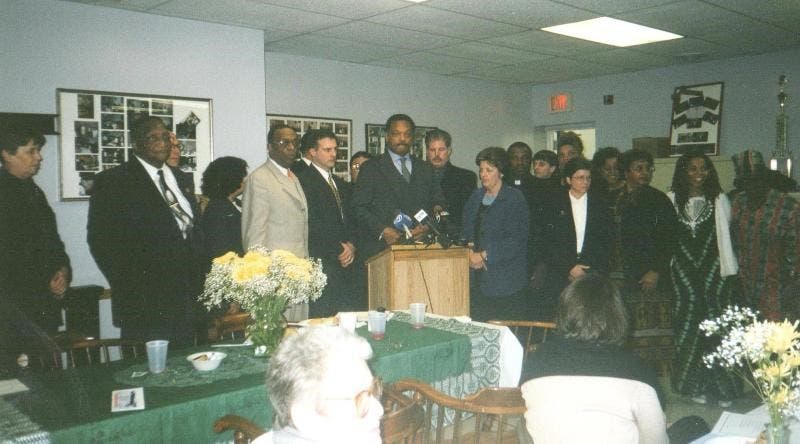
The City of Highland Park responded to these allegations by hiring Thomas Sullivan, former U.S. Attorney, to conduct an internal investigation. At the City Hall press conference unveiling the 346-page report in May 2000, Sullivan concluded the Highland Park Police Department leadership does “not get a clean bill of health by any manner or means.” He found that many officers did engage in racist practices.
Just outside City Hall, St. Paul’s Rev. Don Harwell and protesters asserted, “Racial profiling is alive and well in Highland Park.”
Ultimately, the cascade of protests and testimony that began with the 12 Highland Park officers led the Illinois legislature in 2003, in a bill introduced by then State Sen. Barack Obama, to mandate that every law enforcement agency send data annually on police stops to the Illinois Department of Transportation. Highland Park Mayor Daniel Pierce opined, “If as a result of this episode, Highland Park can help raise awareness of a national problem, and offer solutions to that problem, then something good will have come of this controversy.”
But no issue better underlines the social tensions then simmering in Highland Park and Highwood than housing, especially for Latinos.
On the one hand, Highland Park has a history of embracing inclusive housing. Starting in 1973, when the city established its Housing Commission, through 1998, Highland Park sponsored a cumulative 212 low-income housing units for families with children as well as the more politically palatable seniors.
On the other hand, Highland Park and Highwood together and separately pursued development policies that rapidly expanded high-end housing at the expense of its more modest, wood-framed housing stock and the low- and moderate-income people, mostly Latino, who lived in it.
In the 1990s, as soon as President Bill Clinton lifted the McKinney Act requirement that decommissioned military bases like Fort Sheridan (located between Highland Park/Highwood and Lake Forest) must accommodate the homeless, a joint task force of municipal and county officials got congressional permission to turn the site over to developer Richard Stein as the all-luxury “Town of Fort Sheridan.” That joint task force had been prepared to allocate a portion of the base for formerly homeless families and veterans, not because they wanted to, but because they had to. It was frustrating to see defeat snatched from the jaws of victory.
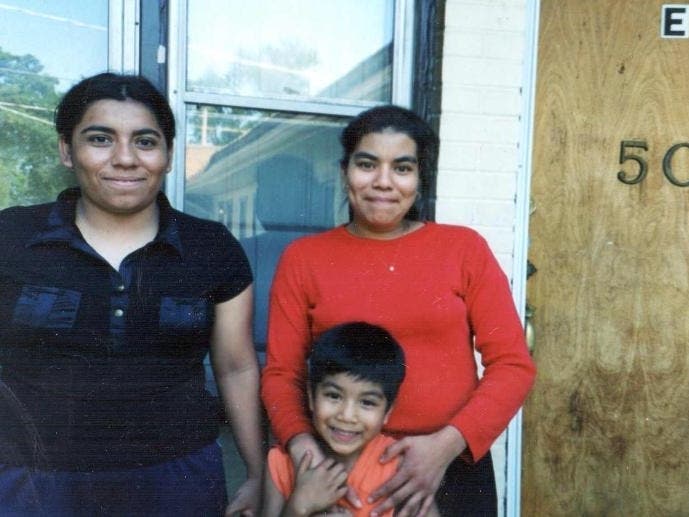
In 1998, Highland Park Mayor Ray Geraci, fresh from his Fort Sheridan coup, established a tax increment financing district to create Renaissance Place, an all-luxury development downtown that included a Saks Fifth Avenue store. The project ended up displacing more than a dozen families, all Mexican-American, who rented homes on that Green Bay Road site. Contrary to what the mayor stated publicly, my Freedom of Information Act request at the time revealed that the City gave the families no financial or other relocation assistance.
Only one family got an extra two months, to allow the eldest son to graduate from the high school. I remember going to the house to talk to the family. All the neighboring homes were already boarded up. The mother, who worked at a nearby mall, told me that landlords were illegally turning her down due to her having children. She decided to move to California.
It was spring and tulips were coming up in her front yard, but they and the house would soon give way to a luxury department store on the site. Mayor Geraci and the builders used golden shovels at the groundbreaking.
Across the street that same year, new condos under construction would also displace dozens of Latino families. Although this was not part of the TIF district, it involved the same developer as Renaissance Place, Heitman Properties. Tenants told me that a company manager rounded them up and told them that new condos would be developed “out of the price range of Mexicans.” In addition, the tenants alleged that the city cut gas and electric services until the tenants called in protest, that tenants were forced out of the public parks by police and that at least one tenant was forcibly removed by police.
Local developers served in city government, creating conflicts of interest. David Hoffman, chairman of the Highland Park Housing Commission in 1998, was also the president of Red Seal Development, one of the developers of Fort Sheridan. A letter to the local newspaper called the TIF district displacement “ethnic cleansing.”
Highland Parkers were not universally in favor of what seemed to be a developer free-for-all in their town. This development discontent was instrumental in Daniel Pierce’s victory over incumbent Geraci in the April 1999 Highland Park mayoral race.
Between the lost opportunity for affordable housing at Fort Sheridan, displacement by Renaissance Place, the rampant tear-downs of single family homes by wealthy buyers, and the widening gulf between stagnating worker salaries and rising suburban housing prices, well-respected civic leaders like Betsy Lassar, Housing Commission chair, and Janet Freed, who led the Highland Park Welfare Council, called for a housing needs study.
The time was right for a housing study because the City had also been working on updating its comprehensive plan.
I believe that the concurrent public allegations of racial profiling by police didn’t hurt the prospects for success on affordable housing.
In 1999, the City allocated funds to the Voorhees Center of the University of Illinois at Chicago to conduct the study and come up with policy solutions. When Crimo was born, the study was nearly done.
The Highland Park Affordable Housing Plan was adopted in January 2001. It contained a menu of affirmative policy suggestions that have since been implemented, such as inclusionary zoning (affordable housing set-aside in market-rate buildings), an affordable housing trust fund financed in part through a teardown tax, a program for first-time homebuyers, and the creation of a Highland Park Community Land Trust (now Community Partners for Affordable Housing) to own and control affordable housing in perpetuity.
These remain the most progressive housing policies in Illinois. It’s too bad the overall high-end trajectory of Highland Park was already literally set in stone by then.
Highwood, a smaller neighboring suburb to the north, attached at the hip to Highland Park through a shared school district and a township government, moved along a similar pro-development path. The town was home to a dominant Italian-American population, members of which owned the popular restaurants that lined Green Bay and Sheridan Roads and ran the local government. Since the 1960s, Mexican-American families moved to Highwood in increasing numbers, in order to work at the army base, at landscaping and other companies, and in the many restaurants in town. They lived in houses that had been converted to two- or three-family homes, above stores, and in old apartment buildings.
When the joint government task force turned Fort Sheridan into a luxury enclave, it gave an official thumbs-up to the market pressures that increasingly threatened Latino renters.
Developer Richard Shields, Richie Stein’s right-hand man, told me he would build a wall so his homeowners would not have to look at Northshore Estates, a sprawling 250-unit apartment complex housing mostly Hispanics. He told me he wanted to find a buyer for it. Years later, the complex did indeed change hands. (It’s now the luxury “Arrive North Shore.”) This occurred despite the best efforts of tenants themselves, my organization, Family Service of South Lake County, United Power for Action and Justice, and the Voorhees Center, whose Impact Study documented the positive tax and consumer value to Highwood of housing the current residents, half of whom worked in the town.
The Highwood city government adopted a rental inspection policy that Latino residents said – and our investigation showed – unfairly targeted them. In early 2003, Highwood used both a TIF district designation and rental inspections to close a five-unit building that housed workers from Carousel Linens, located next door. One of the tenants, Celita Vasquez, was the shop steward and helped to corral Carousel owner Scott Close, the needle trades union, the Jewish Council on Urban Affairs, and my organization to stop the demolition. A sympathetic member of the Highwood City Council also stepped in to find alternate housing for the families when it looked like we would not prevail.
“I just believe it’s illegal, what the city is trying to force me to do. They want to kick Latinos out of town here; I think that’s the bottom line,” said Close to the Chicago Tribune.
I was also quoted in that story affirming our support for the tenants and as a result, received an anonymous hate letter. I contacted the police and the FBI, but the writer was never identified. It was filled with racial epithets and threats of violence.
A year later, the city of Highwood shuttered four apartment buildings housing 70 renters, claiming their landlord did not make requested repairs. The tenants, almost all Mexican, had to be out in 48 hours. I met with many of those tenants the day they got the notices under their doors. My former colleague Bernie Kleina of the HOPE Fair Housing Center told the Chicago Tribune, “Show me a town that is overzealous in their enforcement of the codes and I will show you a town with a growing Latino population.”
During that era over two decades ago, HUD and the Justice Department investigated and found cause in numerous cases of displacement caused by TIFs or rental inspection ordinances in Addison, Cicero, Elgin, Waukegan, and West Chicago, all of which did indeed have significant Latino populations.
I remember participating in a meeting attended by Highland Park Mayor Daniel Pierce, organized by RELATE (Religious Leaders Acting Together for Equality), a group of north suburban religious leaders. Members expressed the discomfort many Black and Latino people felt in Highland Park.
Mayor Pierce countered with the policies and programs that showed that on the contrary, they were welcomed in the town.
You do not need to be defensive, we said.
Pierce slammed the table. “I’m not being defensive!”
We left wondering if he heard our message that perception is reality, meaning that the onus is on the city to broadcast as well as institute practices that demonstrate Highland Park is an inclusive community.
Years later, I think the Highland Park City Council has come to understand this message.
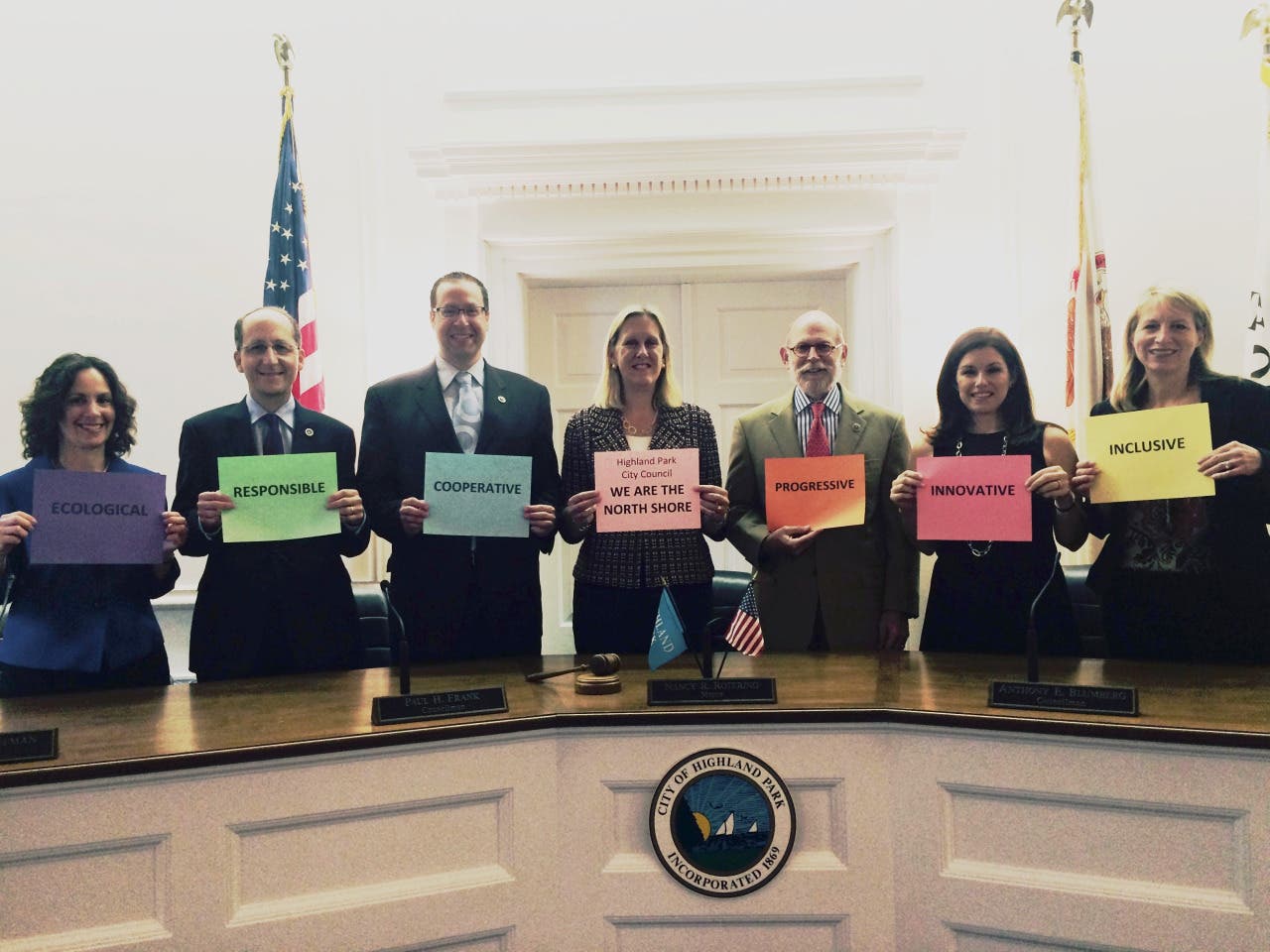
Inspired by the “We are the 99 percent” campaign, Open Communities, which had just broadened its scope and discarded the Interfaith Housing Center name, completed a focus group study that found Chicagoans, regardless of race, felt the northern suburbs were elitist. Open Communities responded by providing a social media forum, We Are the North Shore, for north suburban residents to speak to their welcoming attitude and existing racial diversity in the area.
The only municipality that contributed to our We Are the North Shore campaign was Highland Park.
Still, so much pain and dislocation over the years could have been avoided.
Latinos remain underrepresented in government despite their numbers. Although 44% Latino, the Highwood City Council remains all white. Black people are virtually invisible in both cities at less than one percent of the population in Highland Park and just over three percent in Highwood.
We saw many people abused in Highland Park and Highwood because of their race or class. What if the powers that be had followed the law and included housing and services for the homeless at Fort Sheridan? What if the houses on Green Bay Road had been rehabbed instead of being torn down for a Saks Fifth Avenue that isn’t even there anymore? What if the Highwood government had upheld the rights of its Latino residents, instead of treating them as undesirables?
In situations like this of communal responsibility, sincere acknowledgment of wrongs done is almost as important as corrective policies and messages. A reckoning with the past and a heartfelt apology to those injured is part of the pilgrimage to justice.
Dr. Martin Luther King, Jr. described this final stage as the precondition to reconciliation:
And so the aftermath of violence is bitterness, but the aftermath of nonviolence is the creation of the beloved community. The aftermath of nonviolence is redemption and reconciliation. This is a method that seeks to transform and to redeem and win the friendship of the opponent, and make it possible for men to live together as brothers in a community and not continually live with bitterness and friction.
With this reckoning, people come together as equals. They are no longer defensive, no longer walled behind untruths. When young people grow up in an atmosphere of respect and honesty, there is less chance for prejudice and hatred to take root.
This essay, which several people who also lived these experiences encouraged me to write, has brought back some personally painful memories. I do not wish to rub salt in the wounds of a traumatized community. I ask myself, is it worth it to remember? And then I think of a comment made by a Black high school student in a nonviolence training I helped facilitate: “If I don’t know my history, I don’t know how to value myself.”
To paraphrase Winston Churchill, our communities shape us just as we shape our communities. To some extent, we are all products of our history and culture – but, as conscious beings, we can also bend the path we’ve inherited toward a better destination.
Highland Park and Highwood are fairer, more inclusive places now than they were 22 years ago. But they are far from perfect, and the misdeeds that occurred in terms of policing and housing policy have left their mark on people like Robert Crimo III. These racist policies and decisions need to be remembered and acknowledged – and not just in Chicago’s North Shore. Only by owning up to past abuses and striving for what Dr. King called the “beloved community” can we make future hate crimes genuinely unthinkable.