Schools
Police Union Rep 'Threatens' Not To Help Schools: Board Members
As the D-219 board debates cutting cops from Skokie high schools, a union representative warned officers would not respond "for any reason."


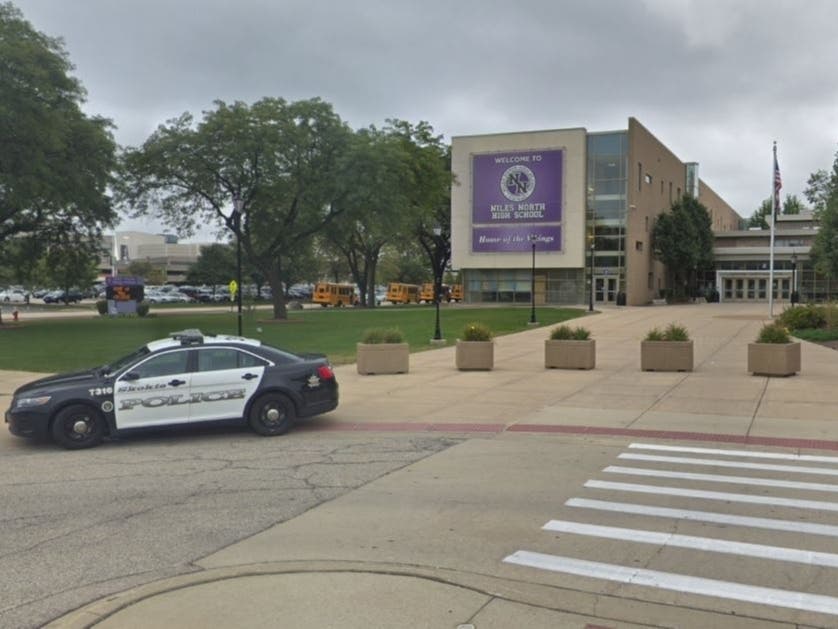
SKOKIE, IL — School board members demanded an apology from a representative of the union representing police officers in Skokie during a discussion of police officers assigned to Niles Township High School District 219 schools.
The District 219 board addressed the potential removal of the school resource officer, or SRO, program for a second consecutive meeting Tuesday. No vote was taken, as the item was placed on the agenda for discussion only. The board is expected to again take up the issue at its August meeting.
In the wake of nationwide demonstrations in favor of equal justice and against police violence, boards of several area school districts and individual schools have elected to end their relationships with their respective police departments. Generally, school districts pay all or part of the salary of sworn local police officers assigned to school buildings.
Find out what's happening in Skokiefor free with the latest updates from Patch.
Spokesperson Jim Szczepaniak, the district's director of community relations and strategic partnerships, read public comments aloud at the start of the meeting.
More than two dozen of those who submitted comments opposed the continuation of the district's SRO program, compared to two people in favor. At a previous meeting, the comments were similarly lopsided, with 86 against keeping police in schools and 11 in favor, according to board members.
Find out what's happening in Skokiefor free with the latest updates from Patch.
Jason Stanford, a social studies teacher and mock trial coach at Niles West High School, is a former police officer with the Evanston Police Department. He too called for an end to District 219's SRO program.
"The training that an individual completes at a police academy does not train them to work with adolescents in a school environment," Stanford said. "The primary goal of the training that takes place in the police academy is to teach future officers laws and how to enforce laws in their communities. A police officer that has undergone this type of training and worked in the communities will have a very difficult time shifting their mindset once they become an SRO in our schools."
Stanford, who is Black, said he had personally witnessed police discuss how they think high school students — mainly non-white ones — are committing crimes outside of school, and how law enforcement sought to write up more criminal incident reports while at school.
"By continuing the SRO program in our schools, we are continuing to perpetuate the school-to-prison pipeline for our Black and Brown students," he said. "Police officers are supposed to make individuals in a school community feel safe. Unfortunately for many of our Black and Brown students and staff, this is not the case."
Stanford shared an annotated bibliography of research into the effects of police in schools that supports his comments.
One of those in favor of keeping cops in schools was Elline Eliasoff. She said she was scared of what could happen without an officer on campus.
"In the case of a school shooter, quick reaction time equates to lives saved," Eliasoff said. "As a mother of a child in the district, I am terrified at the thought of a random act of violence that could injure mine or any child in the school and a system not equipped to quickly respond to such incident."
The most vocal backer of keeping police in Skokie schools was the vice president of the Fraternal Order of Police Lodge 68.
Damon Nikolopoulos said he had offered to speak with board members, but they did not contact him. He criticized board members for posting their views about police in schools on social media, which he sought to refute.
Nikolopoulos said the union contract was negotiated according to state law. Rather than protecting officers from discipline for misconduct, he said it lays out the way they can be disciplined.
In fact, the contract limits the scope of discipline available to the police chief and gives employees who face discipline the option to choose whether to appeal the chief's decision to an appointed police board or through a grievance and arbitration procedure.
Nikolopoulos also described the village's demographic makeup, citing it as evidence against racial bias.
"That much diversity in a community the size of Skokie can hardly be characterized as racist," he said.
The police union representative called for the board to vote on the matter so the community knows where individual members stand. Nikolopoulos then suggested that — if the board voted to end its contract with the Skokie Police Department — officers would not show up to district facilities when someone calls 911.
"For the record, if the majority of the school board sees no value in the SRO positions and believes that having Skokie police officers at Niles West and Niles North facilitate a school to prison pipeline, then the board has the authority to terminate its agreement with the village," Nikolopoulos said.
"Should this school board decide that they believe a Skokie police officer is no longer needed in either school, there should be no reason for the police to respond to any D-219 facility for any reason," he said, in a remark several board members described as a threat. "The school staff could be trained to handle any and all situations."
Stacy Joyce, who said she was a Niles North alum who has since become a professional educator, called for the establishment of a new model of discipline in schools.
"When I think about the high school students I have taught and the misguided choices and actions they have made or taken full of hormones and a taste of 'freedom' from their home life, I simply can't imagine bringing officers of the law into those disciplinary situations and have it end as a positive learning experience for the students," Joyce said. "The police and justice system were not designed for educational purposes, so I don't understand why they would handle day to day discipline in schools."
Crystal Johnson, who identified herself as a parent of three children who will soon attend Niles North, said the harm of police in school is particularly acute for students with special needs.
"Even if the D-219 SRO is the nicest and most restrained individual in the world, our children are growing up in a world where they see police regularly shoot unarmed individuals who pose no threat," Johnson said. "Having police within schools in this climate is not healthy for children, particularly Black children or children like my daughter. Police officers are not educators, they should not be a daily part of the school experience."
Several Niles Township high school alumni also submitted form letters in opposition to the SRO program.
Board member Jill Manrique, who is seeking to remove SROs from D-219 schools before the start of the year, said she had not received information about the program she requested a month earlier, including the cost of the program, memorandums of understanding with the district and discipline data broken down by race and sex. She said the administration's inability to provide that information shows the SRO program is not being adequately monitored.
The board member also criticized the comments from Nikolopoulos, who had accused her of posting falsehoods on social media.
"We heard tonight them say the quiet part loud. Everybody heard them say that they were threatening to not come help the students," Manrique said. "And the irony is not lost on me and I'm sure it's not lost on the rest of the people listening, and the people sitting here on this Zoom from the board and the administration, that we are going incredibly slow in removing police officers that are threatening our safety because we don't feel safe without them? That's ridiculous. If those are the type of people that are inside our schools, then that's a huge problem."
Board member James Specker said he was alarmed by the "threat" from the police representative. He called on the superintendent to speak to Skokie's mayor and police chief about it.
Mayor George Van Dusen said in an email that Skokie police take an oath to serve and protect everyone in the village and praised the department. He declined to say whether he considered Nikolopoulos' remarks to be a threat or whether he personally supported stationing police officers in schools.
"We are dedicated to providing protection to all sectors of the Village — schools, businesses, residences, nonprofits," Van Dusen said. "We have an excellent Police Department and their dedication is above reproach. That service will continue. Our residents expect no less and deserve no less."
Member Rebecca Abraham said the history of the development of school resource officer programs, especially in the Chicago area, has been a racist one.
"Specifically during a pandemic, there's even more reason to get rid of SROs and increase social workers, and nurses, and school psychologists to handle what an SRO does — disrupting fights, deescalating conflicts — those are all things that could be done by others," she said, adding that it was not the first time a police officer threatened not to help the school. She demanded an apology from Nikolopoulos.
"I think it's a prime example of why we need to remove SROs," she said. "If just critiquing them ... elicits a fragile response of maybe we just won't do our jobs anymore, how are they going to respond to students that are uncomfortable with them or criticize them?"
But board member Neema Abraham said parents in the local immigrant community that she has spoken to want police in schools. Members of the community are less likely to share their views at public meetings, she explained.
"They have a different perspective," she said. "They want the SROs there. They feel like their kids are not safe if there's no police presence there."
Board member Rich Evonitz also asked for details of the SRO program, including what its goals are and when, if ever, the board has undertaken a review of it to see how it aligns with equity goals. He said he would welcome a review, while indicating he supported keeping police in schools to build trust in the community.
"Because of its welcoming nature to people of all races, ethnicities and religions, Skokie is a target," Evonitz said. "District 219 needs strong partnerships with law enforcement to ensure that our staff and our students are protected."
Board President David Ko did not address the police officer's remarks or share his thoughts on the program during the discussion.
Superintendent Steven Isoye declined to share his personal view on police in schools when asked. He said he would continue to gather information before presenting a recommendation to the board.
No data about District 219's relationship with the Skokie Police Department was included in the meeting materials or available Thursday, despite being requested more than a month ago by a member of the board.
However, a police report from the most recent unsolved homicide in Skokie gives a snapshot of the work of a District 219 SRO.
Officer Mike Jaworski reported that he was in the dean's office at Niles North, interviewing a student as part of an investigation of a "minor in possession of cannabis" on the afternoon of May 19, 2017, when he heard gunfire coming from the Old Orchard Mall. It turned out the officer had just heard the fatal shooting of Eric Cybak, who was found dead in the mall's parking lot later that afternoon.
Jaworski reported that he paused the interview with the student, opened the window to briefly look around the parking lot, then closed the window and continued to speak with the student and their parent. Within a minute, he reported hearing another gunshot. This time he called the police department to ask if anyone else had called in a report of gunfire at the mall.
"The dispatcher told me that no one has called. I then explained to Communications what I heard," Jaworski reported. "[Skokie Police Department] Communications told me they had no units available and I advised that if I heard anything further, I will let them know."
The school resource officer reported conducting no further investigation of the homicide he had just witnessed while probing a teenager's possible pot possession. In the more than three years since, police have not released any information about possible suspects, vehicles that may have been involved or any arrests associated with the case.
The board is expected to take the issue up again at a meeting next month. Ko suggested the discussion take place at a regular scheduled meeting rather than a special meeting to allow more public participation and transparency. The district has a policy of not recording its special meetings.
Get more local news delivered straight to your inbox. Sign up for free Patch newsletters and alerts.