Neighbor News
Sharp Romantic Comedy Splinter Returns April 29th and 30th in Evanston
Interview with Dmitry Yakubov, Director of the play Splinter, Part II
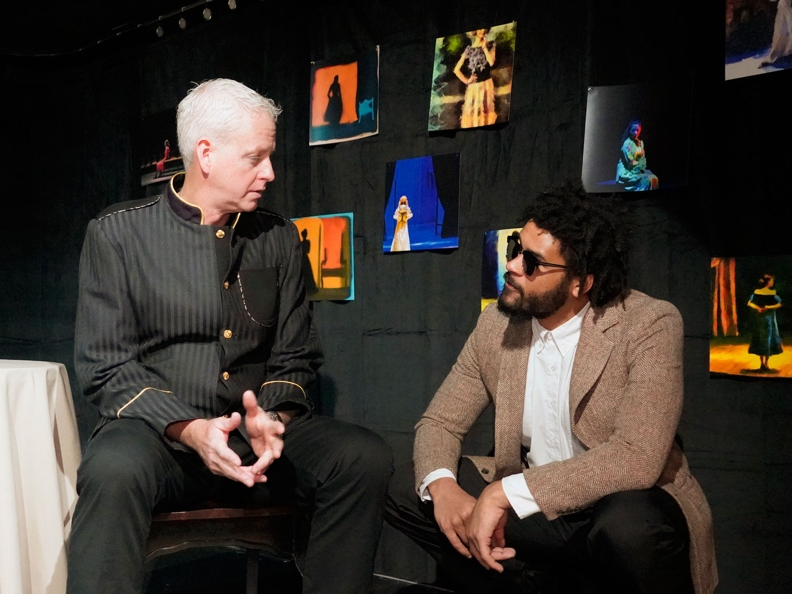


New Romantic Comedy Play Explores the Splinter in Your Heart
Following a glorious Chicagoland premiere of Splinter: A Romantic Comedy in
Wheeling, IL, last month, the play will be performed in Evanston on Saturday April 29th
at 7:00 p.m. and Sunday April 30th at 6:00 p.m. at Puth Family Theater of Music Institute of Chicago, 1702 Sherman Ave, Evanston, IL 60201.
Get Tickets now:
bit.ly/3m5eh2v
Part II of Interview with Dmitriy Yakubov, Director of "Splinter"
Find out what's happening in Skokiefor free with the latest updates from Patch.
Vadim Dekhtyar: In the play Splinter, the development of the conflict is wonderfully and very accurately described, as it spirals throughout the piece. This type of interaction is described in the 'Karpman Drama Triangle' model. And I'll tell you in a nutshell what it is. Karmpan is an American psychiatrist, whose work is based in part on 'transactional analysis,' a method of studying behavior through observing interactions which was founded by Eric Berne. I think that many have read this author, or at least heard about Berne and his book "Games People Play, People who play games"—this is about the psychological games that people play among themselves.
Dmitry Yakubov: And not on purpose. This is an unconscious attitude.
Find out what's happening in Skokiefor free with the latest updates from Patch.
VD: It's completely unconscious. What Eric Berne called pastime structuring. Karpman was his student and received an award for developing this model. And the model consists in describing the roles in this triangle. And the roles are formed in this model as follows - there is a victim, this is a person who suffers. If there is a victim, then there is always a persecutor. Karpman's theory says that this "persecutor-victim" connection is a fairly stable connection that can last for a long time. But the most interesting begins when the third person appears. Once again, I want to note that in your performance, the classic model of Karpman is very clearly visible in the relationships of the characters.
So, a third person appears who takes on the role of a rescuer. He sees that there is a suffering person, there is also an aggressor and rushes to save. And this is where the completely unexpected development of the plot begins. What does this mean? Roles very quickly begin to change in unpredictable ways. Very often, the victim moves into the role of an aggressor in relation to the rescuer, to whom she herself sometimes calls and turns. Does it really sound like a plot development?
Dmitry: It really does. Indeed, with the advent of the third person, the roles begin to somehow change, role-playing games change, and in the end it leads in a completely unexpected direction.
VD: While I watched the play, I counted. Almost three times each of the participants—and in this performance there are three roles, three people—almost three times each changed and was in each corner of the Karpman triangle. This is such an obvious initial plot, when the main character is a clear victim. There is also a conditional aggressor, who later becomes both a rescuer and a victim. They moved along these corners of this triangle quite a few times. It was fascinating.
Dmitry: The characters change these roles throughout the performance.
VD: Absolutely. But in the play, these movements are interesting to watch. Without even consciously monitoring and not realizing what is happening. If you do not know this model, then just watch the plot. In the play, it is wonderful to watch this, but in real life it leads to real conflicts, dramas, and the destruction of the family.
Dmitry: In general, it must be said that in the performance this led to the destruction of this couple. It's just that we, as viewers, may not perceive it so tragically, since it does not concern us. Although I know that many girls cried at the end of the performance, while laughing in the middle of the performance. Because there are really a lot of comic scenes. This is something sad, in some ways very funny, and in some ways very encouraging story.
VD: There are different levels of psychological games. But not playing at all—this does not happen. When we talk about dramatic games, then, of course, there is a way out, otherwise it would be...But not everyone finds it or finds it in a painful way. Or it ends badly enough. But speaking of the exit, you need to understand what is happening. This is the first step. When we talk about Karpman's triangle, or psychological games, there is a key concept that is missing when playing psychological games. This is the concept of responsibility. In this game, this concept is like a hot potato, everyone tosses each other, because no one wants to take responsibility for their actions, for their actions, emotions.
Of course, this is possible and real, this can and should be learned—the ability to take responsibility. This will be the way to stop this game or go beyond the Karpman triangle.
Dmitriy: The production interested a lot of people. Your explanation helps us understand these relationships, which the actors brilliantly played, not as a creative person or actor, but as a specialist in the field of hypnosis and NLP, which is especially interesting. I appreciate that you can analyze the performance with an understanding of the psychological nuances, and you speak brilliantly on this subject. Of course, I hear this for the first time and I, as a director, am extremely interested in rediscovering my play, Splinter.
DV: Dmitry, I am sharing psychological secrets, and today you are sharing professional
directorial secrets. Another question, Dmitry, to you. How did you work with actors?
Dmitriy: We worked through each moment separately. We worked very hard on how people look at each other, how they react to each other's words. How does body language change after a person receives some information or news. And so on, so on. I was interested precisely in psychological nuances, precisely in the life of the human spirit that Stanislavsky spoke about. What is important on stage? What is the purpose of theater? Show the life of the human spirit. And this task is extremely difficult. What is needed here is an understanding of human psychology, and relationships between people, and some knowledge of the basics of psychology, which I acquired, in particular, at my university and after that I began to study many things for myself. As I already mentioned, I devoted many years to social psychology and sociology. David Myers is just a go-to book for me on social psychology. I love this author very much. And he himself studied a lot of things and psychological directions. And being here, preparing for future productions, I already approached this not only as a director, but also as a psychologist. Like a director-psychologist. This is what I was interested in. And the actors felt it, they were drawn to it, because it was a new approach for them, and they were very interested in it. They repeatedly told me that this method of rehearsing enriched them very much. This is not just rehearsals, but also like a studio, like a school where they go to acquire new knowledge about acting, about the stage, about the theater. And it was especially flattering to hear, because these people are with acting education and serious experience in the theater.
________