Politics & Government
Progressive Income Tax Constitutional Amendment Headed To Ballot
In a party-line vote on Memorial Day, the House voted to put a proposed amendment to the Illinois Constitution on the November 2020 ballot.


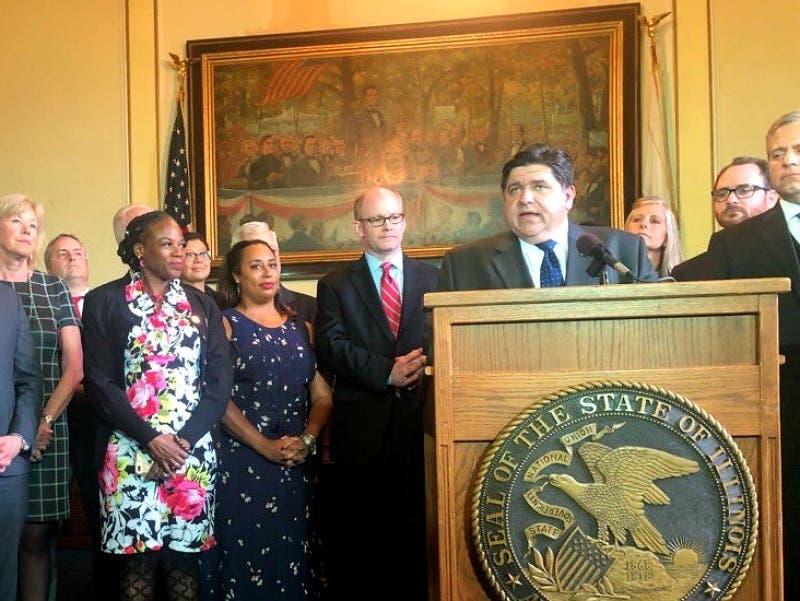
SPRINGFIELD, IL — State lawmakers approved a proposed amendment Monday to eliminate a clause in the Illinois Constitution that restricts the state to a single, flat income tax. In a party-line vote on Memorial Day, the Illinois House voted for the measure 73-44, with all Republicans in the chamber opposed. One Democrat, Rep. Andre Thapedi of Chicago, was absent. The vote puts the constitutional amendment on the ballot next year, but it does not define or limit what future rates might look like.
The amendment would allow the state to impose a progressive income tax, which Gov. JB Pritzker identified as a key source of increased revenue to stave off significant cuts to services and a continued expansion of the state's $135 billion unfunded pension liability.
Although the amendment contains no tax rate structure, no requirement for progressive rates and removes the constitutional limitation on multiple income taxes, Pritzker has promised a new set of graduated tax rates that would only see income tax bills rise for people making more than $250,000. According to the governor's office, raising rates to nearly 8 percent for the richest 3 percent of taxpayers will generate an additional $3.4 billion in revenue.
Find out what's happening in Springfieldfor free with the latest updates from Patch.
“For years, Illinoisans have been fighting to make our income tax system more fair to middle class families and those striving to get there, and this monumental vote in the General Assembly means that voters will have the right to decide our system for themselves in November 2020," Pritzker said after Monday's vote. He thanked Senate President John Cullerton and House Speaker Mike Madigan for shepherding the proposed amendment through Springfield.
“Reforming Illinois’ tax system to put middle-class families first by providing those families with tax relief is a major step toward a stronger Illinois, and I commend Governor Pritzker for his leadership," Madigan said. "Middle-class families bear too much of the burden under the current tax system, and a Fair Tax will enable us to make the wealthy pay their fair share to balance the budget and invest in critical resources like education and health care — all while providing relief for 97% of taxpayers."
Find out what's happening in Springfieldfor free with the latest updates from Patch.
GOP legislators warned that Pritzker's math was not going to add up. Peoria Republican Rep. Ryan Spain argued keeping rates flat would stop elected officials from continually raising taxes to keep up with increased spending, according to the Associated Press.
“It acts as a very powerful disincentive to continue adjustments and manipulation of tax rates to feed the whims of the General Assembly and the appetite for spending," Spain said.
The previous significant vote in Springfield to raise taxes also took place on a holiday. Nearly two years ago, the Senate voted on Independence Day 2017 to override a veto from former Gov. Bruce Rauner, raise the flat tax to about 5 percent and pass the state's first budget in two years.
Alongside the proposed amendment, Pritzker and Democratic lawmakers announced plans to create a task force to come up with recommendations to provide property tax relief to homeowners. Created through an Senate amendment to the new tax rates, the task force would be required to report back to the governor and General Assembly by the end of the year with an initial report due within 90 days of the law's effective date. The governor's office announced it will appoint two members of the task force, with the rest of the group comprised of state makers appointed by House and Senate leadership.
The group "will be charged with using a racial and economic equity lens to identify the causes of increasingly burdensome property taxes across Illinois, review best practices in public policy strategies that create short- and long-term property tax relief for homeowners, and make recommendations to assist in the development of short- and long-term administrative, electoral, and legislative changes to create short- and long-term property tax relief for homeowners," according to a release.
The task force proposal appeared to have assuaged a pair of House Democrats who questioned the rush to approve the constitutional amendment, the language of which was altered last month and approved through abbreviated committee hearings. Rep. Sam Yingling, of Grayslake, and Rep. Jonathan Carroll, of Northbrook, both wound up supporting the bill despite issuing public statements expressing concerns with the lack of property tax relief.
Rep. Blaine Wihour, a Beecher City Republican, said state lawmakers had failed to address the major problems facing the state's economy.
“We’ve done nothing to relieve the pressure on middle class homeowners," Wihour said, according to the Belleville News-Democrat. "All we ever do in this body is ask for taxpayers to put up more money to prop up an unsustainable government system that’s led by politicians who have shown over and over they have proven themselves untrustworthy with that money.”
Sen. Dan Harmon, an Oak Park Democrat, sponsored the proposed amendment. He has been pushing for Illinois to implement graduated income tax rates for nearly a decade, which he described as "critical and necessary as a prelude" to any legislative attempt to provide property tax relief.
"What really changed here was Gov. Pritzker," Harmon said, thanking the billionaire Democrat after the amendment's passage through the House Monday. "I can't tell you how grateful I am that you have made this a cause. It's the right thing to do. I understand you might pay a little bit more under the rate structure, but you know that this is the right thing for Illinois, it's the right thing for the middle class."
The proposed amendment will now head to voters in next November's election. Its passage requires approval from either a majority of all of those voting in the election, or 60 percent of votes cast on the amendment question.
Earlier:
Get more local news delivered straight to your inbox. Sign up for free Patch newsletters and alerts.