Politics & Government
State Income Tax Constitutional Amendment Passes Senate Committee
A committee approved a bill Wednesday to give voters a chance to repeal the Illinois Constitution's ban on progressive income tax rates.


SPRINGFIELD, IL — An Illinois Senate committee has passed a bill to propose a constitutional amendment that would eliminate the state's flat income tax mandate. The change would allow state lawmakers to establish different income tax rates for different levels of income as well as new taxes on different types of income.
The Senate Executive Committee voted 12-5 Wednesday to send the proposed amendment to the full Senate, which voted 36-15 on Tuesday to waive the requirement for six days of notice before a committee hearing. Both were party line votes with Republican senators opposing the changes introduced by Democrats in the majority.
In Illinois, constitutional amendments require approval from 60% of the members of each chamber and 60% of voters. If the proposal for an amendment allowing a graduated income tax is approved this session by the General Assembly, a referendum question will be presented to voters in November.
Find out what's happening in Springfieldfor free with the latest updates from Patch.
A change to the Illinois Constitution is necessary for the adoption of the progressive income tax rates proposed last month by Gov. J.B. Pritzker. Ahead of his election in November, the Chicago Democrat campaigned on a promise to protect middle class taxpayers while raising rates on the wealthy. His proposed "fair tax" anticipates the state can raise $3.4 billion from the top 3% of earners, while the other 97% would pay less.
"It doesn't make sense that I pay the same rate as a teacher or a first responder," said Pritkzer, one of 18 Illinois billionaires, at a press conference Tuesday. "Today, we are taking a first step, a next step to fix that unfairness."
Find out what's happening in Springfieldfor free with the latest updates from Patch.
The bill's sponsor, Oak Park Democrat Sen. Dan Harmon, changed the language of the amendment Tuesday. The first version of the proposed constitutional change suggested "lower rates apply to lower income levels and higher rates apply to higher income levels. No government other than the State may impose a tax on or measured by income."
Harmon amended it to eliminate any mention of a "fair tax." Now it simply says, "The General Assembly shall provide by law for the rate or rates of any tax on or measured by income imposed by the State." Both versions eliminated the constitutional limitation of a single state income tax for individuals and a single tax for corporations. He announced the amendment at a press conference with the governor.
"It is simply a slightly more 'lawyerly' way of saying what all of the prior versions of the amendment have said: that Illinois should have the tools to adopt a fair income tax where lower rates apply to lower income levels and higher rates apply to higher income levels," Harmon said. "This is something we've been working on for the better part of 10 years. What's different now is Gov. Pritzker, a governor brave enough to say this is the solution for our state and to put his considerable political capital behind this effort."
Harmon's proposed amendment does not specify any rate structure. Pritzker's proposed "fair tax" includes a top rate of 7.95% of all income for those reporting more than $1 million in income in Illinois.
Senate Minority Leader Bill Brady, a Bloomington Republican, said his caucus would not be supporting the constitutional change because it would put middle class families at risk.
"This provision opens up the opportunity to raise taxes even easier, and to play some games with our tax code. I believe that the crafters of our current constitution, and the fact that the people embraced that constitution which included a flat tax, was there to protect middle-income families from politicians. We've proven that it's fairly easy to raise taxes in Illinois in the last couple years and I think that this works toward even making that easier," Brady said before the committee's vote Wednesday. "The people who testified against this are people who employ middle-income families, and the concern that this opens the door is very, very alarming to us."
Matoon Republican Sen. Dale Righter, the committee's minority spokesperson, said Harmon's amended version was "actually worse than the original" because it eliminates the constitutional prohibition on more than one income tax levied on any individual.
"J.B. Pritzker's the governor today," Righter said. "But there'll be someone else in office. This leaves the door wide open to anything, including a system of taxation that taxes different types of income at different rates."
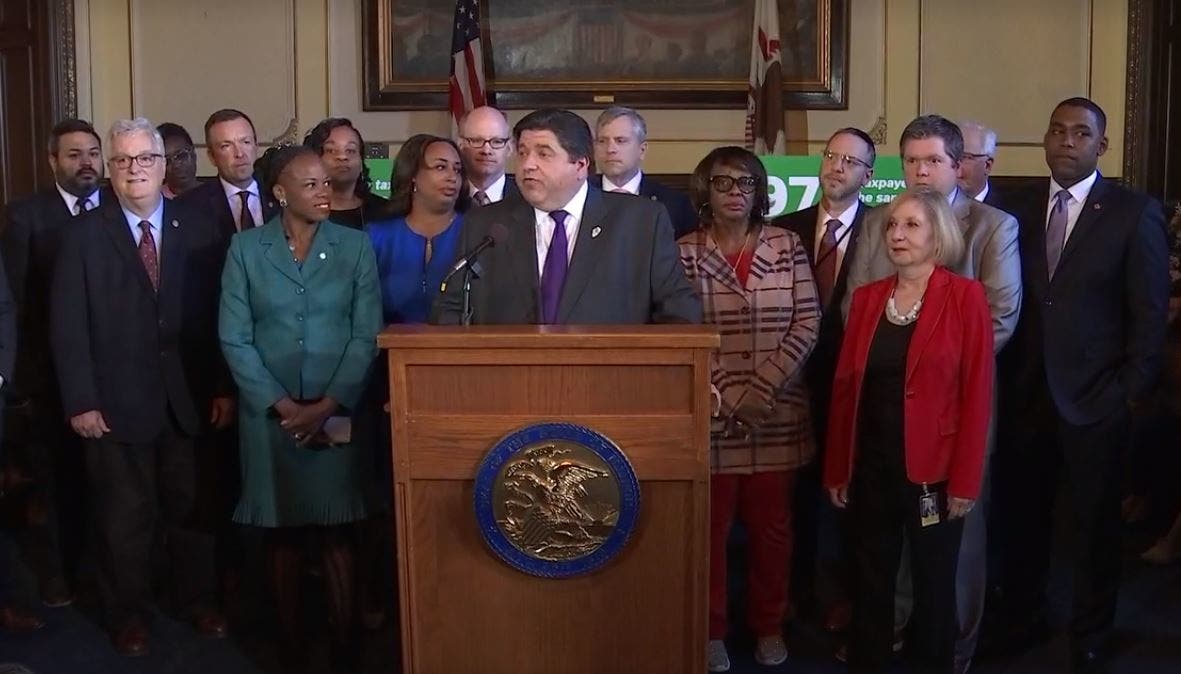
Pritzker said claims by opponents that his proposed tax plan would lead to the departure of wealthy residents and cost the state jobs are unfounded.
"For those who will oppose a fair tax by waging a misinformation campaign: It is transparent that you are defending an unfair status quo that benefits the wealthiest Illinoisans instead of offering your own ideas for how to fix our state's problems," Pritzker said. "Fact checkers have made this abundantly clear."
House Minority Leader Jim Durkin, a Republican from Western Springs, said the actual income rates should be included in the proposed constitutional questions since state lawmakers were, historically, not trustworthy.
“The 'unfair status quo' is what has happened to Illinois taxpayers by the same Democrats who run these chambers, who have passed massive tax increases in the last 10 years based on the premise that we would pay off our bills and get Illinois fixed — It never happened," Durkin told reporters Tuesday. "We should not be giving these Democrats in this building the ability to change rates and virtually a blank check to raise taxes on Illinoisans in the future."
Republicans have proposed their own constitutional amendment on income taxes. A bill sponsored by Sen. Dan McConchie of Hawthorn Woods would require a two-thirds vote of state lawmakers in both houses for any tax increase or new tax.
With Democrats holding a supermajority of 40 seats to 19 for Republicans, the constitutional amendment is likely to receive the 35 votes it needs for passage. In the House, 70 votes are required, but Democrats hold a slimmer supermajority with 74 seats to 44 held by the GOP .
Riverside Democrat Rep. Mike Zalewski said House Democrats aim to work with the governor to send the constitutional amendment to voters in the fall.
"The last four years have shown that our current tax system does not work for anybody," Zalewski said. "It's been four years of devastation. It's been four years of us trying to climb out of a needless hole."
Earlier:
Get more local news delivered straight to your inbox. Sign up for free Patch newsletters and alerts.