Schools
School District 303 Considers Class Without Textbooks
The concept of a paperless society continues to take root, and classrooms potentially are no exception.


Technological gains seem to be driving us ever closer toward becoming a “paperless society,” where everything traditionally recorded on paper is replaced with a digital alternative that can be viewed on a computer screen, tablet or smartphone. But how about a paperless classroom?
That’s right — no textbooks for students to lug around, perhaps someday no homework assignments that can be conveniently eaten by the dog. (No doubt some inventive child early on will suggest, “My dog deleted my homework.”)
But the idea of a paperless classroom — or at least a classroom without textbooks — is looming, and the concept was touched on briefly during a discussion of high school astronomy resources this week when the St. Charles Community Unit School District 303 Board of Education’s Learning and Teaching Committee met in the Administration Center.
Find out what's happening in St. Charlesfor free with the latest updates from Patch.
“The cost of textbooks is so enormous, and quite frankly they’re being used less and less,” Dr. Donald Schlomann, District 303’s superintendent of schools, told those attending the committee meeting. “This is a brave new world … this is really the first time we’ve dipped our toe into a really no-textbook environment, and I don’t think it will be the last time.”
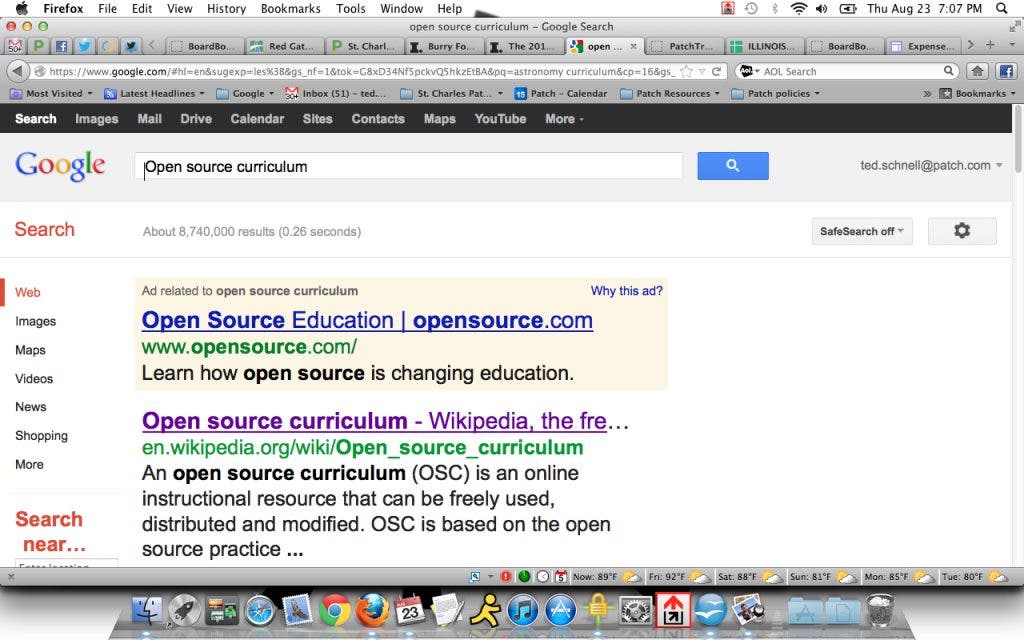
At the college level, educators call the concept open-source instruction, a concept similar to open-source software, where users who want it have access to the software’s source code. The idea is that the more eyes that look at the source code, the greater the likelihood they will be able to spot and resolve code errors, make substantial improvements to the code or even add new features to the software.
Find out what's happening in St. Charlesfor free with the latest updates from Patch.
With open-source instruction, which is being used at the college level, there are no textbooks needed — the curriculum is all online, meaning on Internet websites. Following the open-source software model, educators and others involved in the development of the curriculum can correct, modify or change it as new information becomes available or new discoveries are made.
In theory, such updates could occur immediately, where as with textbooks, which often are not reprinted every year, the change would come much more slowly.
In the case of the astronomy resources the committee was looking at on Monday evening, students would log onto the host website to a home page that might include homework assignments, announcements by the teacher, and other information for the students. But the educational materials also would be on the site — or could include offsite links to other materials.
Other advantages of online instruction include interactivity — a term the student may not be familiar with could have a link to its definition, for example, or holding the mouse over a diagram on a Web page might call up an explanation. That makes it easier for students to find and learn information provided as part of the coursework.
Committee members expressed concerns, however. One pointed out, for example, that searching for information on the Internet can be an open-ended effort, as link after link is explored — and many prove to be of little or no use.
Instructors, however, could limit such searches by directing students to specific websites to find the information they seek.
The idea had mixed reactions among St. Charles Patch Facebook followers on Thursday:
- St. Charles Patch How would you feel about a classroom without textbooks?
Diane Morales likes this.
-
- Joyce Sester School fees are killing parents. Will they be forced to buying Ipads? Will the school fees go up even more? 2:20pm
- Brandon Snow Yeah I don't wanna be responsible for and IPad or make my kids responsible for them either they have a hard enough time keeping their books in order 5:55pm via mobile
- Krista Oleksiak Lipnisky Text books- sure! :) but gotta love the chapter books! Keep those!!! 6:08pm via mobile
- St. Charles Patch Joyce Sester and Brandon Snow, you both raise good points. 6:09pm
- St. Charles Patch Krista Oleksiak Lipnisky, what do you mean by chapter books? 6:10pm
- Krista Oleksiak Lipnisky I teach elementary......I could get ride of the text books and incorporate trade books/ chapter books (novels) 6:14pm via mobile
The St. Charles Community Unit School District 303 Board of Education is scheduled to consider the astronomy curriculum on Sept. 10.
Get more local news delivered straight to your inbox. Sign up for free Patch newsletters and alerts.