Schools
St. Charles Educators Urged: Narrow Global Achievement Gap
District 303 teachers, administrators urged to stop teaching kids to do well on tests, teach them to become lifelong students, instead.


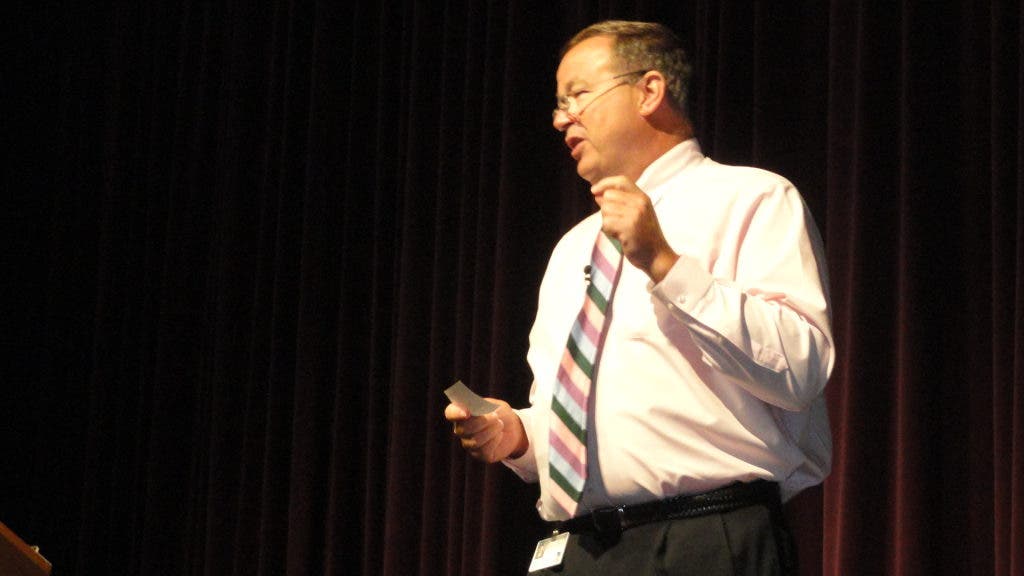


School district leaders on Friday rallied the troops to prepare for change as educators and administrators enter a new school year with optimism about improving education, fueled in part because the No Child Left Behind Act is scheduled to expire in 2014.
Friday’s gathering in the large auditorium of off Randall and Bolcum roads marked the start of a teacher institute day, when children got to stay home but teachers did not. School officials said it mostly likely would be the only time this year that nearly all school district employees would meet at one location.
For about two hours, speakers ranging from St. Charles Education Association President Pam Turiff to Board of Education President Steve Spurling to Superintendent Dr. Donald Schlomann and others spoke about progress the district has made and the opportunity it has to help reshape federal education policy after the No Child law expires as reasons for optimism about the future.
Find out what's happening in St. Charlesfor free with the latest updates from Patch.
Some of those reasons were more palpable than others — for example, the progress the district is making installing air conditioning. Schlomann said the district expects to have it installed in all the district’s 12 elementary schools within five years, but the plans include it also for the three middle schools.
But focusing on the future of education in an increasingly digital world and in terms of preparing today’s students for careers and/or college had the spotlight for much of the two-hour session, with a theme inspired by the book The Global Achievement Gap by Tony Wagner.
Find out what's happening in St. Charlesfor free with the latest updates from Patch.
Turiff, talking about education reform, talked specifically about the need to train and inspire students to not just to graduate, but to become lifelong learners who would continue to increase their knowledge and acquire new skills as needed in a world where technology is changing — and require the workforce to adapt and learn to skills to keep pace with it.
Teaching children to be lifelong learners was a common theme throughout the morning, as was developing in them the skills they will need to carry them through life. Turiff outlined some of those — helping children develop critical thinking/analytical skills, to become problem solvers, to be flexible and adaptable, to be effective at communication. But others during the session also pointed to the need for students leaving skill to be able to work on their own, but also as members of a team.
Schlomann, who told educators that the district’s administrators had to undergo between 60 and 80 hours of training over the summer in preparation for the new school year, praised the district for its improvement in scores — the ACT, SAT and ISAT. While that is wonderful news, he said, the district needs to move on.
With the No Child Left Behind Act set to expire in 2014, Schlomann said educations have an opportunity to help shape whatever replace it. In the meantime, however, he noted that District 303 alumni have offered the district suggestions on what they perceive as the district’s strengths and weaknesses in terms of preparing them for the workplace or for college.
The district’s educators, he said, have an opportunity to “change the way we’re thinking about education and prepare ourselves for whatever the government is going to hand down to us.”
That’s going to require the district to focus not only on kids who are going on to college, but those who are going on to a career right out of college, or who are going on to receive training at at a technical school or an institution like Elgin Community College, he said..
In that regard, he introduced a panel of four people representing employers in today’s job market — three of whom are District 303 alumna.
The panelists were Ron Bullock, Jeff Surges, Navy Cmdr. Nancy Fink and Patrick Crimmins.
The four shared their insights into what they need to see in high school graduates entering the workforce. Among the numerous attributes they said they valued were:
- The ability to communicate, which includes listening and understanding directions as well as being able to clearly lay our directions, expectations, etc.
- The ability to have and foster relationships with other.
- Basic computer skills and the ability to continue to learn new skills along the way.
- The ability to take existing knowledge and use it creatively/innovatively.
- The ability to work independently as required, but also to work as a member of a team.
- The ability to take the initiative to do extra things for the company — or team.
- Adaptability and flexibility.
- Passion.
Schlomann put the discussion into perspective, noting that throughout our country’s history, Americans have celebrated the risk takers and innovators, the influencers who brought about change.
Yet change, he said, typically inspires such reactions as dislike, eagerness to embrace change, or an excitement or distaste based upon the situation.
Change, he said, is occurring rapidly. Point to the development of the iPad, Schlomann noted that in less than 2½ years since it came out, it has changed how we think about education and has sparked such rapid change that businesses which could not adapt quickly enough have gone out of business.
Some companies simply failed to anticipate a need to adapt. Schlomann asked rhetorically how will backpack companies adapt if textbooks are replaces by iPads or similar devices.
District 303 already is considering its first foray into an astronomy class without formal textbooks — whose material is stored online.
“How do we not only survive but thrive in the face of rapid change?” he asked.
The No Child Left Behind Act sought to force conformity in education, Schlomann said, which is contrary to the American spirit’s celebration of innovation and risk-taking.
Summarizing from The Global Achievement Act by Tony Wagner, Schlomann reiterated some of the common skills mentioned by the panel of area employers that educators need to instill in their students — imagination and curiosity; the ability to work independently and in teams; critical-thinking and problem-solving skills, among others.
Follow St. Charles Patch by "liking" our Facebook page and following us on Twitter at @StCharlsILPatch.
You also can subscribe to have the St. Charles Patch newsletter delivered to your inbox.
Get more local news delivered straight to your inbox. Sign up for free Patch newsletters and alerts.