Politics & Government
St. Charles Observes Pancreatic Cancer Awareness Month
Survivor shares tale of devastation wrought by disease as the City Council passes a resolution designating November as awareness month.


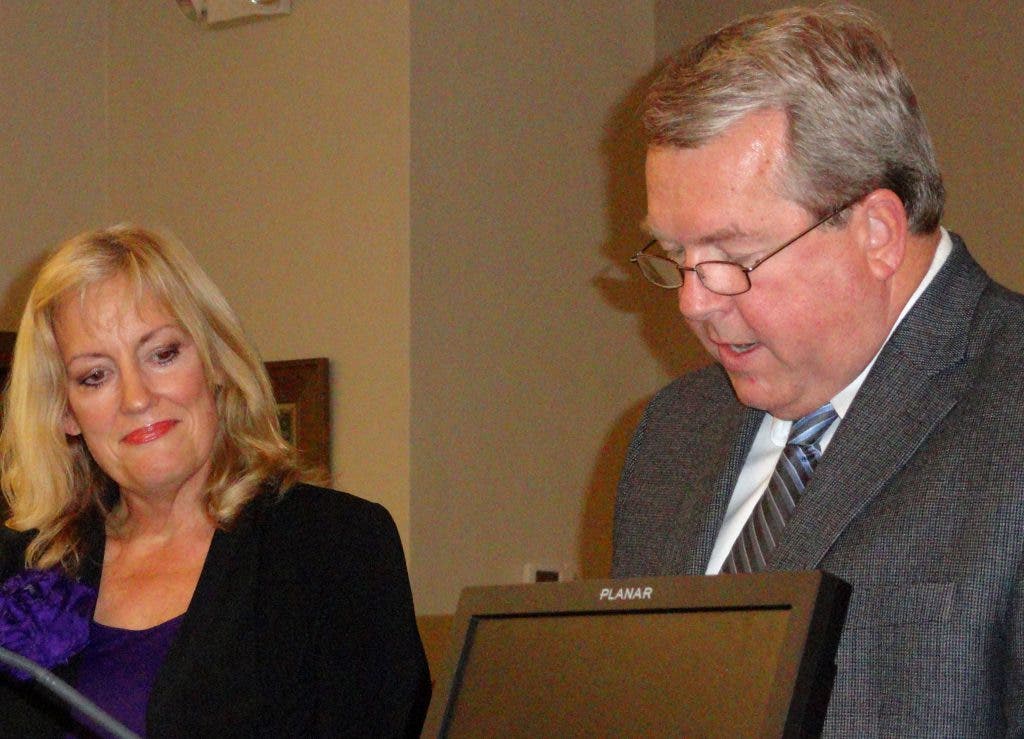
In a hushed St. Charles City Council Chambers on Oct. 15, Judy Sarvas shared a tale of heartbreak and tragedy as she spoke of how pancreatic cancer has afflicted her family.
“I am a 13-year resident of St. Charles and a three-year survivor as of Sept. 18,” Sarvas told those attending the meeting. “Survivorship was earned, though in the hardest of all ways. I have a terrible family history of cancer, and particularly pancreatic cancer.”
And 30 years ago, Sarvas said, a beloved uncle of hers died shortly after his 50th birthday and not long after he had been diagnosed with pancreatic cancer.
Find out what's happening in St. Charlesfor free with the latest updates from Patch.
“This big, strapping teddy bear of an uncle withered away to 150 pounds and died before our eyes in two months,” she said.
Frequently, by the the time pancreatic cancer is diagnosed, it is too late. Symptoms don’t manifest themselves until the cancer has grown and advanced too far along to be surgically removed or cured by chemo- or radiation therapies. Pancreatic cancer is considered to be among deadliest cancers for that very reason.
Find out what's happening in St. Charlesfor free with the latest updates from Patch.
“Seven of my mother’s other siblings died of related cancers, but the worst stories started eight years ago,” Sarvas said. “My brother Doug lives in Boston. On his second birthday, my nephew was diagnosed with ependymoma, an incurable brain cancer. Three months after that, his wife, my sister-in-law Sheila, was diagnosed with leiomyosarcoma, an extremely rare, pernicious disease that goes throughout your whole body … They fought concurrently for six years.
“In the midst of all that, our mother was diagnosed with Stage IV pancreatic cancer, only three months after her older brother had also died of pancreatic cancer,” Sarvas continued. “So at this point, my brother was losing in 14 months an uncle, a mother, a child and then his wife.”
So her brother Doug went to a doctor and asked for a thorough exam, still having a 10-year-old son to care for and a 20-year-old daughter who, like himself, had been devastated by their losses. “He went to the doctor with no symptoms. He was diagnosed with pancreatic cancer at the age of 49,” she said.
On the day after their mother was buried and the day of his surgery, Sarvas went to Boston and spent a month with her brother’s family. When she returned home, she said, she went to the hospital and asked to be scanned. The results were inconclusive, but she forwarded them to Massachusetts General Hospital in Boston. Doctors there diagnosed her with pancreatic cancer.
Six months into her treatment, while meeting a doctor there, she said she looked him in the eye and said, “I’m lucky, aren’t I?” His response, she said, was to take her hand in his and say, “You have no idea.”
“With most people with this pernicious disease, by the time you have any symptoms … by the time you get to that point, it’s too late,” she said. “The doctors will tell you, ‘Get our affairs in order.’”
The National Institutes of Health and the U.S. Department of Health and Human Services say it the fourth-leading cause of cancer death in the nation among both men and women.
“I thank you for your time and it is an honor to address this group and to create awareness for pancreatic cancer,” Sarvas told a completely quiet crowd in the City Council chambers. “It is one of the most pernicious, deadly diseases on the face of the earth.”
Yet it receives almost no attention, according to the resolution the City Council adopted. The federal government invests far less money into pancreatic cancer research than it does for other deadly cancers — just 2 percent of the National Cancer Institute’s federal research funding is for pancreatic cancer research.
Sarvas urged anyone encountering pancreatic cancer to go online to the Pancreative Cancer Action Network. “It is a fantastic organization providing support for patients, families and research dollars for the hope of an early detection device,” she said.
Related:
- Facts About Pancreatic Cancer
Get more local news delivered straight to your inbox. Sign up for free Patch newsletters and alerts.