Arts & Entertainment
St. Charles Woman Knits Her Way to Creativity
Connie Blieszner makes one-of-a-kind garments with a knitting machine.


Connie Blieszner of St. Charles remembers early childhood motivation to find a hobby she enjoyed.
"My mother didn't allow being lazy at home," Blieszner said. "We were always expected to be doing something."
For Blieszner, doing something meant learning to knit at age 6. She knitted by hand with traditional needles on and off for years. All that changed when she tried using a knitting frame, a machine that enables faster knitting and often produces more evenly textured fabric than knitting with hand-held needles.
"On a whim, I went out and bought knitting machine in 1991," said the Rockford, IL native. "I just took to it naturally. It opened a lot of creative doors for me."
Blieszner now creates patterns for and knits as many as 10 pieces of wearable art a year; mostly one-of-a-kind silk and wool jackets that blend rich colors and classic style. For inspiration, she weaves together her various life influences, such as technical abilities from her career as an engineer and her curiosity about topics like the Silk Road and the art deco artistic movement of the early 20th century.
"I started working with Japanese and Chinese ideas, and I realized that I was going down the Silk Road," Blieszner said of what she's made during the past 10 years. She has created various Asian-inspired garments and a jacket made to simulate mirror embroidery patterns from India, among others.
"My garments all start with a sketch," Blieszner said. "I use a sketch book and a black pen. I get an idea down on paper and I write notes with it."
After devising the initial concept, she designs pattern pieces and measures how they will all fit together before she even sits down at the knitting frame. She especially enjoys what she calls "construction challenges" by answering the question "How do I manage to get this idea into a real garment?"
The more difficult the idea, the more Blieszner can apply her math skills and manipulate a computer program designed for use with the knitting frame to help produce the more complicated aspects of a garment. One of her Silk Road-influenced pieces is a vest formed by two circles; a small circle knitted to fit inside a large doughnut-shaped piece that makes up the body of the vest. Overall circular patterns were formed by knitting pie-shaped pieces together.
Blieszner estimates it takes 35 to 50 hours of work to complete a garment and a more intricate piece can take up to 5,000 passes of the knitting frame carriage, which is about double that of an average garment she creates.
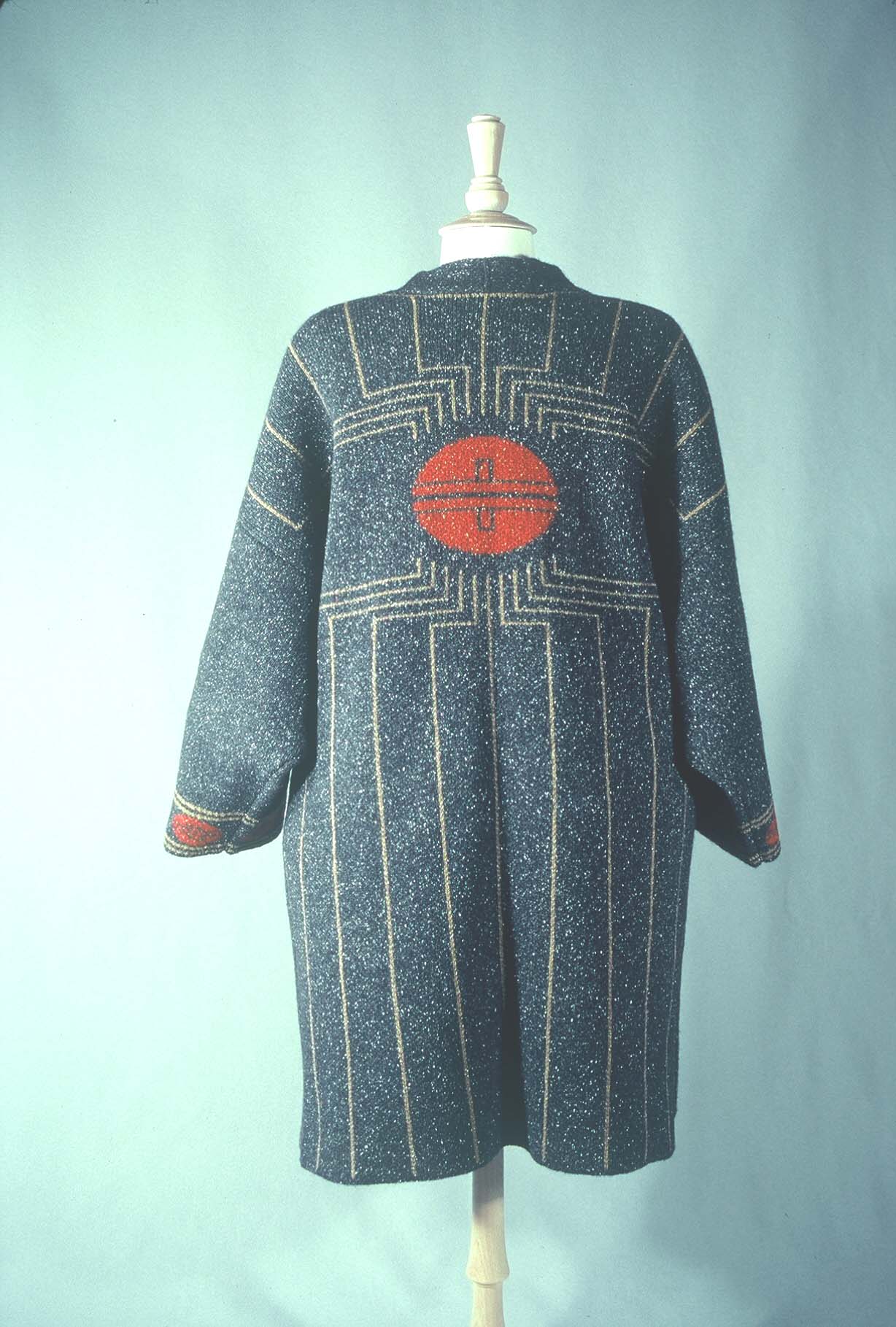
From all the garments Blieszner has made, her own favorite piece is a haori, a knee-length, Japanese-style coat, often worn over a kimono to add formality to an outfit. Blieszner's rendition features a dark graphite background with thin, mustard-colored stripes and a rust-colored sun symbol on the back. She admires it most because she was able to successfully solve the problem of including just two colors in each row of knitting.
Blieszner is dedicated to the fact that she creates only one-of-a-kind garments.
"Even if someone wants something I've already done, they are not reproduced because the person who bought it, bought it as a one-of-a-kind product," she said. "I use exclusively natural fibers. I like the final result and I get quality colors with them."
She mostly sells her garments during special events. Three of her jackets and one vest will be featured in the St. Charles-based Fine Line Creative Arts Center's annual Uncommon Threads wearable art fashion show and sale planned 10:30 a.m. to 3 p.m. Sunday, Oct. 17 at the Stonegate Conference and Banquet Centre in Hoffman Estates, IL.
Lynn Caldwell, executive director of Fine Line, where Blieszner teaches frame knitting, said Blieszner's "design aesthetic" forms the basis for her exquisite garments. Caldwell also said Blieszner's artistic ability and approach to instruction are helpful to Fine Line students.
"Connie is extremely knowledgeable and she can work out any problem a student might have because she is so technically inclined," Caldwell said.
Blieszner is pleased to share her abilities with others.
"I enjoy teaching, especially beginners," she said. "They're an open book. There's just so much you can pour into them. I like the idea of getting people started on the right path, with the right information."
For more information about Fine Line's Uncommon Threads wearable art fashion show and sale and classes taught by Blieszner, visit www.fineline.org.