Politics & Government
Rare Coin Worth Nearly $400,000 Missing From Western Springs Post Office
A registered-mail package containing a 1795 gold eagle coin remains missing after disappearing en route to a Western Springs address.


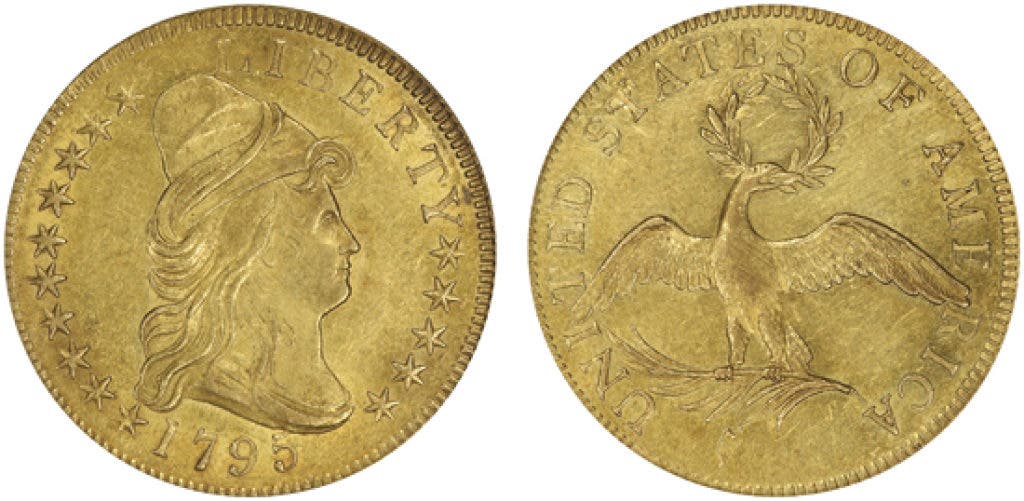

An extraordinarily rare coin more than two centuries old that was sold for $379,500 in a May auction has been missing since passing through the five months ago. Efforts to locate the coin have so far been fruitless.
The 1795 $10 gold eagle was purchased from auction house Spink Smythe for $330,000 (plus a $49,500 buyer’s premium) on May 3 and sent by registered mail on May 16, but never reached its intended destination at a Western Springs address despite having been traced to the Village post office.
The USPS Office of Inspector General (USPSOIG) interviewed Western Springs postal employees, who “denied any knowledge relating to the whereabouts of the coin,” according to a report from Scott Pierce, the deputy special agent in charge of the USPSOIG’s Great Lakes Field Office.
Find out what's happening in Western Springsfor free with the latest updates from Patch.
“Following receipt of the Office of Inspector General report of investigation, Postal Service management disciplined two employees for failing to maintain the sanctity and security of the mail,” Pierce wrote in the report. “The coin has not been recovered.”
According to an article in Coin World, the FBI has also been consulted on the matter.
Find out what's happening in Western Springsfor free with the latest updates from Patch.
Western Springs Postmaster Gary Krause declined to speak on the case, saying that he could not comment about “internal issues.”
The coin in question was by far the most expensive in Spink Smythe’s May 3 catalogue—and even then, its sale price doubled the auction house’s estimated value of $150,000-$170,000.
According to the auction house’s catalogue, only 5,583 Eagle $10 pieces were minted in 1795, the first year of their production—but what sets this particular piece apart is that the branch upon which the eagle is perched on the reverse of the coin has only nine leaves instead of the more-common 13. It is estimated that only about 300-500 of this “nine-leaf” variety of coin were ever struck, and only about 20 remain extant.
Beyond that, this particular coin is said to be one of the best-preserved of its type, one of perhaps 10 free from “some post-strike malidy [sic]—be it cleaning, mounting, or otherwise,” the catalogue declared [from link, select May 3]. The coin is graded “mint state 61,” meaning that while it does show blemishes and flaws, it has never been circulated.
“You would be hard-pressed to find an example that surpassed the present in terms of originality or eye appeal—a truly once in a generation offering,” the catalogue said.
Coins of this particular rarity are a magnet for thieves, said Doug Davis, the founder and president of the Numismatic Crime Information Center, which has advised investigators on this case and others involving missing or stolen currency.
However, Davis said that while there is significant money to be made in rare coins, a coin this distinct and unique would be difficult to unload for profit.
“It’s one of those coins that’s not going to be dealt on the market without someone noticing it,” Davis said. “It’s not going to be sold unless it goes underground to a private collection or perhaps to across the waters to Europe."
“It’s out there somewhere.”
Where, exactly, remains unclear.
Get more local news delivered straight to your inbox. Sign up for free Patch newsletters and alerts.