Community Corner
The Sad Story of Western Springs' Signal Girl
In 1908, the Burlington Railroad began hiring females to staff its signal towers. But, four years later, that would become a big controversy

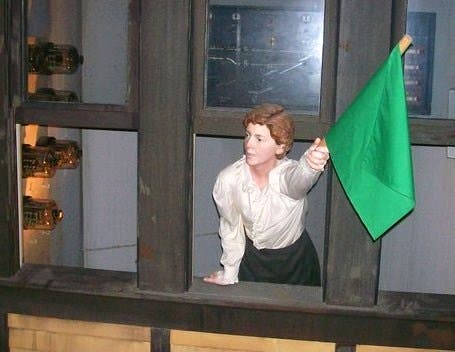
In the early days of railroading, male employees occupied virtually all of the jobs. But, starting in 1908, many railroads began hiring females to work in signal towers. The Burlington railroad was no exception. In fact, in 1910, the Chicago Tribune printed a full page story lauding this development.
But, the railroad’s new hiring policy wasn’t an attempt to treat women more fairly. It was based on simple economics. Why? A year or so earlier, a major train accident occurred after a male signal operator had worked too many hours and dozed off. Because of the resulting accident, the government reduced the number of hours such employees could work. So the railroads cut these employees’ paid hours. And, the lower take-home pay prompted many men to leave the railroads for more lucrative jobs.
About this same time, railroads began replacing their complicated telegraph systems with telephones. This set the stage for hiring less skilled “signal girls” at lower pay.
Find out what's happening in Western Springsfor free with the latest updates from Patch.
By 1910, there were 14 such women working between Chicago and Aurora. Virtually all were found on the nine-hour night shift when most higher-seniority men did not want to work. These women would sit in the towers alone, like the one that has been re-created in downtown Western Springs. Their job was to make sure that the 40 night-time trains were kept a safe distance apart. They did this by “blocking” trains with electrically operated semaphore signals and by communicating via telephone with their counterparts to the east and west.
But, the job was very physical, too. For example, if a train’s schedule had to be changed, the signal girl would get this information by phone, transcribe it onto paper, attach it to a hoop device, climb down the ladder from the tower with a lantern, and hold it up for the engineer to grab as he passed by at 40 miles per hour. And, on some winter nights in Western Springs, the signal girl might also have to walk a quarter of a mile down the tracks to dislodge ice from the semaphore signals. But, despite these challenges, no female signal operator had ever been reprimanded in their first two years.
Find out what's happening in Western Springsfor free with the latest updates from Patch.
Unfortunately, that all changed at 6:36 a.m. on July 14, 1912. On that very foggy morning, 13 persons were killed and 28 injured when an eastbound mail train from Hinsdale crashed into the rear of a passenger train that was stopped in Western Springs. This train had been halted in Western Springs until another train was cleared to leave the Congress Street station, just east of La Grange.
Most of the final blame fell on the passenger train’s flagman who did not do enough to warn the oncoming train. Blame also went to the engineer of the mail train for going too fast on the foggy morning, as well as for not observing the warning signals. But, Mrs. Judith Wilcox, the Western Springs “signal girl”, was also faulted by the newspapers because she has mentioned that she misunderstood a telephone message from her Hinsdale counterpart. Some felt this might have contributed to the accident.
The newspapers also reported that some years earlier, while working as a Burlington ticket agent, Mrs. Wilcox had been sent to a mental hospital for a short evaluation following a complaint from a disgruntled fellow employee. However, she was subsequently cleared and released. And, before being re-employed by the Burlington in 1911, she was given a complete physical exam and found to be perfectly normal. But, once this became known, the damage was done.
Chicago newspaper headlines quickly claimed that “Woman’s Insanity Known to Railroad”. And, on July 23, a coroner’s jury formally recommended that, in the future, no women be employed as signal operators by the railroads. But, while Mrs. Wilcox’s eventual fate is not known, neither the Burlington Railroad nor the Interstate Commerce Commission assigned any direct responsibility to her.
For the past five years, the Western Springs Historical Society has presented a “Blast from the Past” featuring the history of Western Springs. After these five years, this author is “retiring”. But, I hope you will take time to read some of the previous 200+ stories which can be viewed by clicking on the author’s name shown above. I ALSO HOPE YOU WILL ENJOY READING THEM AS MUCH AS I HAVE ENJOYED WRITING THEM. Thank You!