Community Corner
The Night a Boeing 247 Fell On Western Springs
The peaceful calm of December 20, 1934, was shattered at 8:12 p.m.

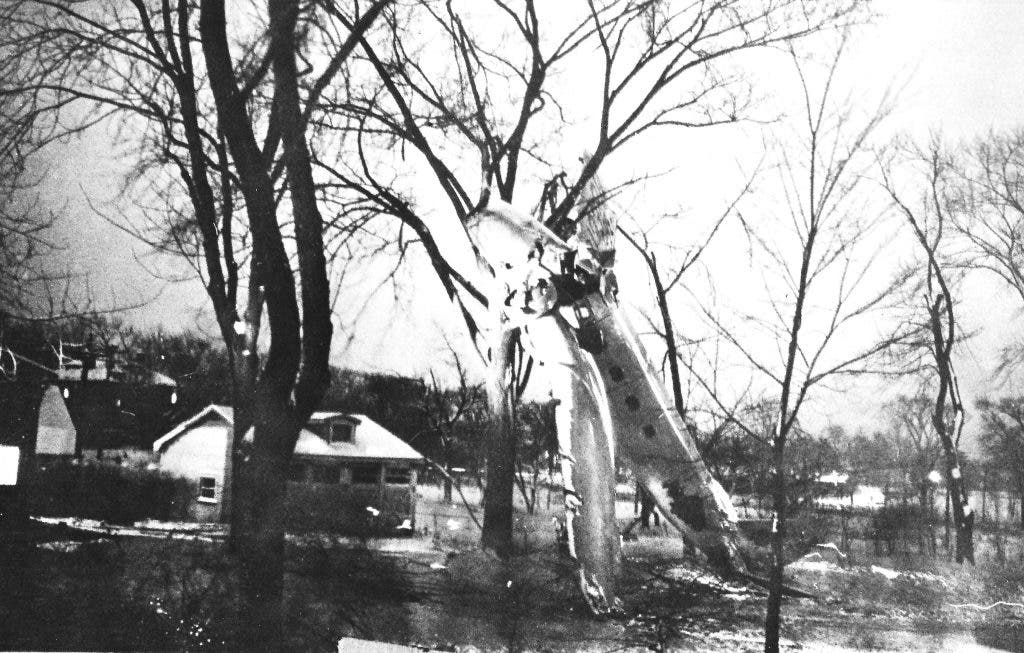


It was a cold Thursday evening when United Airlines Flight 6 left Chicago Midway (then called Municipal) Airport, headed west for Omaha. That evening the plane carried a light load--just the pilot, co-pilot, stewardess, one passenger and 1,600 pounds of cargo.
The all-metal,10-passenger Boeing 247 was the most modern airliner of its day but on this particular evening, Dec. 20, 1934, the aircraft encountered severe ice and snow near Aurora and began to lose power in one of its two engines. The pilot turned the plane around, trying to return to the airport. But the plane lost all power just as it approached Western Springs.
According to the Western Springs Historical Society archives, the plane came in at a very low altitude heading east. It just missed the roof of the B. W. Rhoads house on the southwest corner of Prospect Avenue and Walnut Street, snapping off the top limbs of two trees in the Rhoads’ front yard.
Find out what's happening in Western Springsfor free with the latest updates from Patch.
The plane then lost one of its two engines as it came to rest at a 45-degree angle, tail down, against a large parkway elm on the east side of Prospect. The time was 8:12 p.m.
The Rhoads family, of 4344 Prospect Ave., was not at home, but their neighbors, the A. J. Smith family, heard the crash and called the Western Springs Fire Department. Fortunately, there was just a small fire that was quickly extinguished.
Find out what's happening in Western Springsfor free with the latest updates from Patch.
The only serious injury occurred when the pilot slipped as he exited the icy plane, fell 15 feet to the ground, and broke his leg.
After the injured were taken to the Hinsdale Sanitarium, Western Springs firemen helped disassemble the plane throughout the night so the wreckage could be removed the next day. Meanwhile, the village’s small police force had to deputize citizens in order to control the crowds of curiosity seekers who visited the site all night long and into the following day.
The official accident report attributed the crash to carburetor icing. One might think the story ended there. but the damaged aircraft was subsequently repaired and returned to service. The plane served throughout most of World War II as an Army Air Force transport aircraft. In late 1944, it was returned to commercial passenger service with United Airlines.