Clover Stewart has spent much of the last 14 months zipping up COVID-19 casualties in body bags. At times, she has felt like one of the many living casualties of the pandemic—frontline medical workers who, at the height of the COVID-19 outbreak, have witnessed a lifetime’s worth of gruesome deaths in the course of a typical week.
One night in March 2020, amid the frenzied efforts of the medical staff, the grim sounds of patients gasping for air, and the acrid smell of disinfectant, Stewart’s job got very personal: She recognized one of the deceased as the receptionist she and her pregnant daughter recently spoke with at a doctor’s visit.
“I prayed for sanity,” said Stewart, who works in a critical care unit in Brooklyn, New York, and credits her faith for helping her to cope. That night, immersed in death and full of anxiety that she and her daughter may have contracted the virus, Stewart received a voicemail. A fellow Jehovah's Witness was making a special effort to check on congregants working in healthcare and to share an encouraging Bible verse.
Find out what's happening in South Bendfor free with the latest updates from Patch.
“God was with me,” she said, as she reflected on the reassurance that God sees her tears.
In the year that has followed, spiritual focus has helped Stewart and other frontline medical workers in her religious community battle through the mental and emotional toll of the pandemic.
Find out what's happening in South Bendfor free with the latest updates from Patch.
“What healthcare workers are experiencing is akin to domestic combat,” Andrew J. Smith, Ph.D., director of the University of Utah Health Occupational Trauma Program at the Huntsman Mental Health Institute, said in a press release from his institution.
According to a study conducted by Smith’s group, more than half of the doctors, nurses and emergency responders providing COVID-19 care could be at risk for one or more mental health problems—including acute traumatic stress, depression, and anxiety.
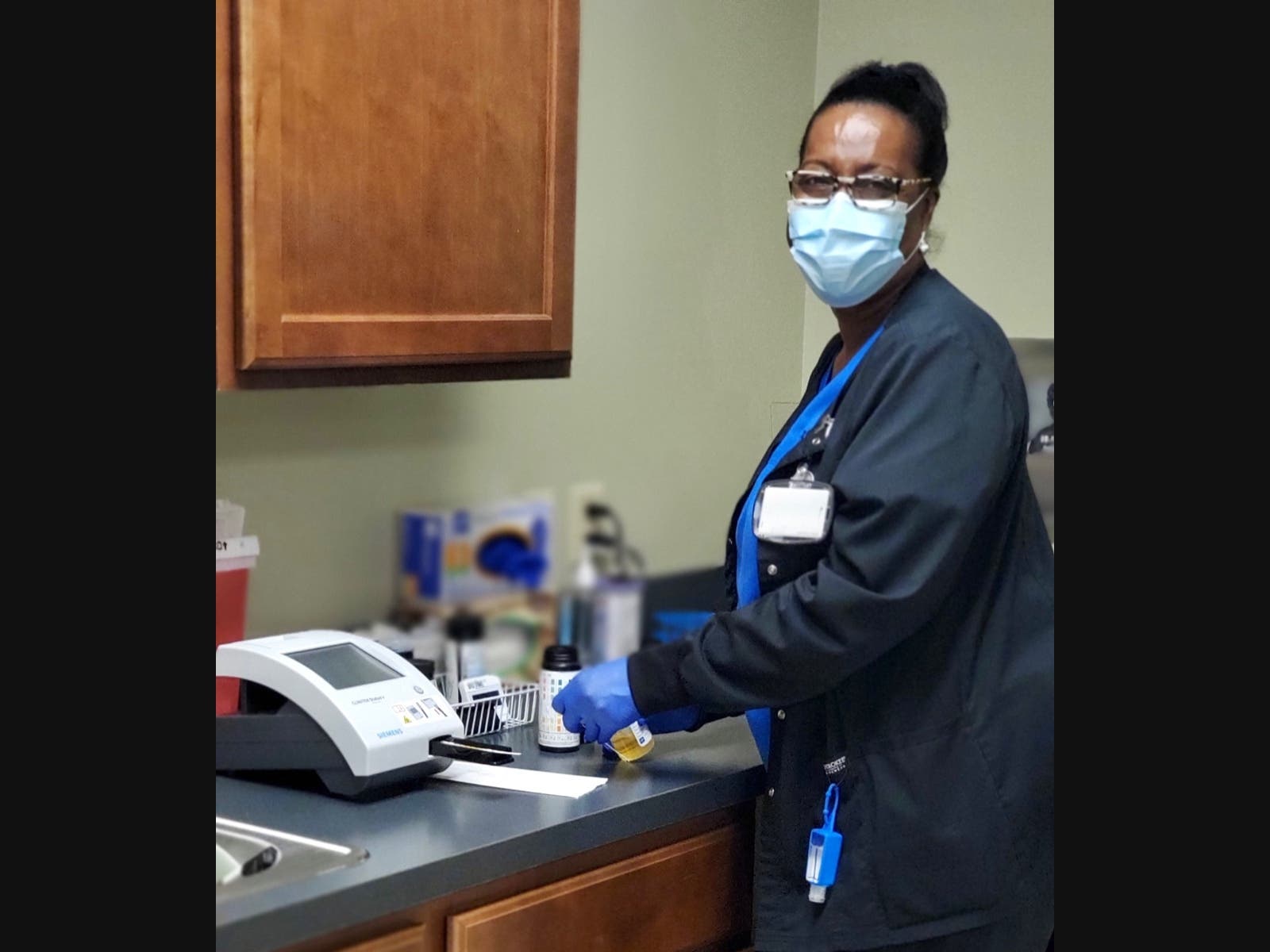
“Stress was pretty high,” says Rochelle Sills, an experienced LPN at a busy medical office in South Bend, Indiana. She will probably never forget the desperate phone calls to the medical office as the pandemic escalated. “I’m having trouble breathing!” As people gasped for air, Sills felt helpless instructing them to call 911.
“We were anxious for them. A lot of people having that kind of difficulty ended up on ventilators. A lot of them came off, but a lot of them didn’t,” says Sills.
Loneliness and isolation are mental health risk factors exacerbated by social restrictions due to COVID-19. Sills lives alone, but she was used to socializing with her big family of nine siblings. The pandemic closed the doors on family movie nights and meals for over a year.
In December, the clouds of the pandemic grew even darker for Sills when her youngest sister suddenly died due to COVID-19 complications.
She recalls this dark moment: “My sister contracted it, and she was getting well. She called me, and we talked. A few days later she was feeling like she couldn’t catch her breath. Her husband took her to the emergency room. She walked back on her own . . . An hour later they called and said she had died.”
How did Sills navigate these storms? She smiles as she speaks of her friends in the local congregation of Jehovah’s Witnesses in South Bend. “At the meetings on Zoom we couldn’t feel and touch each other, but we could talk about what was going on. The brothers checked on me daily. It was beautiful.”
And when her sister died, the South Bend congregants rallied to her aid with handwritten cards and sincere phone calls. Some cooked and dropped off meals on her doorstep. Sills often reads those cards again and again, finding peace and calm in the kind and encouraging words.
American psychological and psychiatric associations, while not advocating or endorsing any specific religion, acknowledge a role for spirituality and religious faith in coping with distress and trauma.
Lawrence Onoda, Ph.D., a clinical psychologist in Mission Hills, California, noted a number of ways spirituality can help, including giving people “a positive hope and meaning toward life, comfort by looking for answers and strength from a higher power, and a collective shared experience of support and community.”
For nurse practitioner Brandy German, such support and community helped her through her own struggle with COVID-19.
“I was able to take my focus off how bad I was feeling,” she said. “I didn’t feel alone anymore.”
German tested positive in late March 2020 after weeks of seeing patients with the hallmark symptoms at her clinic in Angola, Indiana. While she quarantined with a mild case, her husband soon developed severe COVID-19 that would last months.
“I was pretty sure I gave him the virus,” German said. “I didn’t want him to know how scared I was. I felt very isolated.”
During that time, German joined virtual ministry groups almost every morning to write letters with positive Bible messages to community members. She also continued her regular schedule of meeting twice a week with her congregation online.
Filling up the spiritual "tank" has also helped counteract the emotional toll of healthcare work during the pandemic, says Adrian Barnes, a helicopter flight paramedic based out of Sacramento, California.
During his hour-long commute to and from work, he listens to uplifting religious songs and audio recordings of the scriptures on JW Library, a free Android and iOS app from Jehovah’s Witnesses featuring content also available on jw.org. “This keeps me focused and calm,” he said. “I look at it as God talking to me on my way to work and back.”
In his 24-hour shifts, he sees pain, suffering, and hopelessness. “It can be emotionally draining,” Barnes said.
He recalled arriving at one facility to transport a COVID-19 patient, only to see her and all the others lying face down in their ICU hospital beds to reduce pressure on their lungs. In that surreal moment, hearing the intermittent release of pressurized air from more than a dozen ventilators, Barnes realized the merciless brutality of the pandemic.
“It was a big eye opener for me,” he said. “I can only do the best that I can. There comes a point when you have to look to someone greater for help, and that’s God.”
For Sills, that help comes through the pages of the Bible. She explains, “Fear can cripple us. But that’s when you pick up the Bible and you start reading and meditating. That helped me to get through.” Reflecting on the advice and examples in the scriptures gives Sills the strength to cope with the loneliness, fear, and loss caused by the pandemic.
When Stewart is surrounded by death inside the frigid trailer where COVID's victims temporarily rest, she likewise recalls scriptures of comfort, peace, and hope. She never forgets to pray and be thankful for her family of faith.
“God is going to get me through this,” she said.
(For more information on gaining comfort through the scriptures, please see https://www.jw.org/en/bible-teachings/peace-happiness/real-hope-future-bible-promises/)