Community Corner
No Alien Megastructure In Blinking Tabby’s Star, Study Finds
It was a long shot that bizarre blinking detected by Kepler was a megastructure built by aliens to harvest energy from their own stars.


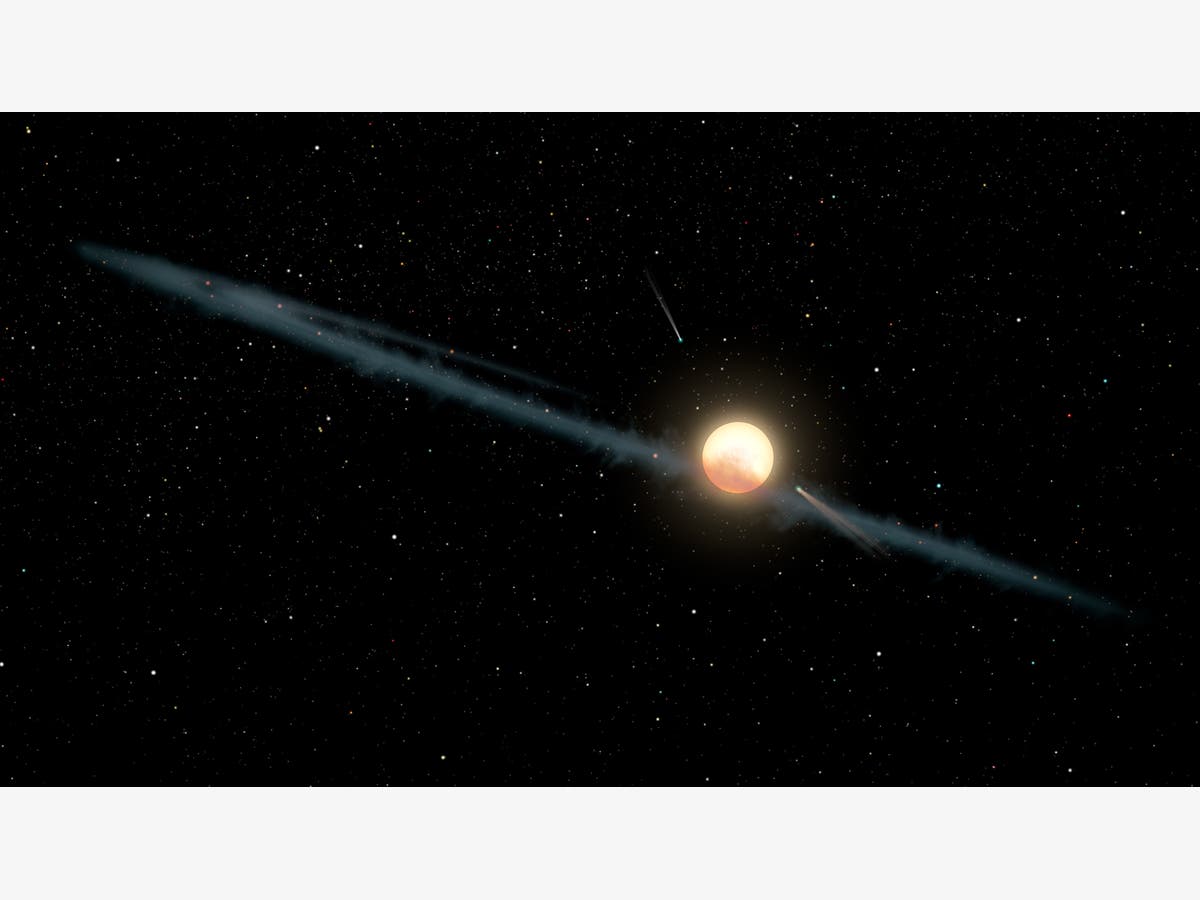
BATON ROUGE, LA — Tabby’s Star, located more than 1,500 light-years away and discovered in data collected by NASA’S planet-hunting Kepler space telescope, is something of a mystery to astronomers. It’s about 50 percent bigger than our sun and burns about 1,000 degrees hotter, but its bizarre blinking prompted all kinds of theories since its discovery more than two years ago.
The star is named for Tabetha Boyajian, an assistant professor at Louisiana State University’s Department of Physics and Astronomy, who has been studying it since citizen scientists with the Planet Hunters project, who sift through data collected by Kepler, reported its bizarre dimming to her team in 2015.
Tabby’s Star, officially classified as KIC 8462852, has dimmed dramatically several times over — by as much as 22 percent from 1890 to 1989 — sometimes for a few days, sometimes for a week. It is classified as an “F star,” and it shouldn’t blink at all, but rather should maintain constant brightness. What was up with that, Boyajian and co-author Jason Wright, an assistant professor in Pennsylvania State University’s Department of Astronomy and Astrophysics, wondered.
Find out what's happening in Baton Rougefor free with the latest updates from Patch.
Their research threw threw dust — literally — on the notion that the erratic blinking might be from some structure built by an advanced alien civilization harvesting energy produced by parent stars. This was always a remote possibility, even if it appealed to groups looking for signs of alien life.
“Dust is most likely the reason why the star's light appears to dim and brighten," Boyajian, the lead author of a new study published online Wednesday in The Astrophysical Journal Letters, said in a statement. “The new data shows that different colors of light are being blocked at different intensities. Therefore, whatever is passing between us and the star is not opaque, as would be expected from a planet or alien megastructure."
Find out what's happening in Baton Rougefor free with the latest updates from Patch.
The findings match those of University of Arizona-Tuscon’s Huan Meng, the lead author of a study published last fall in The Astrophysical Journal. Meng also concluded that dust particles were responsible for the flickering.
"This pretty much rules out the alien megastructure theory, as that could not explain the wavelength-dependent dimming," Meng said in a statement. "We suspect, instead, there is a cloud of dust orbiting the star with a roughly 700-day orbital period."
But there is still much to be learned about Tabby’s Star.
"This latest research rules out alien megastructures, but it raises the probability of other phenomena being behind the dimming," Wright said in the statement. "There are models involving circumstellar material — like exocomets, which were Boyajian's team's original hypothesis — which seem to be consistent with the data we have."
He said some astronomers “favor the idea that nothing is blocking the star — that it just gets dimmer on its own — and this also is consistent with this summer's data.”
Image via NASA/JPL-Caltech
Get more local news delivered straight to your inbox. Sign up for free Patch newsletters and alerts.